













Brain Scans Can Read Memories

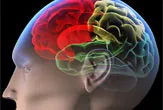
Humans create memories of locations in physical or virtual space as they move around – and it all shows up on brain scans.
Researchers tracked brain activity related to "spatial memory" as volunteers moved about inside a virtual reality setup. Their new study challenges previous scientific thinking by showing that memories are recorded in regular patterns.
"Surprisingly, just by looking at the brain data we could predict exactly where they were in the virtual reality environment," said Eleanor Maguire, a neuroscientist at the University College London in the U.K. "In other words, we could 'read' their spatial memories."
Maguire and her colleagues focused on the hippocampus, or a small part of the brain that deals with navigation, memory recall and imagining future events. Neurons known as "place cells" activate in the hippocampus and inform people of where they are as they move around.
The researchers used an fMRI scanner to detect blood flow changes in the brain, and study the activity of the place cells as a volunteer controlled movement inside the virtual environment. They then ran the results through a computer algorithm developed by Demis Hassabis, another neuroscientist at University College London.
Earlier studies with rats had also focused on the hippocampus and measured activity at the level of dozens of neurons at most. But that research had suggested that the brain did not record memory in any sort of regular pattern – a trend that this latest study may overturn. Maguire and Hassabis examined thousands of neurons as opposed to just dozens, which allowed them to pick out broader patterns.
"By looking at activity over tens of thousands of neurons, we can see that there must be a functional structure – a pattern – to how these memories are encoded," Maguire said. "Otherwise, our experiment simply would not have been possible to do."
Get the world’s most fascinating discoveries delivered straight to your inbox.
Mind-reading research has grown increasingly sophisticated over the years. Another recent study predicted people's preference for one of two drinks with 80 percent accuracy. And earlier findings showed that people's brains reflect abnormal activity up to half a minute before making errors.
The latest findings on memory could lead to many more studies that examine how actual memories end up encoded across our brain cells, Maguire said. She and Hassabis want to look beyond spatial memories to see if brain scans can pick up patterns in our memories of the past, as well as visions of the future. Such work could also have clinical implications for understanding diseases that attack memory.
"Understanding how we as humans record our memories is critical to helping us learn how information is processed in the hippocampus and how our memories are eroded by diseases such as Alzheimer's," added Demis Hassabis.
- Top 10 Mysteries of the Mind
- Hollywood Gets Inside the Minds of Moviegoers
- Computer to Read Minds
