













Maxwell's Demon Converts Information into Energy

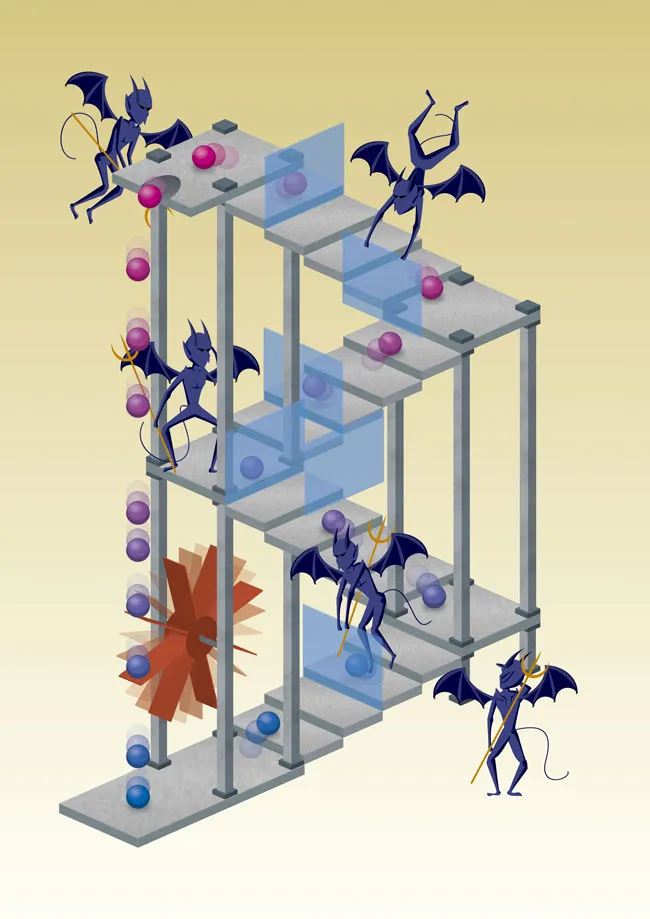
For the first time, scientists have converted information into pure energy, experimentally verifying a thought experiment first proposed 150 years ago.
The idea was originally formulated by physicist James Clerk Maxwell, but it gained controversy because it appeared to violate the second law of thermodynamics. Put in experimental terms, this law states that when hot and cold water are mixed, they will eventually reach an equilibrium middling temperature.
Maxwell proposed that a hypothetical being (later dubbed Maxwell's demon) could separate the water into two compartments and reverse the process, isolating hot molecules from cold by letting only the hotter-than-average through a trap-door between the compartments.
Because mixed water is considered more disordered (i.e. of higher entropy) than separated water, the demon has converted a system from a state of disorder to a state of order, using only information (the knowledge of which molecules were hot and cold).
That seemed to violate the law, which also states that entropy should not decrease in an isolated system. In other words, the demon should not have been able to separate the hot and cold water without expending energy.
Later Hungarian physicist Leó Szilárd proposed that the process does not violate the laws of physics, because the demon would in fact have had to expend some energy to ascertain which molecules are hot and cold.
Putting it into action
Get the world’s most fascinating discoveries delivered straight to your inbox.
While scientists have continued to debate the theory, never before has anyone put the experiment into action.Recently, physicist Shoichi Toyabe of Chuo University in Japan and colleagues did just that.
"Nowadays we have the technology, even single molecules can be observed and we can control very small elements very quickly, so in principle it's not difficult to make a kind of Maxwell's demon," said study coauthor Masaki Sano of the University of Tokyo.
The researchers set up a very miniature version of a spiral staircase and caused a molecule to climb up this staircase using information.
In the setup, the staircase was actually made of potential energy and created using electric fields. The molecule had some thermal energy – heat – so it would fluctuate, moving in random directions.
The scientists used a high-speed camera to photograph the molecule. When it happened to be moving up the staircase, they let it move freely, but when it happened to be moving down the staircase, the researchers blocked its motion by inserting a virtual wall using an electric field.
"It's like the particle is making random steps up or down, but only when the particle goes up the stairs, we put some wall on the stairs to avoid the particle falling down," Sano told LiveScience. "This is kind of a Maxwell's demon."
As the particle moved up the staircase, it gained energy because it moved to a location of higher potential – akin to climbing a mountain. Yet the researchers never had to push the particle up the mountain (i.e. do work or input energy) – they simply used the information about which direction it happened to be moving in at any given time to guide the climb.
Energy boost
Not only were the researchers able to move the particle up the stairs, but they were able to precisely measure how much energy was converted from information.
The researchers describe their results in the Nov. 14 online edition of the journal Nature Physics.
In an accompanying essay in the same issue of the journal, physicist Christian Van den Broeck of the University of Hasselt in Belgium, who was not involved in the new study, called it "a direct verification of information-to-energy conversion."
While the experiment itself does show that it's possible to create energy out of information, in practice, the technique doesn't offer potential for solving the energy crisis any time soon.
"The true energetic cost of this information-to-energy conversion experiment lies somewhat hidden in its huge peripheral apparatus (including the doctoral student who is operating the experiment)," Van den Broeck wrote. "As such, the experiment is reminiscent of producing a tiny shot of energy from nuclear fusion in a reactor that is consuming considerably more energy."
- Twisted Physics: 7 Recent Mind-Blowing Findings
- Album - Behind the Scenes at the Largest U.S. Atom Smasher
- Top 10 Unexplained Phenomena
