















Tree Deaths Double in Western U.S. Forests

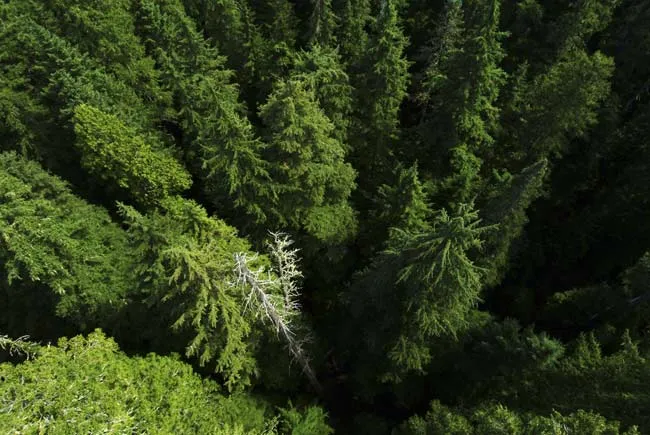
Trees in western U.S. forests are dying at twice the rate they were a few decades ago, a new study finds. Researchers think the most likely culprit is the regional impacts of global warming.
If this trend in tree deaths continues, it could change the very nature and structure of the forests, with impacts on ecosystems and western communities. It could also further exacerbate global warming, by reducing the amount of carbon stored in the forests.
"When the trees across the West appear to be dying at twice the rate they used to, that's not a good sign," said study team member Mark Harmon of Oregon State University.
The study's findings are detailed in the Jan. 23 issue of the journal Science.
Deaths doubling
The researchers used data from 76 forest plots gathered by generations of scientists over more than 50 years. All the forest stands were 200 or more years old, some having been established more than 500 years ago. Looking at old-growth forests was key because they are less disturbed and have a wide variety of trees of different ages.
Tree sites were located in Oregon, Washington, California, Arizona, Colorado, New Mexico and southwestern British Columbia.
Get the world’s most fascinating discoveries delivered straight to your inbox.
The data showed that there had been a doubling of tree mortality in just 17 years in the Pacific Northwest and 25 years in California. Interior states had a slightly slower rate change, taking 29 years to double.
"This suggests that one, or several, northwestern tree species are sensitive to whatever is going on," said study team member Jerry Franklin of the University of Washington, in Seattle.
The death rates increased across a wide variety of forest and tree types, at all elevations, and in trees of all sizes and ages.
The researchers ruled out a number of possible causes of the increasing death rates, including air pollution, long-term effects of fire suppression, over-crowding of forests, forest fragmentation and insect attack. These forces tend to play a more limited and temporary role in tree deaths.
But the authors did find a strong correlation between tree deaths and rising regional temperatures.
"Average temperature in the West rose by more than 1 degree Fahrenheit [0.6 degree Celsius] over the last few decades," said study team member Phil van Mantgem of the United States Geological Survey. "While this may not sound like much, it has been enough to reduce winter snowpack, cause earlier snowmelt, and lengthen the summer drought."
Those longer summer droughts could be stressing the trees, leading to higher death rates. The warmer temperatures could also be giving a boost to insects and diseases that attack trees. For example, bark beetle infestations have been on the rise in the West, and have been linked to warming temperatures.
The study was funded by the National Science Foundation, the U.S. Forest Service's Pacific Northwest Research Station, National Park Service, the University of Washington and Oregon State University.
Carbon feedback
Whatever is causing the tree deaths, the increased mortality rate could lead to substantial changes in western forests.
Essentially, forests have begun to lose trees faster than new ones can become established, the scientists said. Overall, this could mean that trees in these forests will become younger and smaller on average, making them more susceptible to sudden diebacks.
A changing forest structure could have cascading effects, such as changing the suitability of the environment for wildlife species that live there. "That may be our biggest concern," said study team member Nate Stephenson, also of the USGS. "Is the trend we're seeing a prelude to bigger, more abrupt changes to our forests?"
The higher death rates could also mean that western forests become net sources, instead of sinks, of carbon dioxide .
Trees, like other plants, take up carbon dioxide from the atmosphere to fuel their photosynthesis. The converted carbon gets stored in the trees. As the trees die, the forests as a whole will absorb less carbon dioxide and then inject more greenhouse gases back into the atmosphere. This could lead to a "feedback loop" where more carbon dioxide increases warming, which kills more trees, which further increases carbon dioxide levels.
- Video: Goldilocks and the Greenhouse
- Top 10 Surprising Results of Global Warming
- Tree News, Information and Images

Andrea Thompson is an associate editor at Scientific American, where she covers sustainability, energy and the environment. Prior to that, she was a senior writer covering climate science at Climate Central and a reporter and editor at Live Science, where she primarily covered Earth science and the environment. She holds a graduate degree in science health and environmental reporting from New York University, as well as a bachelor of science and and masters of science in atmospheric chemistry from the Georgia Institute of Technology.