













Solar Flares Could Disrupt Critical GPS Devices
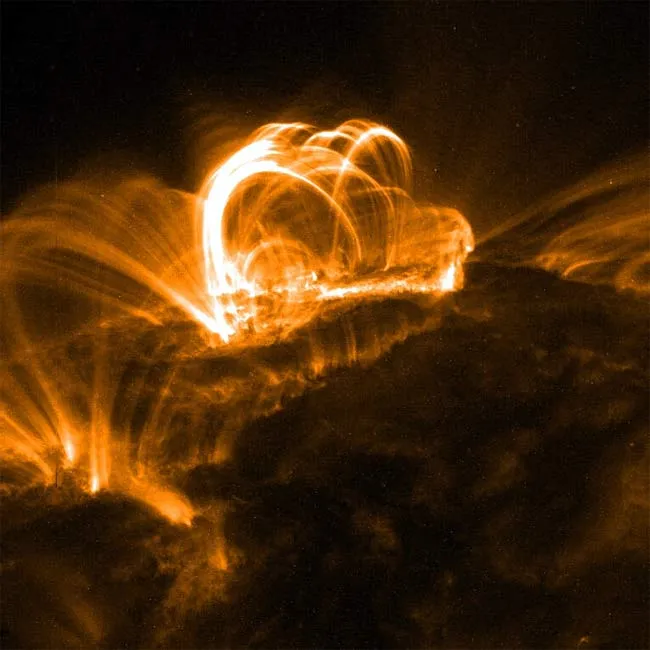
Fiery discharges from the sun could disrupt Global Positioning System (GPS) receivers, according to new research.
Since solar flares are somewhat unpredictable, the scientist said such disruptions could cause problems for "safety-of-line" operations, including navigating passenger jets, stabilizing oil rigs and locating mobile phone distress calls.
"If you're driving to the beach using your car's navigation system, you'll be OK. If you're on a commercial airplane in zero visibility weather, maybe not," said Paul Kintner Jr., professor of electrical and computer engineering at Cornell University and head of Cornell's GPS Laboratory.
Alessandro Cerruti, Kintner's graduate student, first noticed the effect on Sept. 7, 2005 while investigating an unrelated topic. He was in the process of operating a GPS receiver at Arecibo Observatory in Puerto Rico when a solar flare occurred, causing the receiver's signal to drop significantly.
He examined data from other receivers operated by the Federal Aviation Administration (FAA) and the Brazilian Air Force and found all of these receivers had suffered the same disruption at the exact time of a solar flare.
The researchers suggested the reason the flares cause signal loss is due to the accompanying solar radio bursts. These bursts occur over the same frequency bands at which the GPS satellites transmit, so they can cause receivers to become confused and lose their signal.
The flare observed by Cerruti last year was moderate and short-lived. In 2011 and 2012, during the next solar maximum, solar storms are predicted to be more intense and longer-lasting than in previous peaks, scientists say.
Get the world’s most fascinating discoveries delivered straight to your inbox.
Knowing that solar flares zap the signal from GPS operations could help mitigate any future problems.
Kintner suggested equipping GPS receivers with weak signal-tracking devices or increasing the signal power from GPS satellites. But even these solutions have drawbacks. The former requires a new receiver design, and its associated compromises, and the latter requires a new satellite design that neither exists nor is planned.
"I think the best remedy is to be aware of the problem and operate GPS systems with the knowledge that they may fail during a solar flare," Kintner said.
The results of the study will be published in a forthcoming issue of the journal Space Weather.
Jeanna Bryner is managing editor of Scientific American. Previously she was editor in chief of Live Science and, prior to that, an editor at Scholastic's Science World magazine. Bryner has an English degree from Salisbury University, a master's degree in biogeochemistry and environmental sciences from the University of Maryland and a graduate science journalism degree from New York University. She has worked as a biologist in Florida, where she monitored wetlands and did field surveys for endangered species, including the gorgeous Florida Scrub Jay. She also received an ocean sciences journalism fellowship from the Woods Hole Oceanographic Institution. She is a firm believer that science is for everyone and that just about everything can be viewed through the lens of science.