A dramatic thinning of Earth's protective ozone layer above the Arctic last year was the result of intense upper-level winds and an extra dose of space weather, scientists said Tuesday.
Ozone, which screens out some of the Sun's harmful ultraviolet radiation, declined by up to 60 percent in the stratosphere over high northern latitudes in the spring of 2004. Officials issued a health warning earlier this year for residents of the far North.
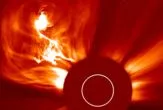
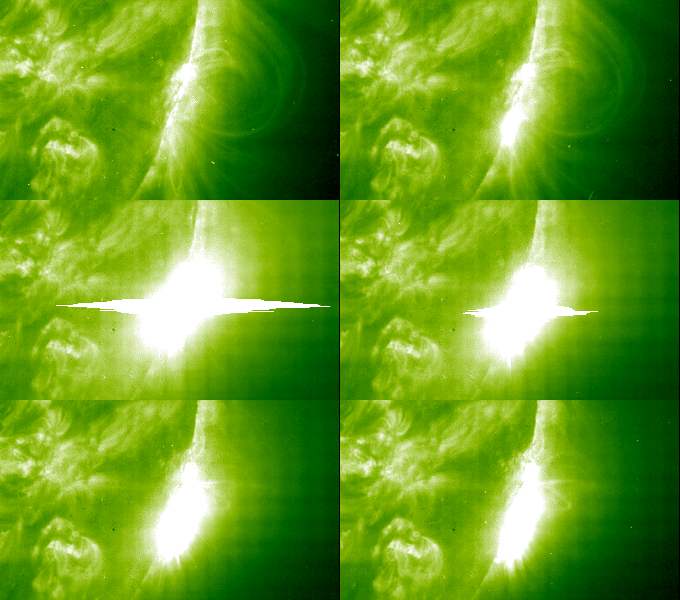
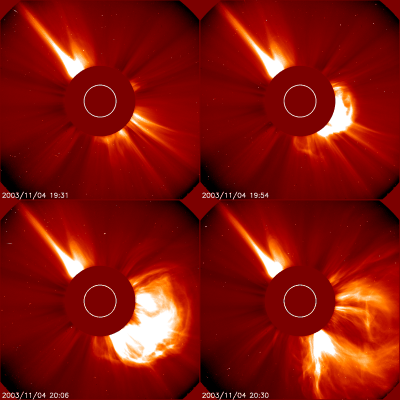
In a new study, scientists conclude that an intense round of solar storms around Halloween in 2003 was at the root of the problem. Charged particles from the storms triggered chemical reactions that increased the formation of extra nitrogen in the upper stratosphere, some 20 miles up. Nitrogen levels climbed to their highest in at least two decades.
Upper-atmosphere winds associated with the system, called the polar stratospheric vortex, sped up in February and March of 2004 to the fastest speeds ever recorded, the new study found. The spinning vortex allowed nitrogen gas to sink from the high stratosphere, some 20 miles up, to lower altitudes.
The nitrogen gas is known to destroy ozone.
Sign up for the Live Science daily newsletter now
Get the world’s most fascinating discoveries delivered straight to your inbox.
"This decline was completely unexpected," said Cora Randall, a physicist at the University of Colorado, Boulder who led the study. "The findings point out a critical need to better understand the processes occurring in the ozone layer."
Researchers from Canada and Europe contributed to the study, which drew data from seven satellites. The results are detailed in the March 2 online issue of Geophysical Research Letters, published by the American Geophysical Union.
Ozone is a form of oxygen. Its protective qualities make life as we know it possible. (Near the ground, ozone plays the opposite role, being the main component in smog.)
The upper-level ozone layer has thinned dramatically in the Southern Hemisphere in recent decades, creating a dangerous hole through which UV rays stream. The decline is due largely to man-made chlorofluorocarbons released into the atmosphere.
The new study suggests a better understanding is needed of how the Sun itself alters the ozone layer.
"No one predicted the dramatic loss of ozone in the upper stratosphere of the Northern Hemisphere in the spring of 2004," Randall said. "That we can still be surprised illustrates the difficulties in separating atmospheric effects due to natural and human-induced causes."
The thinning of the Arctic ozone layer continues, owing in part to cold temperatures in the stratosphere, according to a separate recent study that suggests a northern hole could develop as a twin to the southern one.
Exposure to excessive UV radiation can cause skin cancer. Animals and plants can be adversely affected, too.
Robert is an independent health and science journalist and writer based in Phoenix, Arizona. He is a former editor-in-chief of Live Science with over 20 years of experience as a reporter and editor. He has worked on websites such as Space.com and Tom's Guide, and is a contributor on Medium, covering how we age and how to optimize the mind and body through time. He has a journalism degree from Humboldt State University in California.