Elephants Know Good People from Bad

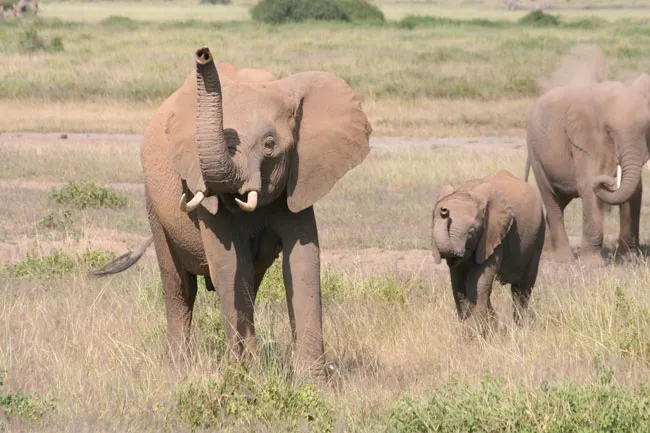
Elephants can apparently smell and see which humans might be out to get them, research now suggests.
As elephants roam Amboseli National Park in Kenya within sight of famed Mt. Kilimanjaro, they may run afoul of members of the Maasai or Kamba tribes. While the Kamba nowadays threaten only elephants that invade their farmland, Maasai warriors occasionally show off their virility by spearing elephants.
Since elephants face different levels of peril from people depending on their tribe, scientists reasoned elephants might use their senses to distinguish who might be dangerous. For instance, the pachyderms might rely on their eyesight—Maasai traditionally wear red shawls.
The scientists also deduced that elephants might employ their keen sense of smell to distinguish Maasai from Kamba. Their body odors likely differ because Maasai eat substantial amounts of milk and occasionally cattle blood and beef while the Kamba diet consists of vegetables and maize, along with some meat. Also, unlike the Kamba, the Maasai use ochre and sheep fat in body decorations.
The researchers had heard of several instances of elephants reacting "to even faint signals of Maasai, with elephants running away from Maasai men that were several kilometers away," said cognitive psychologist Lucy Bates at the University of St. Andrews in Scotland. The pachyderms even stayed away from a vehicle "for several days after Maasai men had been carried in it."
Cognitive psychologist Richard Byrne at the University of St. Andrews, along with Bates and colleagues, tried displaying clean, unworn red and white cloths on bushes in Amboseli. They found elephants behaved significantly more aggressively toward the red cloths.
"We think that this is the first time that it has been experimentally shown that any animal can categorize a single species of potential predator into subclasses based on such subtle cues," Bates said.
Get the world’s most fascinating discoveries delivered straight to your inbox.
The researchers also presented elephants with red clothing that had been worn for five days by either a Maasai or a Kamba man. The pachyderms reacted with greater fear toward the Maasai-scented clothing—they moved faster away and farther away, fleeing toward tall grass for cover, and took significantly longer to relax after they stopped running.
The differences the researchers saw between elephant responses to sights and smells might relate to the amount of risk the pachyderms sense. "With any scent present, fear and escape reactions seem to dominate anything else," Bates said.
Future research can focus on "what cues in the garments the elephants are attending to—what specific smells signal Maasai and Kamba? What aspect of the red cloths do the elephants respond to—the brightness, the hue?" Bates said.
Moreover, "we don't know how many ethnic groups the elephants can discriminate, or how elephants respond to females of these groups—both of which would be interesting questions to answer," she added.
The scientists, collaborating with the Amboseli Elephant Research Project, detailed their findings online Oct. 18 in the journal Current Biology.
- 10 Amazing Things You Didn't Know About Animals
- Amazing Animal Abilities
- Image Gallery: The World's Biggest Beasts