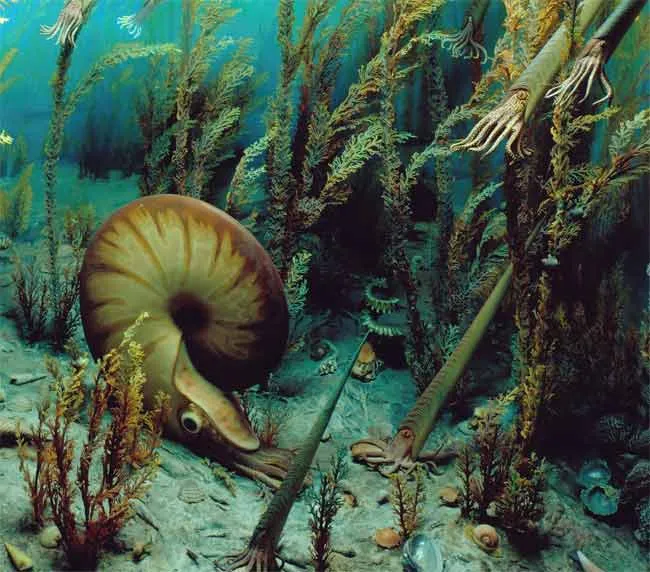
The largest extinction in Earth's history not only wiped out 95 percent of sea creatures and 70 percent of land animals, it also gave the oceans a fundamental "face lift," according to a new study.
Before the end-Permian mass extinction 250 million years ago, the seas were home to a balance of both ecologically simple communities and complex ones. Following the extinction, complex communities displaced simple ones, coming to outnumber them three-to-one, a pattern that prevails today [image].
It reflects the current dominance of complex, mobile organisms, such as snails and crabs, and the decreased diversity of simple, stationary organisms such as sea lilies, which filter nutrients from the water.
Latest Videos From
Give and take
In communities with a simple structure, organisms just pull resources from a common pool in a similar way without interacting with one another or their environment. "It's a simple system when everyone comes in and they grab their portion of the pie, and the pie doesn't change," said lead researcher Peter Wagner of The Field Museum in Chicago.
"The other is a more complicated system where organisms come in and they take a piece of the pie, but then they put something back into the pie for other organisms to take," Wagner told LiveScience.
Until now, scientists had assumed that while complexity in general had slowly ramped up over time, the structure of communities had remained somewhat constant.
This drastic change in marine structure has eluded scientists for decades. Previous research relied on single numbers, such as the number of species alive during a certain time, to track the diversity of marine life.
For example, let's say there are two communities, each containing five species and a total of 300 individuals. In one community all species are equally common, each containing 60 individuals, while in the second community one species greatly outnumbers the other four. Counting the number of species would miss this subtle difference. The scientists relied on the Paleobiology Database, which catalogues studied fossil records from nearly 1,200 locations representing the past 540 million years.
Ocean lots
In complex communities, the organisms interact in many ways and depend on one another for food or living quarters, just like a tree provides many homes for animals like birds and ants. The shift toward complexity is what could have allowed a greater number of different species to exist within a limited amount of space with limited resources.
"You are cramming more species into a given patch of real estate for a given number of bodies," said David Jablonski of the University of Chicago, who was not involved in the study.
The scientists found the results held even after taking into account factors that could have biased the data, including how fossils are preserved or collected. Still, the study isn't foolproof, since the fossil records came from various locations with different collection methods, according to Doug Erwin of the Smithsonian Institution, who was not involved in the work.
The research does open the door for follow-up studies. "There's always more work to be done. But this is a very interesting, and to me very intriguing, first-cut look at this whole sweep of geologic time that suggests there's this changeover," Jablonski said.

 Live Science Plus