













Huge New Virus Defies Classification

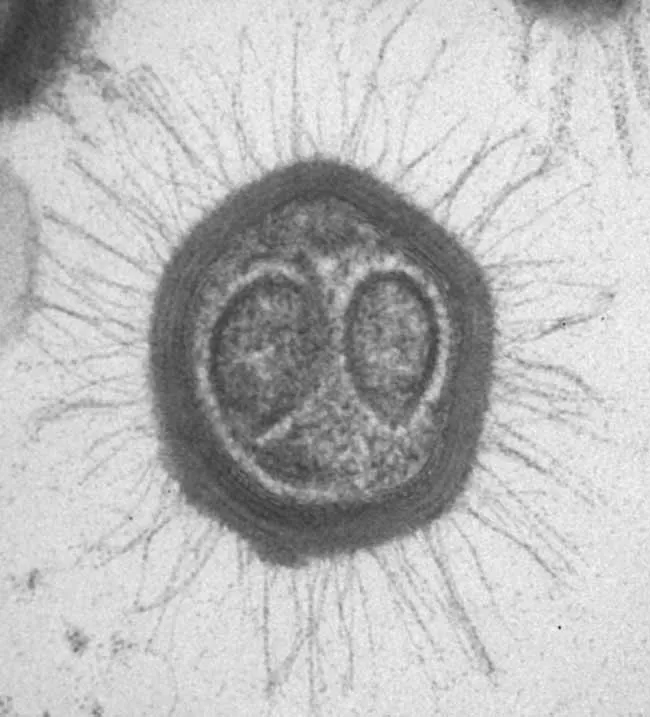
French biologists have just mapped out the genetic sequence of the largest known virus, and the complexity of the thing has them questioning what it is.
The genetic code of the mimivirus, as it is called, is three times longer than that of other viruses and contains elements that blur the lines between life and non-life.
Whether viruses are alive has been a matter of debate for more than half a century. They are often thought of as merely complex "biomolecules" - lifeless capsules of genetic information that must invade a living cell and hijack its machinery to reproduce.
The typical virus is 200 nanometers, or 8 millionths of an inch wide and writes its genetic code in either of two molecules: DNA or RNA, but not both.
Mimivirus, however, is more than 400 nanometers wide and has both DNA and RNA. It is so large and complex that researchers had trouble recognizing it as a virus.
"We considered it a bacteria for a year and a half," said Didier Raoult of the Universite de la Mediterranee in Marseilles, France.
Mimivirus was found during a search in 1992 for the source of an outbreak of pneumonia in Bradford, England. Although the virus was spotted inside an amoeba, it was not immediately identified and, therefore, sat in limbo for several years.
Get the world’s most fascinating discoveries delivered straight to your inbox.
Raoult and his colleagues later obtained the mysterious "bug" and identified it as a virus a year ago. They named it mimivirus for the fact that it "mimics" bacteria. Mimivirus is, however, like other viruses in that it is not able to convert energy or replicate on its own.
The same group that identified the virus has now unraveled its genome. The work was described recently in the online version of the journal Science. Mimivirus was found to have 1.2 million base pairs - the ones and zeros of the genetic code. In this long data sequence, there are more than 1,200 genes, or "mini-programs" that give instructions for making proteins. Many bacteria do not have that many genes.
The biologists also discovered that mimivirus has seven genes common to all three of the generally-accepted domains of life: bacteria, archaea (like bacteria but slightly more complicated), and eukaryotes (everything else, from fungi to plants to animals).
There are 63 of these universal life genes. Prior to this, only one of these genes had been found in a virus.
Some of these common genes are involved in translation, which is the actual nuts and bolts of making a protein from the genetic blueprints.
"Viruses are parasites, so they can rely on the protein engineering of the host cell," Raoult said. He therefore found it "bizarre" that mimivirus would bother carrying around translation genes. The researchers are not yet sure, though, if the virus actually uses them.
Mimivirus' unique nature may hold some key to the evolution of singe-celled organisms three billion years ago. Although it will likely take time to generate any consensus for it, the researchers advocate a fourth branch of life for mimivirus, and any other giant viruses that may turn up.
"It really is an organism," Raoult said. "You cannot believe it is just a biomolecule."
