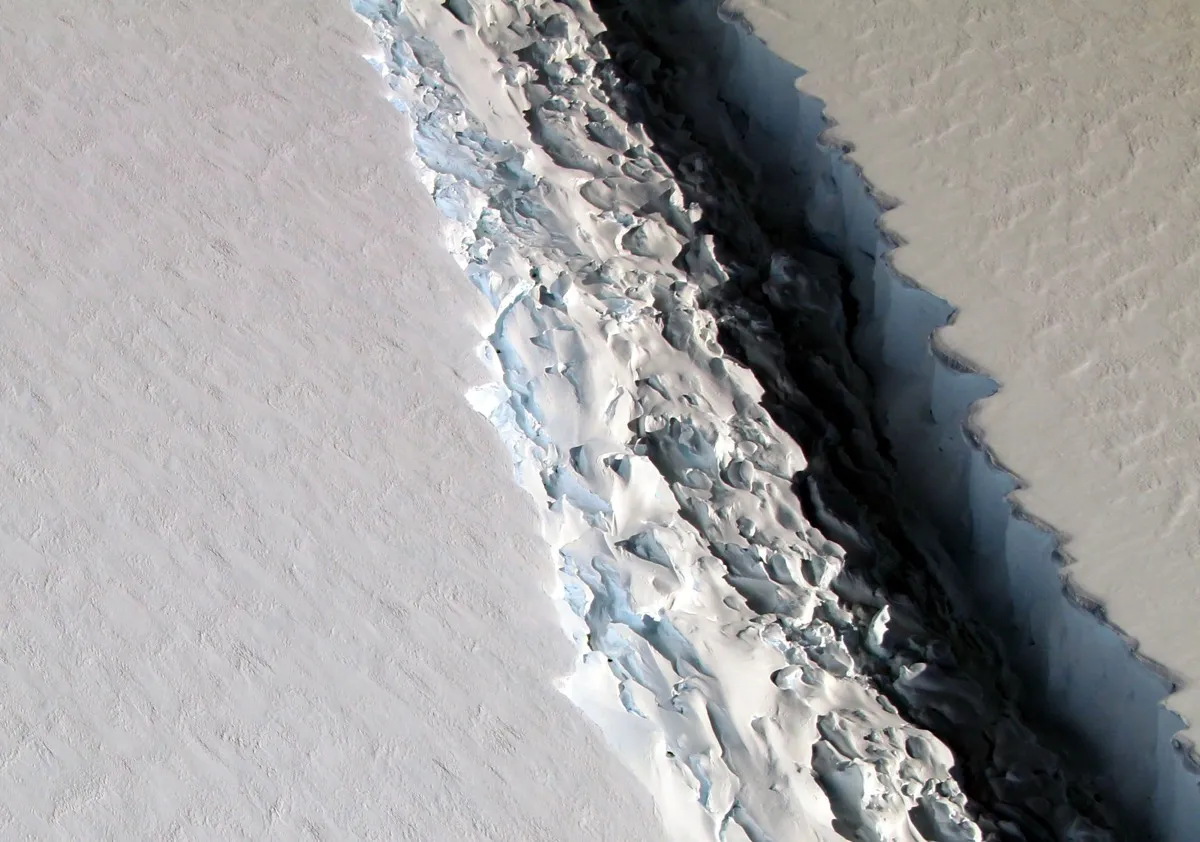
70-Mile-Long Crack Opens Up in Antarctica
Get the world’s most fascinating discoveries delivered straight to your inbox.
You are now subscribed
Your newsletter sign-up was successful
Want to add more newsletters?
Delivered Daily
Daily Newsletter
Sign up for the latest discoveries, groundbreaking research and fascinating breakthroughs that impact you and the wider world direct to your inbox.
Once a week
Life's Little Mysteries
Feed your curiosity with an exclusive mystery every week, solved with science and delivered direct to your inbox before it's seen anywhere else.
Once a week
How It Works
Sign up to our free science & technology newsletter for your weekly fix of fascinating articles, quick quizzes, amazing images, and more
Delivered daily
Space.com Newsletter
Breaking space news, the latest updates on rocket launches, skywatching events and more!
Once a month
Watch This Space
Sign up to our monthly entertainment newsletter to keep up with all our coverage of the latest sci-fi and space movies, tv shows, games and books.
Once a week
Night Sky This Week
Discover this week's must-see night sky events, moon phases, and stunning astrophotos. Sign up for our skywatching newsletter and explore the universe with us!
Join the club
Get full access to premium articles, exclusive features and a growing list of member rewards.
An ominous crack in an Antarctic ice shelf as wide as a football field is long takes on an otherworldly beauty in a new aerial image.
Snapped by scientists on NASA's IceBridge mission, the shot shows a rift in Larsen C, an ice shelf that is floating off the Antarctic Peninsula. When the crack eventually spreads across the entire ice shelf, it will create an iceberg the size of the state of Delaware, according to IceBridge. That's around 2,491 square miles (6,451 square kilometers).
As of Nov. 10, when the IceBridge scientists observed this crack, it was 70 miles (112 km) long and more than 300 feet (91 meters) wide. The dark depths of the crack plunge down about a third of a mile (0.5 km), all the way through the ice to the ocean below. [See More Gorgeous Antarctic Images from IceBridge]
According to NASA Ice, an Earth sciences program at NASA, this rift is relatively new — it showed growth on satellite imagery just this year. The U.K.-based Antarctic research group the MIDAS Project first observed the rift in 2014 and has been tracking it ever since.
Larsen C is Antarctica's fourth-largest ice shelf, and it holds back the land-based glaciers just behind it: Once the ice shelf goes, those slow-flowing glaciers have one less barrier in their journey toward the sea. In 2002, the nearby ice shelf Larsen B partially collapsed after showing similar rifting, NASA's Earth Observatory reported earlier this year, when it showed the collapse alongside a satellite image of the growing Larsen C crevasse.
According to the MIDAS Project, the eventual calving of the Delaware-size sheet of ice would remove between 9 percent and 12 percent of Larsen C's surface area and may lead to the crumbling of the entire ice shelf.
Original article on Live Science.
Get the world’s most fascinating discoveries delivered straight to your inbox.

Stephanie Pappas is a contributing writer for Live Science, covering topics ranging from geoscience to archaeology to the human brain and behavior. She was previously a senior writer for Live Science but is now a freelancer based in Denver, Colorado, and regularly contributes to Scientific American and The Monitor, the monthly magazine of the American Psychological Association. Stephanie received a bachelor's degree in psychology from the University of South Carolina and a graduate certificate in science communication from the University of California, Santa Cruz.