













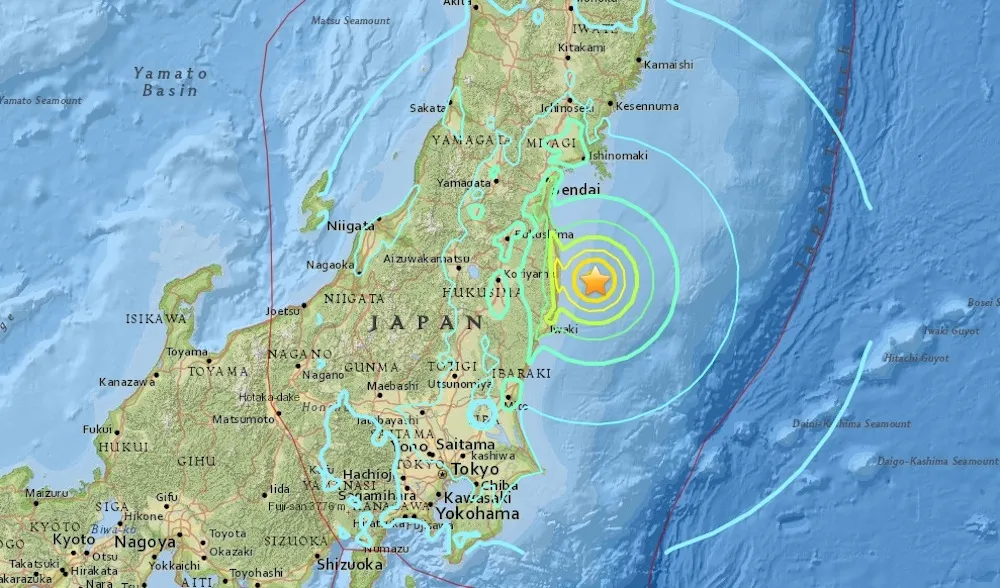
A magnitude-6.9 earthquake struck off the coast of Fukushima, Japan, today (Nov. 21), triggering a tsunami warning.
The earthquake, which was originally reported as a magnitude-7.3, struck around 6 a.m. local time on Nov. 22, about 23 miles (37 kilometers) southeast of Namie, Japan, the U.S. Geological Survey reported. A tsunami warning issued by the Japan Meteorological Agency has predicted wave heights of up to 10 feet (3 meters).
According to the Japan Meteorological Agency, a tsunami warning typically means damage due to tsunami waves is expected and residents should immediately evacuate coastal regions and riverside areas. These warnings also mean that tsunami waves are expected to hit repeatedly, and people should not leave safe ground until the warning is lifted. [Image Gallery: This Millennium's Destructive Earthquakes]
The area is no stranger to catastrophic quakes; on March 11, 2011, a magnitude-9.0 earthquake struck Japan. The so-called Tohoku quake, which released hundreds of years of pent-up stress at the subduction region where the Pacific Plate is diving beneath the Eurasian Plate, set off a massive tsunami with run-up heights of 128 feet (39 m) and inundation reaching 6 miles (9.7 km) inland.
The multistory waves inundated the coastal Fukushima Daiichi Nuclear Power Plant and triggered a level 7 nuclear meltdown. Four years after the quake, 230,000 people who lost their homes were still in temporary housing, according to Japan's Reconstruction Agency. Since the disaster, radioactive waste, such as cesium-134 and cesium-137, has floated across the Pacific Ocean and washed ashore on the West Coast of the U.S.
The epicenter of today's earthquake was about 80 miles (130 km) southwest of the 2011 Tohoku quake's epicenter, but that number can give a misleading impression of how far apart the two quakes occurred, said Don Blakeman, a geophysicist with the USGS in Golden, Colorado. With quakes as large as the 2011 earthquake, "the fault rips for many man tens of kilometers," Blakeman told Live Science.
While the Japan Meteorological Agency issued a tsunami warning for the region around Fukushima and an advisory for the entire coastline of the country, the current quake is unlikely to trigger a Pacific-wide tsunami, Blakeman said.
Get the world’s most fascinating discoveries delivered straight to your inbox.
"This is a strike-slip earthquake," meaning that two sides of the fault move sideways relative to each other. "So, you don't get the vertical movement you need," Blakeman said.
Original article on Live Science.

Tia is the editor-in-chief (premium) and was formerly managing editor and senior writer for Live Science. Her work has appeared in Scientific American, Wired.com, Science News and other outlets. She holds a master's degree in bioengineering from the University of Washington, a graduate certificate in science writing from UC Santa Cruz and a bachelor's degree in mechanical engineering from the University of Texas at Austin. Tia was part of a team at the Milwaukee Journal Sentinel that published the Empty Cradles series on preterm births, which won multiple awards, including the 2012 Casey Medal for Meritorious Journalism.