
 Live Science Plus


Burned bones in Alexander the Great family tomb give up few secrets

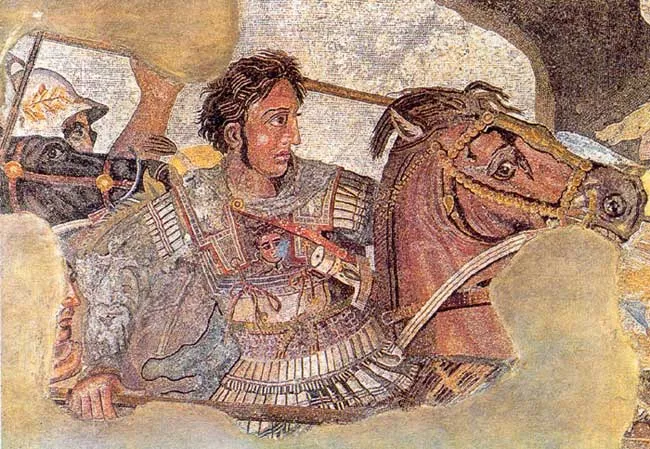
It's a mystery worthy of Sherlock Holmes, with a backstory that puts "Game of Thrones" to shame: Who was laid to rest in a lavish, gold-filled Macedonian tomb near Vergina, Greece? The tomb, discovered in 1977, might be the final resting place of Philip II of Macedon, conqueror of Greece and father of Alexander the Great, who would push his father's empire to the edge of India.
Or, it might be the grave of the distinctly less impressive Philip III Arrhidaios (also written as Arrhidaeus), the half brother of, and figurehead successor to, Alexander the Great.
The latest volley in the debate over which Philip occupies the tomb makes a case for the illustrious Philip II, arguing that the woman found interred alongside the much-debated male body was too old to have been the younger Philip's wife. But this new research seems unlikely to resolve the great Macedonian tomb mystery.
Related: Bones with names: Long-dead bodies archaeologists have identified
A complicated history
Archaeologists discovered the contentious tomb in 1977. Amid paintings and pottery was a gold sarcophagus containing a man's cremated bones. Nearby were the even-more-fragmentary burned bones of a woman.

The tomb's discoverers declared the man was Philip II, who took the throne of Macedonia in 359 B.C. as regent for his infant nephew. Displaying the kind of initiative that defined the Macedonian royal family, Philip II quickly took the throne for himself and started conquering his neighbors.
This went well until 336 B.C., when one of Philip II's bodyguards assassinated him as he walked into a theater in the Macedonian capital of Aegae. It's not entirely clear why the king was murdered; ancient historians told various tales, including one in which the murderer was a former male lover of Philip who had hounded another of Philip's male lovers to suicide and then was himself subjected to sexual assault by one of Philip's in-laws as revenge for that suicide. Some argued that Philip's fourth wife, Olympias, who was rumored by the historian Plutarch to sleep with snakes, had something to do with it.
Get the world’s most fascinating discoveries delivered straight to your inbox.
Regardless of whether Olympias was that diabolical, she certainly knew how to play politics — with bloody results. The queen moved quickly to put her own son, Alexander, on the throne. She arranged for Philip's two children by another wife, Cleopatra Eurydice, to be killed; Cleopatra Eurydice committed suicide by force soon after. Archaeologists who argue that the tomb at Vergina contains Philip II's bones have argued that the female remains found in the tomb belong to Cleopatra Eurydice.
Related: The 10 reasons Alexander the Great was, well, great
But not everyone believed the bones matched those of Philip II. In 1981, a further examination of the remains led to claims that the body instead belonged to Philip III Arrhidaios. After Alexander the Great died in 323 B.C. (under mysterious circumstances, naturally), Philip III Arrhidaios took the throne as a figurehead, with his niece and wife Eurydice (not the same person as his father’s seventh wife) as queen. Ancient historians described Philip III Arrhidaios as mentally unfit. Plutarch blamed Olympias for the mental issues, claiming she'd tried to poison Arrhidaios as a child, but Plutarch clearly was not Olympias' biggest fan, and modern historians are skeptical.
Eurydice, however, was a force to be reckoned with. Her attempts to grab real power put her on a collision course with Olympias and her allies. In 317 B.C., during a war over secession, Olympias' forces defeated the king and queen — Philip III Arrhidaios and Eurydice. He was executed, and she was forced to commit suicide. As if that weren't enough indignity, their bodies were dug up more than a year later and cremated for a royal funeral meant to shore up legitimacy for the next king.
Archaeological arguments
Much of the debate around whether the tomb belongs to Philip II or Philip III Arrhidaios has focused on the burned bones. In the 1980s, Jonathan Musgrave, an anatomist at the University of Bristol in the United Kingdom, created a facial reconstruction of the skull and argued that a notch in the bone over one eye matched historical descriptions of one of Philip II's battle wounds. In 2000, Greek paleoanthropologist Antonis Bartsiokas published a paper in the journal Science arguing that the bone notch and other features Musgrave had highlighted were simply incidental to cremation. (Musgrave does not agree.)
Another line of debate questions whether the bones show signs of warping, which occurs when flesh-covered bodies are cremated. If the bones of Philip III Arrhidaios were dug up and cremated months after the king's death, they might show less warping, or at least a different warping pattern compared with what would be found if the bones were cremated immediately.
Related: See photos of another Alexander-era tomb excavation
Much of this argument falls by the wayside in the new paper, recently accepted for publication by the International Journal of Osteoarchaeology. The researchers, led by Theodore Antikas of Aristotle University in Greece, conducted a five-year forensic study of the bones, including computed tomography (CT) scans.
The researchers argue that the bones of the man and the woman were, in fact, cremated with the flesh still on; however, because Philip III Arrhidaios was not in the ground long enough to become completely skeletal before exhumation, this does little to distinguish the two men.
The new study likewise fails to find any evidence of an eye wound in the male skull, though the researchers did find a healing wound in the hand that might match one of Philip II's battle injuries. The male body also had growths called Schmorl's nodes on his lower vertebrae, a telltale sign of bone stress from horseback riding.
With no smoking guns to identify the male skeleton, the team turned to the female bones. Here, they argue, was a 30- to 34-year-old woman, also a horseback rider, who had a fractured leg bone that would have caused her left leg to be shorter than her right. Tellingly, a set of leg armor, or greaves, found in the tomb appears to be made to fit someone with a shortened left leg, Antikas wrote. This suggests the tomb artifacts, including a quiver holding 74 arrowheads, belonged to the woman buried in the tomb, pointing to her identity as a Scythian princess married to Philip II in 339 B.C. Scythia was a kingdom comprising what is now Central Asia and parts of Eastern Europe.
"The gorytus, arrowheads, spears and everything in the antechamber belong to a Scythian warrior woman and NOT to Philip or any other woman but the seventh wife/concubine, namely the daughter of King Ateas," Antikas wrote in an email to Live Science. (A gorytus is a case for bows and arrows.) Antikas declined to comment on other aspects of the study. If he’s right, however, the woman in the tomb is not the Macedonian Cleopatra Eurydice, but another, foreign bride of Philip II’s.
Bone backlash
But the move toward identifying the tomb's occupants based on the female skeleton rather than the male one brings its own controversy.
"Frankly, I am disappointed that the International Journal of Osteoarchaeology has published this article," said Maria Liston, an anthropologist at the University of Waterloo in Ontario who studies cremated remains in Greece. "I don't think it makes a substantive contribution to this debate, and it certainly does not refute the position of those who say the skeleton is not Philip II."
Among the problems with the new research, Liston said, is an overconfident approach to aging the skeletons. The researchers looked at the pubic symphysis, the cartilage-padded joint of the pubic bone, to peg the woman's age at between 30 and 34 years. But the method they used can't possibly determine age to that level of precision, Liston said. Rather, it can pinpoint the woman's age only to between 21 and 53 years old, she said.
The researchers also found that the sternal end of the clavicle, the end near the breastbone, was fused. But that fusion blows their case out of the water, Liston said, because the bones begin to fuse by 19 or 20 years old and are usually done fusing within a few years, and are always fused entirely by age 29.
"It can't be the age they're saying," Liston told Live Science. If the woman was younger than 29, as the clavicle fusion suggests, she could well be Philip III Arrhidaios' wife Eurydice, who was only about 20 when she died.
Even the broken leg doesn't seal the case, Liston said. She's not convinced the asymmetrical greaves are made for someone with legs of two different lengths — one may simply have a lengthened flange that flared over the ankle, providing the leading leg with an extra bit of protection. Thus, the greaves may not belong to the woman in the tomb at all.
Other archaeologists contacted by Live Science declined to comment, citing the preliminary nature of the paper (the journal has not yet released a final version of the publication) or unfamiliarity with the burial context. The tombs at Vergina are an important cultural and tourist site in Greece and a UNESCO World Heritage Site, which raises the stakes of what would otherwise be a largely academic debate. The museum at Aigai, which oversees the tombs, refers to the tomb as Philip II's without caveat, as does UNESCO. But among archaeologists, nothing is settled.
Related: The 7 most mysterious archaeological finds on Earth
"We're never going to build a case that it's Philip II or Philip III that we could go into court and say, 'We have a positive ID,'" Liston said. She understands the draw of giving the skeleton a name, however.
"I'm as subject as anyone to the thrill of touching the past," she said. But whether the skeleton is Philip II or Philip III, she said, it's rare and exciting to be able to identify so closely a set of bones from more than 2,000 years ago — and either way, the tomb's occupant was a Macedonian royal.
"Frankly, to me, whoever it is, it's really cool," Liston said.
Editor's Note: This article was updated to note that the sternal end of the clavicle was fused, not that the clavicle and sternum were fused, as was stated earlier.
Originally published on Live Science.

Stephanie Pappas is a contributing writer for Live Science, covering topics ranging from geoscience to archaeology to the human brain and behavior. She was previously a senior writer for Live Science but is now a freelancer based in Denver, Colorado, and regularly contributes to Scientific American and The Monitor, the monthly magazine of the American Psychological Association. Stephanie received a bachelor's degree in psychology from the University of South Carolina and a graduate certificate in science communication from the University of California, Santa Cruz.