















Mouth Vision: Blind Fish Suctions Water to Navigate

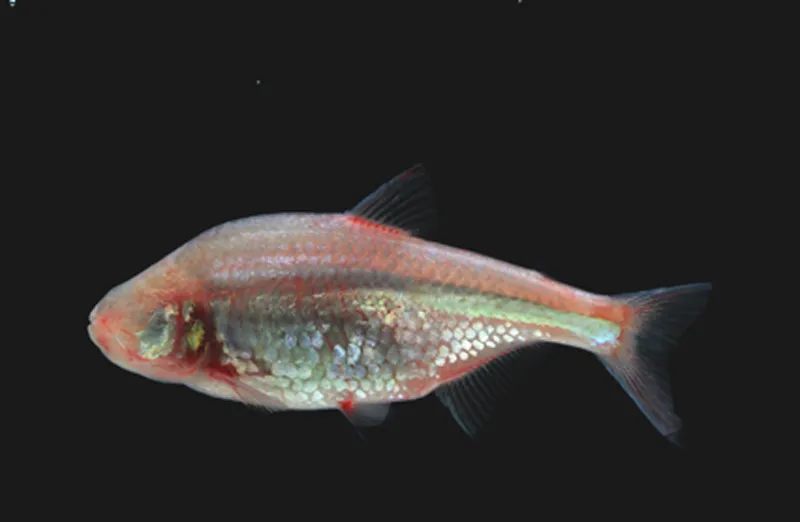
The Mexican blind cavefish does not have eyes, but it can "see" obstacles in dark caves by puckering its mouth and producing bursts of suction, according to a new study. The research describes this unique form of navigation for the first time.
Scientists previously thought the eye-less Mexican cavefish navigated by sensing changes in water pressure produced by waves sent off from the fish's own body. But when the researchers examined the fish, they found some problems with this explanation. For example, larger fish, which would presumably produce larger waves, should be able to identify objects from farther away than smaller fish. In fact, larger fish detected objects at about the same distance as smaller fish did.
Researchers at Tel Aviv University in Israel decided to investigate the sightless navigation further, conducting an experiment in which they counted the number of times the fish opened and closed their mouths when near objects the fish were familiar with. The researchers then moved the objects and observed changes in the fishes' mouth movement in the unfamiliar environment. [In Images: The Extraordinary Evolution of 'Blind Cavefish']
The fish opened and closed their mouths more than twice as frequently in unfamiliar surroundings, and more frequently when approaching an object than in the open, with no objects nearby, suggesting this behavior plays a role in detecting the fish's environment.
Through further analyses, the team determined the suction sent off by this mouth motion produces a signal similar to echolocation — a system in which animals, like bats and dolphins, emit sound waves and detect the distance of an object based on how long the sound takes to bounce back. Instead of measuring time, however, the cavefish appear to measure the magnitude of the pressure change produced by their mouth suction, study co-author Roi Holzman told Live Science.
"In this sense, it is different from echolocation, but it is similar because you have an animal that is purposefully emitting pressure waves to locate obstacles," Holzman said.
The team does not know if other fish use this form of navigation. But some likely do, since all fish have the ability to produce suction waves with their mouths, and all have receptive organs along the sides of their bodies that can detect changes in water pressure. Both adaptations can be traced far back in the evolutionary history of fish, said Holzman.
Get the world’s most fascinating discoveries delivered straight to your inbox.
"It's a [newly discovered] mechanism made out of ancient material, and it just makes sense that other fish would have it," Holzman said. "We haven't tested it yet, but I'd really like to."
The fish may also passively gather information produced by body waves when they swim through water, as previous studies have suggested, the team speculates. But the cavefish likely use both navigation methods in tandem, similar to how submarines rely on both active and passive sonar, Holzman said.
The researchers are now using a hydrophone to study how the fish modulate the suction signal depending on their distance from an obstacle, Holzman said.
The study findings were detailed last week in the Journal of Experimental Biology.
Follow Laura Poppick on Twitter. Follow us @livescience, Facebook & Google+. Original article on Live Science.
