















Photos: Peering into a 12th-Century Byzantine Monastery

Byzantine monastery

Hundreds of years before asbestos became ubiquitous in the construction industry, Byzantine monks used the fibrous material in plaster coatings underlying their wall paintings during the late 1100s, suggests new research in the Byzantine monastery Enkleistra of St. Neophytos in Cyprus.
Monastery in context

But while investigating the 12th-century paintings in the Byzantine monastery Enkleistra of St. Neophytos in Cyprus, UCLA researchers discovered the magnesium silicate mineral, chrysotile (white asbestos), in the finish coating of the plaster underneath a portion of a wall painting. The chrysotile provided a smooth layer with a mirrorlike surface for the painting.
UV light
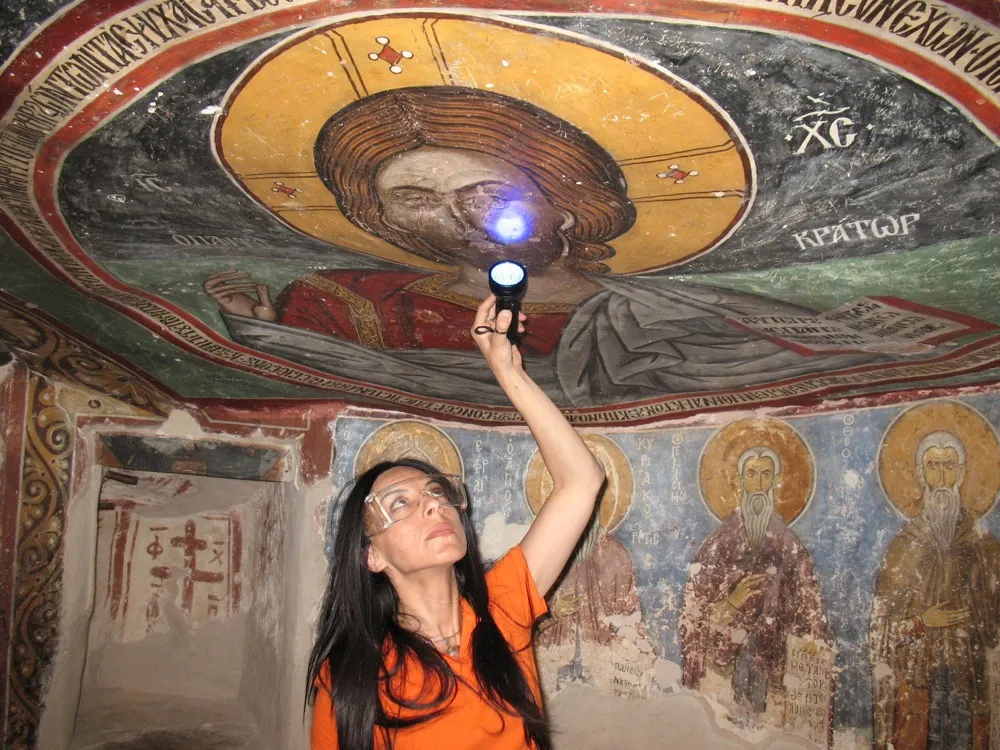
The researchers analyzed some of the paintings on site using various techniques, including infrared, ultraviolet and X-ray fluorescence imaging. Here, UCLA archaeologist Ioanna Kakoulli examines a painting in the monastery under UV light.
Elemental make-up

The researchers also collected micro-samples of the paintings and further analyzed their molecular and elemental makeup with powerful scanning electron microscopes and other methods.
Enthroned Christ

One of the paintings they inspected depicted the "Enthroned Christ" (shown here) holding a book with a red frame. When they analyzed the red frame, they found an asbestos-rich layer that was applied as a finish coating between a red paint layer and a plaster layer made up mostly of plant fibers. "So far, we've only found it in relation to those red pigments," Kakoulli said.
12th-century paintings

Another painting inside the Byzantine monastery Enkleistra of St. Neophytos in Cyprus.
St. Neophytos

Depiction of St. Neophytos flaked by the archangels Michael and Gabriel, who hold him by the shoulders (Bema), in a painting in the Byzantine monastery Enkleistra of St. Neophytos in Cyprus.
Get the world’s most fascinating discoveries delivered straight to your inbox.
Crucifixion

Scene of the Crucifixion on the south wall of the Cell inside the Byzantine monastery, painted over a thin layer of lead white applied as an intermediate layer to mask a preexisting painting.
