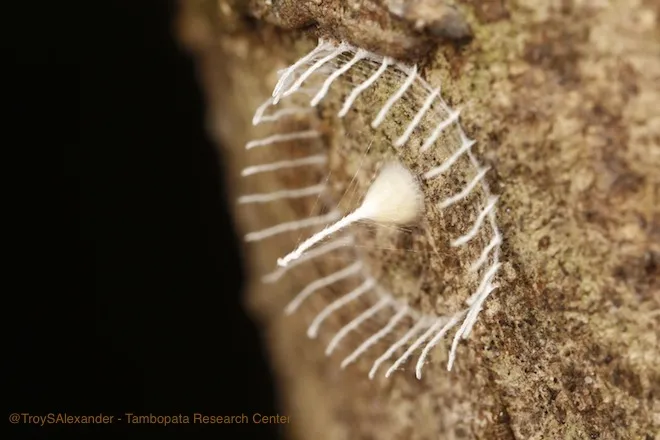
This strange formation found in the Peruvian Amazon resembles a tiny spire surrounded by a webby picket fence and is about 2 centimeters (0.8 inches) wide.
A bizarre-looking web structure has been found in the Peruvian Amazon, and apparently nobody knows what it is, not even scientists.
The strange formation resembles a tiny spire surrounded by a webby picket fence and is about 2 centimeters (0.8 inches) wide. Georgia Tech graduate student Troy Alexander first spotted one of these on the underside of a tarp near the Tambopata Research Center in the Peruvian Amazon. At first he thought it might have been an aborted moth cocoon, he wrote on Reddit. But then he found several more, all of which looked quite similar.
He posted the photos to Reddit and asked other scientists to help him out, besides making queries around the Tambopata Research Center, to no avail. His guess is that "there are eggs in the base of the maypole in the middle of the horse corral, though it might be something pupating," he wrote on Reddit. [See Images of Weird Amazon Web Structure]
Chris Buddle, an arachnologist at McGill University, said that neither he nor any of his associates know what it is. "I have no clue," he said. It's "a seriously fascinating mystery."
"I have no idea what animal made that," Norman Platnick, curator emeritus of spiders at the American Museum of Natural History in New York, told LiveScience.
The weird structure was first spotted on the underside of a tarp near the Tambopata Research Center in the Peruvian Amazon.
So far, Redditors and others have guessed that it could be some kind of moth cocoon, an intricate defense for spider eggs, or even the fruiting body of some type of fungus.
Alexander fell in love with the Peruvian Amazon while on vacation there, he told Colossal, an art blog. So he asked his adviser if he could take a leave of absence to be a volunteer researcher. Shortly thereafter, Alexander flew back to Peru to work at the Tambopata Macaw Project, which focuses on parrot biology and conservation, he told Colossal.
Sign up for the Live Science daily newsletter now
Get the world’s most fascinating discoveries delivered straight to your inbox.
If whatever produces this structure turns out to be a new species, it should come as no surprise — the world's rain forests are expected to perhaps contain millions of new species of arthropods (a group of animals with hard exoskeletons, which includes spiders and insects), according to various scientific estimates. One survey of arthropods in Panama's jungle, in an area about the size of Manhattan, found 25,000 species of insects, spiders and other arthropods, 70 percent of which were new to science. That study also found that there were 300 arthropod species for every one mammal species.
Douglas Main loves the weird and wonderful world of science, digging into amazing Planet Earth discoveries and wacky animal findings (from marsupials mating themselves to death to zombie worms to tear-drinking butterflies) for Live Science. Follow Doug on Google+.