Patches of light that sometimes appear beside the sun are called sundogs. The scientific name is parhelion (plural: parhelia) from the Greek parēlion, meaning "beside the sun." Speculation is that they are called that because they follow the sun like a dog follows its master. Sundogs (or sun dogs) are also referred to as mock suns or phantom suns.
This beautiful picture was captured at sunrise on a cold and still Park City morning. Called sundogs, this phenomenon is caused by sunlight being refracted through ice crystals. Taken by Don Brown with an Olympus OM1 and a 28mm lens, this image shows two parhelia on each side of the sun and one just visible at the top of the image. The ice crystals must be preferentially oriented horizontally and the sun-observer line of sight must be close to horizontal in order to see such a site.
Sundogs often appear as colored areas of light to the left or right of the sun, 22 degrees distant and at the same distance above the horizon as the sun. They are frequently observed on a ring or halo around the sun.
There are also moon dogs that appear alongside the moon and are formed by lunar light passing through ice crystals. Moon dogs, or paraselenae, are not observed as often as sundogs because they are visible when the moon is bright and because they appear during the night.
Sundogs are formed from hexagonal ice crystals in high and cold cirrus clouds or, during very cold weather, by ice crystals drifting in the air at low levels. These crystals act as prisms, bending the light rays passing through them. As the crystals sink through the air they become vertically aligned, refracting the sunlight horizontally so that sundogs are observed.
Sundogs, or parahelia, are bright spots in the sky caused by the refraction of sunlight off tiny ice crystals in the atmosphere. Above the Trans-Alaska Pipeline in midwinter, sundogs meld into a halo around the sun.
(Image credit: Yongwon Kim , University of Alaska Fairbanks)
Sundogs frequently display a reddish tint on the side facing the sun and may sport bluish-white tails that stretch horizontally away from it. The sundog's tail is formed by light passing through the crystal at angles other than the optimal deviation angle.
Just because they are formed from ice crystals does not mean that sundogs can only be observed in cold climates. They can occur at any time of the year and from any place, although they are most visible when the sun is lower on the horizon in January, April, August and October. They also occur when ice crystals in the atmosphere are more common, but can be seen whenever and wherever there are cirrus clouds.
Sign up for the Live Science daily newsletter now
Get the world’s most fascinating discoveries delivered straight to your inbox.
As the sun rises, the sundog can actually drift away from the 22-degree point. Eventually the sun rises to a higher point to where the sundog completely disappears.
Ancient Greeks came to realize that sundogs are fairly accurate rain forecasters. The ice crystals that produce the haloes and sundogs also form cirroform clouds, which make up the typical cloud formation that foretells a precipitating warm front.
Art & literature
There are many mentions of sundogs in literature, art and scientific papers.
Many Greek and Roman authors provide detailed descriptions of sundogs. The Greek philosopher Aristotle (384 B.C. – 322 B.C.) notes that "two mock suns rose with the sun and followed it all through the day until sunset," noting that they are always to the side, never above or below the sun. The Greek poet Aratus (ca. 315 B.C./310 B.C. – 240 B.C.) mentions sundogs in his catalog of weather signs. In his "On the Republic," Cicero shares a detailed description of the phenomenon.
Jacob Hutter (ca 1500 – Feb. 25, 1536), a founder of the Anabaptist movement in what is now Italy, described sundogs in his work, "Brotherly Faithfulness: Epistles from a Time of Persecution."
The "Sundog Painting" (Vädersolstavlan) depicts sundogs in Stockholm in 1535.
The original painting, which was produced shortly after the event and typically attributed to Urban Målare is lost. However, a 1636 copy by Jacob Heinrich Elbfas still exists.
Stephen King wrote about the phenomenon in a short story called "The Sun Dog" in his "Four Past Midnight" collection of short stories. And in "King Henry VI, Part 3," William Shakespeare dramatized the appearance of sundogs during the War of the Roses:
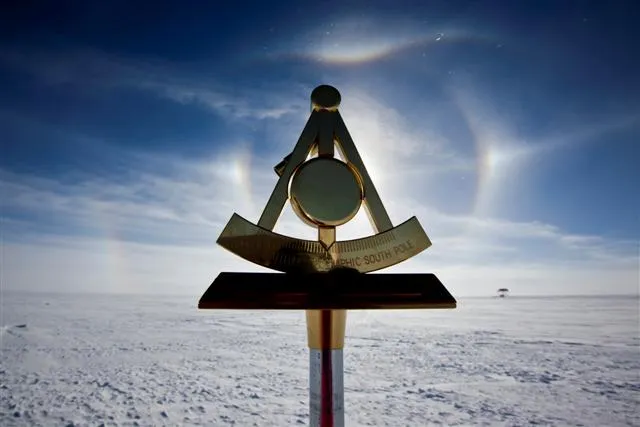
Sundogs over the South Pole.
(Image credit: Deven Stross / NSF)
EDWARD Dazzle mine eyes, or do I see three suns?
RICHARD Three glorious suns, each one a perfect sun; Not separated with the racking clouds, But sever'd in a pale clear-shining sky. See, see! they join, embrace, and seem to kiss, As if they vow'd some league inviolable: Now are they but one lamp, one light, one sun. In this the heaven figures some event.
EDWARD 'Tis wondrous strange, the like yet never heard of. I think it cites us, brother, to the field, That we, the sons of brave Plantagenet, Each one already blazing by our meeds, Should notwithstanding join our lights together And over-shine the earth as this the world. Whate'er it bodes, henceforward will I bear Upon my target three fair-shining suns.
Kim Ann Zimmermann is a contributor to Live Science and sister site Space.com, writing mainly evergreen reference articles that provide background on myriad scientific topics, from astronauts to climate, and from culture to medicine. Her work can also be found in Business News Daily and KM World. She holds a bachelor’s degree in communications from Glassboro State College (now known as Rowan University) in New Jersey.