













Erratic Environment May Be Key to Human Evolution

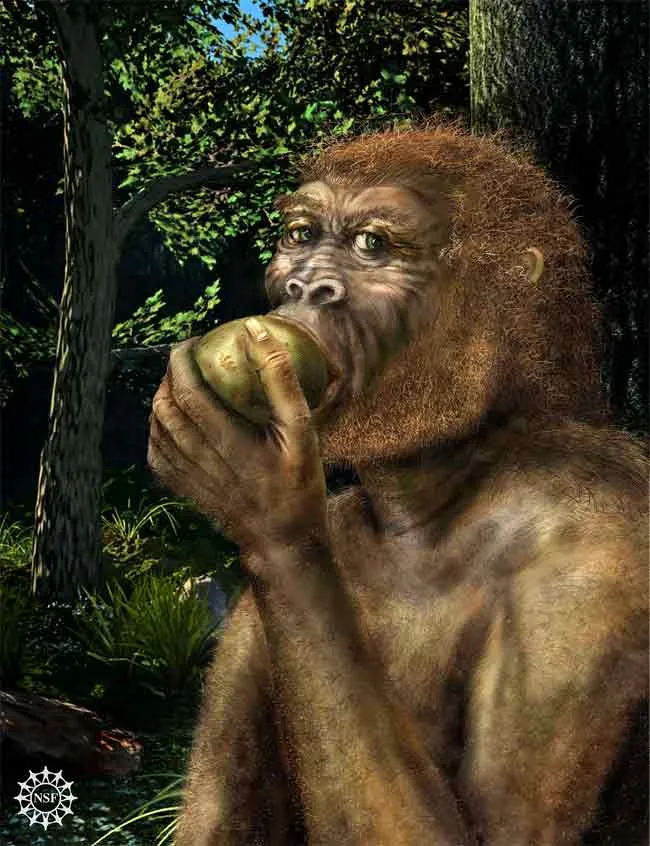
At Olduvai Gorge, where excavations helped to confirm Africa was the cradle of humanity, scientists now find the landscape once fluctuated rapidly, likely guiding early human evolution.These findings suggest that key mental developments within the human lineage may have been linked with a highly variable environment, researchers added.
Olduvai Gorge is a ravine cut into the eastern margin of the Serengeti Plain in northern Tanzania that holds fossils of hominins — members of the human lineage. Excavations at Olduvai Gorge by Louis and Mary Leakey in the mid-1950s helped to establish the African origin of humanity.
The Great Drying?
To learn more about the roots of humanity, scientists analyzed samples of leaf waxes preserved in lake sediments at Olduvai Gorge, identifying which plants dominated the local environment around 2 million years ago. This was about when Homo erectus, a direct ancestor of modern humans who used relatively advanced stone tools, appeared.
"We looked at leaf waxes, because they're tough, they survive well in the sediment," researcher Katherine Freeman, a biogeochemist at Pennsylvania State University, said in a statement.
After four years of work, the researchers focused on carbon isotopes — atoms of the same element with different numbers of neutrons — in the samples, which can reveal what plants reigned over an area. The grasses that dominate savannasengage in a kind of photosynthesis that involves both normal carbon-12 and heavier carbon-13, while trees and shrubs rely on a kind of photosynthesis that prefers carbon-12. (Atoms of carbon-12 each possess six neutrons, while atoms of carbon-13 have seven.)
Scientists had long thought Africa went through a period of gradually increasing dryness — called the Great Drying — over 3 million years, or perhaps one big change in climate that favored the expansion of grasslands across the continent, influencing human evolution. However, the new research instead revealed "strong evidence for dramatic ecosystem changes across the African savanna, in which open grassland landscapes transitioned to closed forests over just hundreds to several thousands of years," researcher Clayton Magill, a biogeochemist at Pennsylvania State University, told LiveScience. [Know Your Roots? Take Our Human Evolution Quiz]
Get the world’s most fascinating discoveries delivered straight to your inbox.
The researchers discovered that Olduvai Gorge abruptly and routinely fluctuated between dry grasslands and damp forests about five or six times during a period of 200,000 years.
"I was surprised by the magnitude of changes and the rapid pace of the changes we found," Freeman told LiveScience. "There was a complete restructuring of the ecosystem from grassland to forest and back again, at least based on how we interpret the data. I've worked on carbon isotopes my whole career, and I've never seen anything like this before."
Losing water
The investigators also constructed a highly detailed record of water history in Olduvai Gorge by analyzing hydrogen isotope ratios in plant waxes and other compounds in nearby lake sediments. These findings support the carbon isotope data, suggesting the region experienced fluctuations in aridity, with dry periods dominated by grasslands and wet periods characterized by expanses of woody cover.
"The research points to the importance of water in an arid landscape like Africa," Magill said in a statement. "The plants are so intimately tied to the water that if you have water shortages, they usually lead to food insecurity."
The research team's statistical and mathematical models link the changes they see with other events at the time, such as alterations in the planet's movement. [50 Amazing Facts About Earth]
"The orbit of the Earth around the sun slowly changes with time," Freeman said in statement. "These changes were tied to the local climate at Olduvai Gorge through changes in the monsoon system in Africa."
Earth's orbit around the sun can vary over time in a number of ways — for instance, Earth's orbit around the sun can grow more or less circular over time, and Earth's axis of spin relative to the sun's equatorial plane can also tilt back and forth. This alters the amount of sunlight Earth receives, energy that drives Earth's atmosphere. "Slight changes in the amount of sunshine changed the intensity of atmospheric circulation and the supply of water. The rain patterns that drive the plant patterns follow this monsoon circulation. We found a correlation between changes in the environment and planetary movement."
The team also found links between changes at Olduvai Gorge and sea-surface temperatures in the tropics.
"We find complementary forcing mechanisms — one is the way Earth orbits, and the other is variation in ocean temperatures surrounding Africa," Freeman said.
These findings now shed light on the environmental shifts the ancestors of modern humans might have had to adapt to in order to survive and thrive.
"Early humans went from having trees available to having only grasses available in just 10 to 100 generations, and their diets would have had to change in response," Magill said in a statement. "Changes in food availability, food type, or the way you get food can trigger evolutionary mechanisms to deal with those changes. The result can be increased brain size and cognition, changes in locomotion and even social changes — how you interact with others in a group."
This variability in the environment coincided with a key period in human evolution, "when the genus Homo was first established and when there was first evidence of tool use," Magill said.
The researchers now hope to examine changes at Olduvai Gorge not just across time but space, which could help shed light on aspects of early human evolution such as foraging patterns.
Magill, Freeman and their colleague Gail Ashley detailed their findings online Dec. 24 in two papers in the journal Proceedings of the National Academy of Sciences.
Follow LiveScience on Twitter @livescience. We're also on Facebook & Google+.
