













Earth's Orbit Blamed for Ancient Hot Spells

About 55 million years ago, an intense heat wave hit the planet. Earth's surface temperature surged by 9 degrees Fahrenheit (5 degrees Celsius). Then, after a relatively short time, the heat subsided, only to be followed by at least two similar, but smaller heat waves.
Based on chemical clues preserved in rocks, scientists believe a surge of carbon dioxide warmed the planet. But where did all of this greenhouse gas come from?
A team of scientists is proposing that it came from the melting of permafrost, frozen soil packed with organic matter, after cycles in the Earth's orbit warmed up the areas near the poles. The melting released a massive amount of carbon into the atmosphere, keeping reflected sunlight from escaping and causing the heat wave.
Previously, other scientists have theorized that the release of the carbon compound methane trapped in marine sediments — in a form known as methane hydrates — changed the atmosphere. But the study published in the April 5 issue of the journal Nature argues that not enough methane would have been released to account for the magnitude of the warming.
Other theories include a comet impact, extensive fires, or the drying of shallow continental seas — "all these difficult ideas," said study researcher Mark Pagani, a professor at Yale University. None of these explain the sequence of progressively smaller heat waves that followed, Pagani and his colleagues argue.
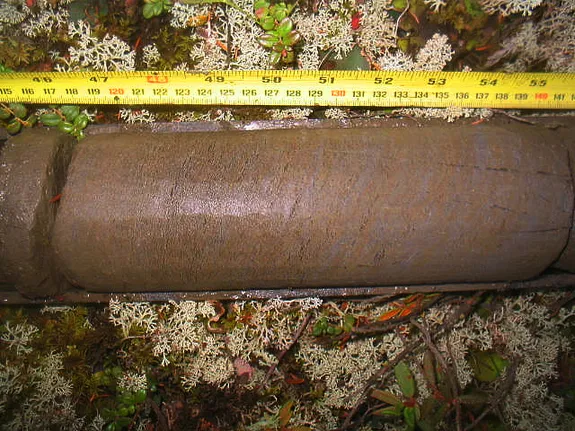
Examining a rock outcrop near Gubbio, Italy that contains evidence of these heat waves, also known as hyperthermals, the team found they lined up with cycles in the Earth's orbit.
The path of Earth around the sun and the planet's orientation can vary slightly in cycles that last up to 100,000 years. The researchers found that the timing of three large hyperthermals — beginning about 55 million years ago — aligned with periods when the tilt of the Earth's axis was greatest and when the planet's orbit was most eccentric (that is, least circular). [50 Amazing Facts About Earth]
Get the world’s most fascinating discoveries delivered straight to your inbox.
This combination meant the high latitudes — the area closest to the poles — had warmer or longer summers, "with the potential to thaw vast areas of permafrost once a warming threshold is reached," wrote the researchers. The cycle became self-reinforcing, as more carbon entering the atmosphere encouraged more warming, which encouraged more melting and the release of more carbon.
"Then our climate models show if you have permafrost and you warm the temperatures slowly, there is sort of a sweet spot in the model: When you cross it, the whole thing just goes," Pagani said.
Modern discussions of melting permafrost focus on the Arctic. But about 50 million years ago, the world was warmer overall than it is now, and Antarctica was not yet ice-covered, so the researchers argue that the southernmost continent probably had its own large stock of carbon tucked away in the permafrost.
This process produced the successive hyperthermals, the team suspects: After a warming stint lasting some 10,000 years, the carbon from the permafrost would be depleted, resulting in atmospheric carbon dioxide that stuck around for about 200,000 years until natural processes drew it out, cooling the planet down, according to Pagani.
Then, about 1 million years later, the process most likely repeated itself, but this time with less permafrost available to melt. This led to a smaller warming pulse, until the hyperthermals ran themselves out, he said.
These ancient hyperthermals are described by the researchers as intense bursts of warming, but nowadays the planet is warming more rapidly. Scientists anticipate that the melting Arctic permafrost is likely to exacerbate things.
"This source of carbon is a large and important source of carbon that has not been released yet; that is just one of those extra things that is waiting around the corner for us," Pagani said.
The research was led by Robert DeConto at the University of Massachusetts, Amherst.
Editor's note: This article was updated at 4:20 pm Eastern Daylight Time to correct an error regarding the timing of the study's publication. It was published in the April 5 issue of the journal Nature, not March 5.
You can follow LiveSciencesenior writer Wynne Parry on Twitter @Wynne_Parry. Follow LiveScience for the latest in science news and discoveries on Twitter @livescience and on Facebook.
