













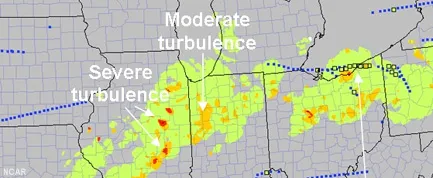
Airplane passengers could soon experience much less in-flight turbulence if testing goes well for a new detection system designed to end stomach-lurching bumpy rides and reduce delays.
The air turbulence detection system , designed by the National Center for Atmospheric Research (NCAR), has already successfully alerted some pilots steering United Airlines commercial flights to patches of rough air as they flew through clouds.
"We hope this will provide a significant boost to the aviation industry in terms of passenger comfort, safety and reduced costs," said NCAR scientist John Williams.
The system uses a mathematical method known as the NEXRAD Turbulence Detection Algorithm, or NTDA, to analyze data obtained from the National Weather Service's network of Next-Generation Doppler Radars (NEXRAD). NTDA detects turbulence in storms by peering into clouds and analyzing the distribution of winds inside. It reprocesses the radar data to remove contaminating factors, such as sunlight, nearby storms or even swarms of insects flying near the radar dish.
The data are compiled into real-time snapshots, or "nowcasts," of turbulence and transmitted to pilots in the cockpit and made available to airline meteorologists and dispatchers via a Web-based display.
Reducing flight delays
THE NTDA system is being tested through October by a group of United Airlines pilots who fly routes east of the Rockies, where air turbulence is a major problem.
Get the world’s most fascinating discoveries delivered straight to your inbox.
Captain Rocky Stone, chief technical pilot for United Airlines, says he is impressed by the system. "The messages I've received in the cockpit gave a very accurate picture of turbulence location and intensity," Stone said. "The depiction of turbulence intensity provides an unprecedented and extremely valuable new tool for pilot situational awareness."
If results from this year's test remain promising, the system could be expanded to additional United aircraft or other airlines. Williams anticipates that by 2011, NTDA will be used across the contiguous United States to provide turbulence reports updated every 15 minutes.
Developers say NTDA could help reduce flight delays by allowing pilots to avoid only those thunderstorms they deem a turbulence threat. "Current FAA guidelines suggest that pilots avoid thunderstorms by a wide margin," Williams explained. "By giving more specific information on the location and intensity of turbulence, we expect that the in-cloud NTDA product will reduce unnecessary deviations and the resulting delays, while also providing increased safety and passenger comfort."
A societal benefit
Air turbulence is a major problem for airlines. According to a review of National Traffic Safety Board data from 1992 to 2001 by the National Aviation Safety Data Analysis Center, turbulence was a factor in at least 509 accidents in the United States that resulted in 251 deaths in general aviation flights, which do not typically include large commercial aircraft. Additionally, the FAA estimates that there are more than 1,000 minor turbulence-related injuries on commercial aircraft annually.
"We expect that our new in-cloud turbulence detection system will be able to mitigate at least a fraction of that cost, producing a significant societal benefit," Williams told LiveScience.
The new system could also do away with the annoyance of repeated in-flight buckling and un-buckling of seat belts, Williams said. "One benefit of our system is that when a pilot uses it to turn on the 'fasten seat belt' sign, the passengers and crew can be confident that there really is turbulence ahead," Williams said.
The research is funded by the Federal Aviation Administration (FAA) in partnership with the National Science Foundation.