













Study Finds the Key to Language: How Humans Form Sentences

Experiments with dogs, chimpanzees and other intelligent animals show that humans aren't the only beings who are able to learn the meanings of words. What distinguishes us is our ability to string those words together in meaningful ways, with one word order conveying something different than another. In short, sentences, not vocabulary, are the true hallmark of language.
Now, a team of researchers who study the neural basis of language have pinpointed the pathway in the brain that allows humans to combine words together into sentences. It's a separate pathway than the one we use to recall the meanings of individual words, a capability we share with other animals.
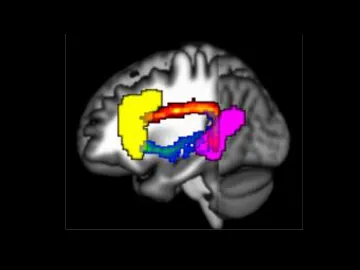
Most prior work on the neuroscience of language focused on bundles of neurons in two brain areas called Broca's region and Wernicke's region — the main hubs of language processing. It has long been known that the regions are connected to one another by upper and lower "white matter" pathways — strings of lipid cells that carry nerve signals — but these haven't been studied nearly as extensively as the neurons in the regions themselves. The new research, published in the latest issue of the peer-reviewed journal Neuron, reveals for the first time the important and distinct roles played by the two pathways.
While vocabulary is accessed along the lower pathway, the meaning of combinations of words is accessed along the upper one.
To come to that conclusion, the researchers used magnetic resonance imaging to visualize the brains of patients suffering from neurodegenerative diseases called "aphasias" that affect their language ability. At the same time, the patients were given tasks testing their comprehension of sentences.
The researchers discovered a clear distinction between patients who had damage to their upper language pathways and those who had damage to their lower pathways, revealing the separate routes the brain uses to draw upon information stored in Broca's and Wernicke's regions. "If you have damage to the lower pathway, you have damage to the lexicon and semantics," lead researcher Stephen Wilson of the University of Arizona explained in a press release. "You forget the name of things, you forget the meaning of words. But surprisingly, you're extremely good at constructing sentences."
Wilson continued, "With damage to the upper pathway, the opposite is true; patients name things quite well, they know the words, they can understand them, they can remember them, but when it comes to figuring out the meaning of a complex sentence, they are going to fail."
Get the world’s most fascinating discoveries delivered straight to your inbox.
If it seems hard to believe that the ability to recall the meaning of single words and the ability to recall the collective meaning of many words together could be divorced from one another, consider this example: The researchers asked the patients: "A man was walking along the railway tracks. He didn't hear the train coming. What happened to the man?"
Most unimpaired people would answer, "The man was hit by a train." The study found that people with damage to their upper language pathway, but a perfectly intact lower pathway, answered "train, man, hit."
This is reminiscent of the primitive language that can be acquired by chimpanzees, such as Nim Chimpsky, a chimp who scientists taught sign language in the 1970s. Nim had no capacity for syntax, and would sign disorderly strings of words such as "Give orange me give eat orange me eat orange give me eat orange give me you." [Chimps vs. Humans: How We're Different]
Conversely, the researchers tested patients' sentence comprehension by presenting them with a sentence like, "The girl who is pushing the boy is green," and then asking which of two pictures — one showing a green girl pushing a boy, the other, a girl pushing a green boy — depicted that scenario accurately.
"Those who have only lower pathway damage do really well on this, which shows that damage to that pathway doesn't interfere with your ability to use the little function words or the functional endings on words to figure out the relationships between the words in a sentence," Wilson said.
But the group of patients with damaged upper pathways couldn't tell their green girls from their green boys.
This article was provided by Life's Little Mysteries, a sister site to LiveScience. Follow us on Twitter @llmysteries, then join us on Facebook. Follow Natalie Wolchover on Twitter @nattyover.

Natalie Wolchover was a staff writer for Live Science from 2010 to 2012 and is currently a senior physics writer and editor for Quanta Magazine. She holds a bachelor's degree in physics from Tufts University and has studied physics at the University of California, Berkeley. Along with the staff of Quanta, Wolchover won the 2022 Pulitzer Prize for explanatory writing for her work on the building of the James Webb Space Telescope. Her work has also appeared in the The Best American Science and Nature Writing and The Best Writing on Mathematics, Nature, The New Yorker and Popular Science. She was the 2016 winner of the Evert Clark/Seth Payne Award, an annual prize for young science journalists, as well as the winner of the 2017 Science Communication Award for the American Institute of Physics.