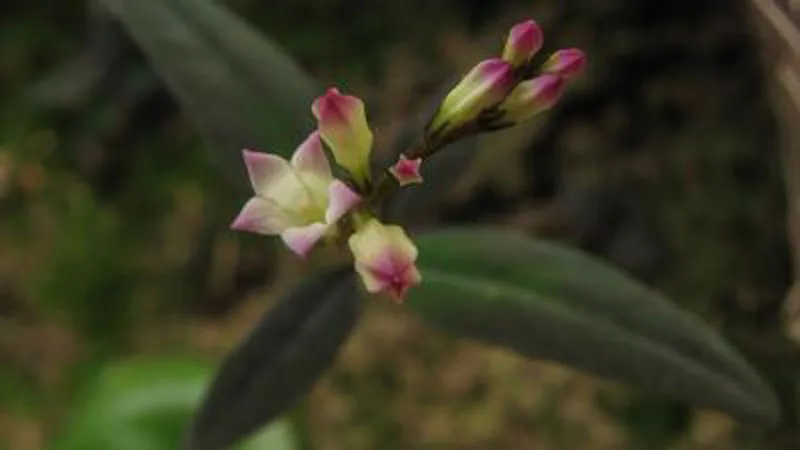
A tiny plant that bows down to bury its seeds was recently discovered in rural northeastern Bahia, Brazil, one of the world's most biologically diverse areas.
The dainty, inch-high plant with pink-and-white flowers was growing in the backyard of a local plant collector and amateur botanist, Alex Popovkin, when it caught the attention of a handyman working for Popovkin, José Carlos Mendes Santos. After the plant was placed on a windowsill, Santos snapped photos of it and uploaded them online. [See images of new plant]
That's how several taxonomic experts helped to identify its family and genus, and a Brazilian botanist suggested that it might be a new species. Scientists from Rutgers University, the State University at Feira de Santana in Bahia, and Western Carolina University collaborated to confirm that the plant was indeed a new species.
"It is very easy to think we have found and described most plant species of the world already, but this discovery shows that there are so [many] left out there without name and recognition," Lena Struwe, a Rutgers University specialist in plants of the Loganiaceae family, said in a statement. Struwe worked with Santos and Popovkin to identify the plant's genus, Spigelia.
The researchers found only a few minuscule plants in Popovkin's field during the first year. The plants died in the dry season, only to reappear in the same spots at the beginning of the rain season. This was explained by the plant's unique propagation trait, a characteristic known as geocarpy.
The Spigelia genuflexa gingerly bends its fruit branches down to release seeds onto the ground.
(Image credit: Alex Popovkin)
When the plant's fruits form, the plant slowly bends its small, fruiting branches down, depositing the seed capsules carefully onto the ground — and sometimes burying them in the soft cover of moss. Geocarpy, which is also practiced by peanut plants, ensures that the seeds will grow into new plants near the mother plant during the following season.
Due to the plant's dexterity, the collaborators decided to name the new species Spigelia genuflexa.
Sign up for the Live Science daily newsletter now
Get the world’s most fascinating discoveries delivered straight to your inbox.
The new plant species is detailed this week in the taxonomic journal PhytoKeys.
You can follow LiveScience writer Remy Melina on Twitter @remymelina. Follow LiveScience for the latest in science news and discoveries on Twitter @livescience and on Facebook.
Remy Melina was a staff writer for Live Science from 2010 to 2012. She holds a bachelor’s degree in Communication from Hofstra University where she graduated with honors.