Radioactive Decay Fuels Earth's Inner Fires

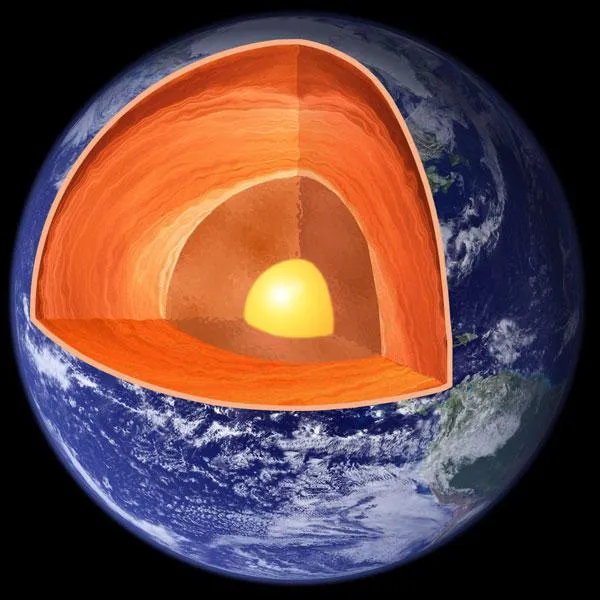
Half of the extraordinary heat of the Earth that erupts on its surface volcanically and drives the titanic motions of the continents is due to radioactivity, scientists find.
This new discovery shows that the planet still retains an extraordinary amount of heat it had from its primordial days.
To better understand the sources of the Earth's heat, scientists studied antineutrinos, elementary particles that, like their neutrino counterparts, only rarely interact with normal matter. Using the Kamioka Liquid-scintillator Antineutrino Detector (KamLAND) located under a mountain in Japan, they analyzed geoneutrinos — ones emitted by decaying radioactive materials within the Earth — over the course of more than seven years.
The specific amount of energy an antineutrino packs on the rare occasions one does collide with normal matter can tell scientists about what material emitted it in the first place — for instance, radioactive material from within the Earth, as opposed to in nuclear reactors. If one also knows how rarely such an antineutrino interacts with normal matter, one can then estimate how many antineutrinos are being emitted and how much energy they are carrying in total.
The researchers found the decay of radioactive isotopes uranium-238 and thorium-232 together contributed 20 trillion watts to the amount of heat Earth radiates into space, about six times as much power as the United States consumes. U.S. power consumption in 2005 averaged about 3.34 trillion watts.
As huge as this value is, it only represents about half of the total heat leaving the planet. The researchers suggest the remainder of the heat comes from the cooling of the Earth since its birth.
Knowing what the sources of heat from Earth are "is a very important issue in geophysics," researcher Itaru Shimizu, an elementary particle physicist at Tohoku University in Miyagi, Japan, told OurAmazingPlanet.
Get the world’s most fascinating discoveries delivered straight to your inbox.
For instance, the heat from Earth's primordial days is thought to be bound to the planet's core, while the heat from radioactive decay is thought to be distributed in the crust and mantle layers of the planet, greatly influencing currents in the mantle, "which drive plate tectonics and geophysical activity," Shimizu said.
The scientists at the KamLAND Collaboration detailed their findings online July 17 in the journal Nature Geoscience.
This story was provided by OurAmazingPlanet, a sister site to LiveScience.