
-
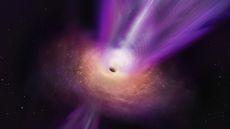 Black holes can destroy planets — but they can also lead us to thriving alien worlds. Here's how.
Whether a galactic environment has the right conditions for habitable planets to form could depend on how the black hole in that galaxy is rotating.
black-holes -
 James Webb telescope could find signs of life on alien 'hycean' ocean worlds
If such worlds exist, they could be among the most common life-bearing planets in the galaxy.
exoplanets -
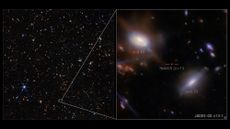 'Totally unexpected' galaxy discovered by James Webb telescope defies our understanding of the early universe
Scientists studying one of the earliest known galaxies using the James Webb Space Telescope have found that the universe's Era of Reionization may have occurred much earlier than previously thought.
astronomy -
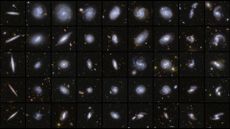 First data from Euclid space telescope reveals 26 million galaxies — and another 1.4 billion are on the way
The Euclid space telescope has spotted 26 million galaxies in just one week of observations.
space -
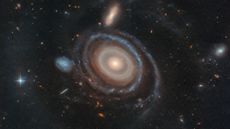 'Bull's-eye!' Hubble telescope spots record-shattering 9-ring galaxy — and the cosmic 'dart' that smashed through its center
Scientists using the Hubble Space Telescope have spotted a record-smashing galaxy wrapped in 9 rings of stars — along with the dwarf galaxy that violently plunged through its center.
astronomy -
 Milky Way quiz: How well do you know our home galaxy?
Quiz Test your knowledge of the Milky Way's size, speed, age, galactic neighbors and more.
Quiz -
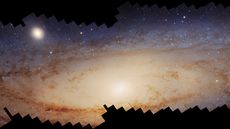 'Herculean' 2.5-billion-pixel mosaic shows our closest galactic neighbor like never before — and took more than a decade to create
The new composite image, which combines hundreds of photos from the Hubble Space Telescope, shows the Andromeda Galaxy with more than 200 million individually resolved stars.
cosmology -
 'Our model of cosmology might be broken': New study reveals the universe is expanding too fast for physics to explain
Astronomers have been confounded by recent evidence that the universe expanded at different rates throughout its life. New findings risk turning the tension into a crisis, scientists say.
cosmology -
 Most of the atoms in your body left the Milky Way on a 'cosmic conveyor belt' long before you were born, new study reveals
New research suggests that most of the atoms within the human body likely spent part of their lives drifting beyond the Milky Way on a cosmic "conveyor belt," before eventually returning to our galaxy.
cosmology


