Get the world’s most fascinating discoveries delivered straight to your inbox.
You are now subscribed
Your newsletter sign-up was successful
Want to add more newsletters?
Join the club
Get full access to premium articles, exclusive features and a growing list of member rewards.
An account already exists for this email address, please log in.
Ancient zircon crystals shed light on 1 billion-year-old meteorite strike in Scotland
Geologists have found that an ancient meteorite hit Scotland 200 million years later than previously thought, which has massive implications for the geological history of the region and some of the U.K.'s earliest land life.
An ancient meteorite strike hit what is now Scotland significantly later than previously thought, scientists say. The finding will rewrite the region's geological history and change what researchers thought they knew about some of the U.K.'s earliest land life.
Researchers initially believed the unnamed meteorite hit Earth 1.17 billion years ago, creating the Stac Fada Member rock layer in northwestern Scotland. However, a new study has determined that the meteorite actually hit 990 million years ago — around 200 million years later than previously thought.
The date difference is significant because it changes the geological timeline of the region, which during the days of the strike hosted some of what is now the U.K.'s earliest nonmarine life — microscopic freshwater organisms that became the ancestors to plants, animals and fungi, according to a statement released by the University of St Andrews in Scotland.
The Stac Fada Member — part of the supercontinentRodinia 1 billion years ago — preserves what Earth's surface environments were like before and after the impact, study co-author Tony Prave, an emeritus professor of geoscience at the University of St Andrews, told Live Science.
"Those environments (rivers, lakes, estuaries) contained well-established microbial ecosystems," Prave said in an email. "Thus the region provides a natural laboratory to examine what microbial ecosystems and their habitats were like before the impact and, importantly, how they recovered following that dramatic event."
The researchers published their findings Monday (April 28) in the journal Geology.
Get the world’s most fascinating discoveries delivered straight to your inbox.
Meteorites are meteoroids — pieces of asteroids or comets — that make it through a planet's atmosphere without burning up and strike the surface. In this case, the strike occurred on Earth during the Precambrian period (4.6 billion to 541 million years ago), when life first evolved and diversified.
To better understand the impact date, researchers analyzed the crystals of zircon minerals in the Stac Fada Member. Zircon is highly resistant and can last for billions of years. Additional rings of zircon grow around the mineral's crystal core over time, like the rings in a tree trunk, and in doing so, they can preserve a record of geological events, according to the American Museum of Natural History.
Zircon also has tiny amounts of the radioactive element uranium in its crystal structure, which decays over a long period of time and changes into lead, Prave noted. Researchers can measure this decay and use it to date ancient geological events.
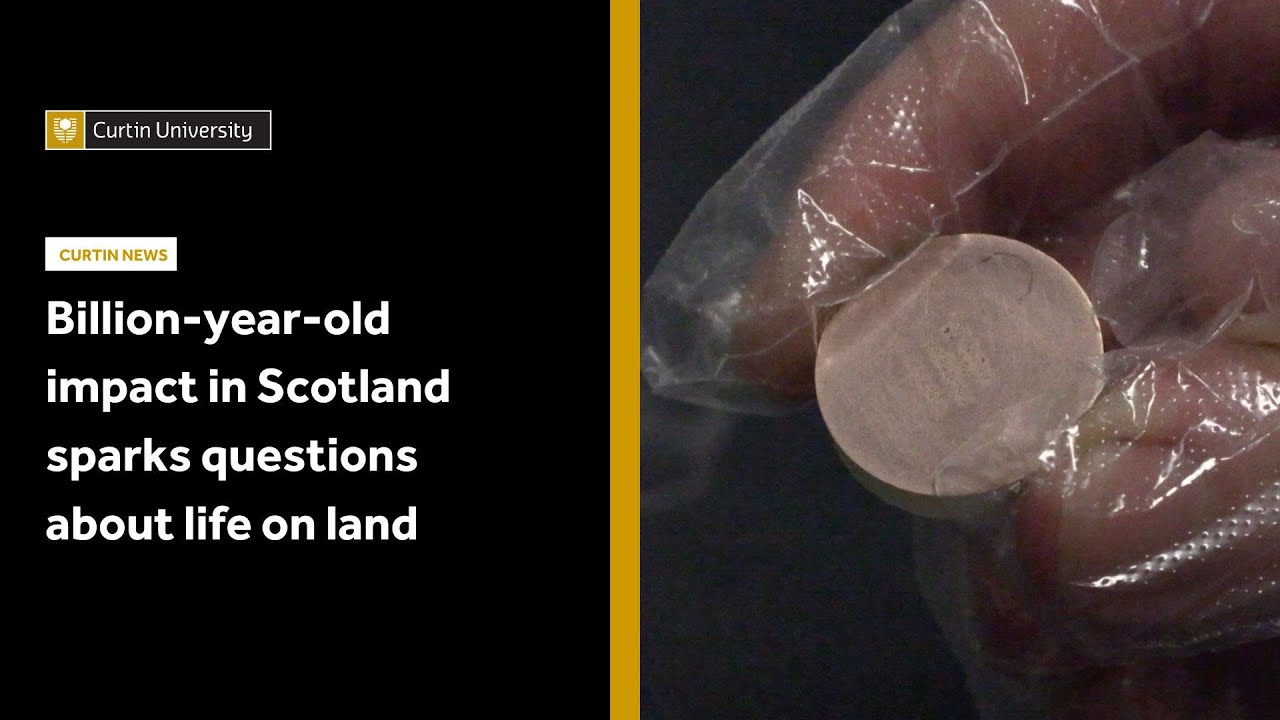
Billion-year-old impact in Scotland sparks questions about life on land - YouTube
"The decay of uranium to lead is like a time clock hence, when the meteorite impacted the rocks, it 'reset' the time clock in the zircon crystals," Prave said. "My colleagues then extracted those zircons from the rock and analysed the ratio of lead to uranium within the crystals..."
The results showed that the impact occurred 200 million years later than researchers thought. The new estimate helps researchers better understand Scotland's ancient geology and early freshwater life, but there's still a lot they don't know about the impact, including the size of the meteorite. To estimate that, researchers would need access to the impact crater, but its location is unknown.
Prave noted that the environment of Stac Fada returned to normal after the impact, and sediment then slowly buried the impact rocks and associated ancient land surface over the next tens of millions of years. These sediments are now the Torridonian mountains. The crater could be beneath them or under the nearby sea, Prave said. Either way, it likely won't be found anytime soon.
"Basically, we'll have to wait another few tens of millions of years for the Torridonian mountains to be eroded away to see if we can find the impact beneath those or, more likely, the impact occurred in what became (about 950 million years later) the north Atlantic Ocean and hence its location will forever remain unknown," Prave said.
Patrick Pester is the trending news writer at Live Science. His work has appeared on other science websites, such as BBC Science Focus and Scientific American. Patrick retrained as a journalist after spending his early career working in zoos and wildlife conservation. He was awarded the Master's Excellence Scholarship to study at Cardiff University where he completed a master's degree in international journalism. He also has a second master's degree in biodiversity, evolution and conservation in action from Middlesex University London. When he isn't writing news, Patrick investigates the sale of human remains.
You must confirm your public display name before commenting
Please logout and then login again, you will then be prompted to enter your display name.