















Uranium: Facts about the radioactive element that powers nuclear reactors and bombs
Uranium is a naturally radioactive element. It powers nuclear reactors and atomic bombs.


Uranium is a radioactive metal central to one of the most devastating acts of war in history. On Aug. 6, 1945, a 10-foot-long (3 meters) bomb fell from the sky over the Japanese city of Hiroshima. Less than a minute later, everything within a mile of the bomb's detonation was obliterated. A massive firestorm rapidly destroyed miles more, killing tens of thousands of people.
This was the first-ever use of an atomic bomb in warfare, and it wouldn't have been possible without uranium. This radioactive metal is unique in that one of its isotopes, uranium-235, is the only naturally occurring isotope capable of sustaining a nuclear fission reaction. (An isotope is a version of the element with a differing number of neutrons in its nucleus.)
To understand uranium, it's important to understand radioactivity. Uranium is naturally radioactive: Its nucleus is unstable, so the element is in a constant state of decay, seeking a more stable arrangement. In fact, uranium was the element that made the discovery of radioactivity possible. In 1897, French physicist Henri Becquerel left some uranium salts on a photographic plate as part of some research on how light influenced these salts. To his surprise, the plate fogged up, indicating some sort of emissions from the uranium salts. Becquerel shared a Nobel Prize with Marie and Pierre Curie in 1903 for the discovery.
What are the properties of uranium?
According to the Jefferson National Linear Accelerator Laboratory, the properties of uranium are:
- Atomic number (number of protons in the nucleus): 92
- Atomic symbol (on the Periodic Table of Elements): U
- Atomic weight (average mass of the atom): 238.02891
- Density: 18.95 grams per cubic centimeter
- Phase at room temperature: Solid
- Melting point: 2,075 degrees Fahrenheit (1,135 degrees Celsius)
- Boiling point: 7,468 F (4,131 C)
- Number of isotopes (atoms of the same element with a different number of neutrons): 16, 3 naturally occurring
- Most common isotopes: U-234 (0.0054% natural abundance), U-235 (0.7204% natural abundance), U-238 (99.2742% natural abundance)
History of uranium
Martin Heinrich Klaproth, a German chemist, discovered uranium in 1789, although it had been known about since at least A.D. 79, when uranium oxide was being used as a coloring agent for ceramic glazes and in glass, according to Chemicool. Klaproth discovered the element in the mineral pitchblende, which at the time was thought to be a zinc and iron ore. The mineral was dissolved in nitric acid, and then potash (potassium salts) was added to the remaining yellow precipitate. Klaproth concluded that he had discovered a new element when the reaction between the potash and precipitate didn't follow any reactions of known elements. His discovery turned out to be uranium oxide and not pure uranium as he had originally believed.

Art deco molded green uranium glass lit by UV light on a table. The uranium glows green with fluorescence. In normal light the glass has a green tint, but does not glow.
According to the Los Alamos National Laboratory, Klaproth named the new element after the recently discovered planet Uranus, which was named for the Greek god of the sky. Eugène-Melchior Péligot, a French chemist, isolated pure uranium in 1841 by heating uranium tetrachloride with potassium.
Uranium was found to be radioactive in 1896 by Antoine H. Becquerel, a French physicist. Becquerel had left a sample of uranium on top of an unexposed photographic plate, which became cloudy. He concluded it was giving off invisible rays, according to the Royal Society of Chemistry. This was the first instance that radioactivity had been studied and opened up a new field of science. Marie Curie, a Polish scientist, coined the term radioactivity shortly after Becquerel's discovery, and with Pierre Curie, a French scientist, continued the research to discover other radioactive elements, such as polonium and radium, and their properties.
Get the world’s most fascinating discoveries delivered straight to your inbox.
Power and war
The universe's uranium formed 6.6 billion years ago in supernovae, according to the World Nuclear Association. It is all over the planet, and makes up about 2 to 4 parts per million of most rocks. It is 48th among the most abundant elements found in natural crustal rock, according to the U.S. Department of Energy, and is 40 times more abundant than silver.
Though uranium is highly associated with radioactivity, its rate of decay is so low that this element is actually not one of the more radioactive ones out there. Uranium-238 has a half-life of an incredible 4.5 billion years. Uranium-235 has a half-life of just over 700 million years. Uranium-234 has a half-life of 245,500 years, but it occurs only indirectly from the decay of U-238. The strangest isotope of uranium is Uranium-214, created in 2021 at the Heavy Ion Research Facility in Lanzhou, China. Uranium-214 can only be made in artificial circumstances – researchers hit tungsten samples with argon lasers – and has a half-life of a mere half a millisecond.
In comparison, the most radioactive element is polonium. It has a half-life of a mere 138 days.
Still, uranium has explosive potential, thanks to its ability to sustain a nuclear chain reaction. U-235 is "fissile," meaning that its nucleus can be split by thermal neutrons — neutrons with the same energy as their ambient surroundings. Here's how it works, according to the World Nuclear Association: The nucleus of a U-235 atom has 143 neutrons. When a free neutron bumps into the atom, it splits the nucleus, throwing off additional neutrons, which can then zing into the nuclei of nearby U-235 atoms, creating a self-sustaining cascade of nuclear fission. The fission events each generate heat. In a nuclear reactor, this heat is used to boil water, creating steam that turns a turbine to generate power, and the reaction is controlled by materials such as cadmium or boron, which can absorb extra neutrons to take them out of the reaction chain.
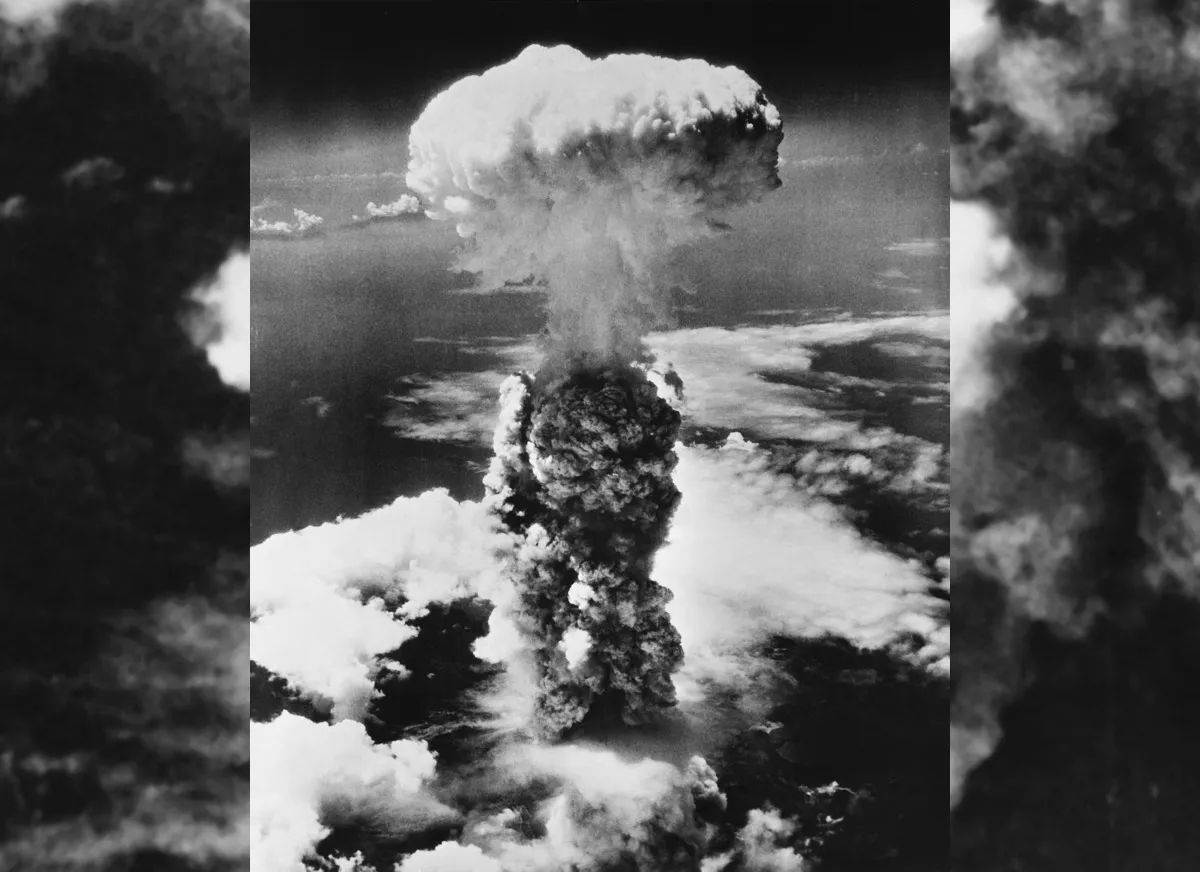
The United States dropped an atomic bomb on Hiroshima, Japan, on Aug. 6, 1945.
In a fission bomb like the one that destroyed Hiroshima, the reaction goes supercritical. What this means is that the fission occurs at an ever-increasing rate. These supercritical reactions release massive amounts of energy: The blast that destroyed Hiroshima had the power of an estimated 15 kilotons of TNT, all created with less than a kilogram (2.2 pounds) of uranium undergoing fission.
To make uranium fission more efficient, nuclear engineers enrich it. Natural uranium is only about 0.7% U-235, the fissile isotope. The rest is U-238. To increase the proportion of U-235, engineers either gasify the uranium to separate out the isotopes or use centrifuges. According to the World Nuclear Association, most enriched uranium for nuclear power plants is made up of between 3% and 5% U-235.
On the other end of the scale is depleted uranium, which is used for tank armor and to make bullets. Depleted uranium is what's left over after enriched uranium is spent at a power plant. It's about 40% less radioactive than natural uranium, according to the U.S. Department of Veterans Affairs. This depleted uranium is only dangerous if it is inhaled, ingested or enters the body in a shooting or explosion.
Facts about uranium
- Only 1.38% of the uranium in the "Little Boy" bomb that destroyed Hiroshima underwent fission, according to the Atomic Heritage Foundation. The bomb contained about 140 pounds (64 kg) of uranium total.
- The "Little Boy" bomb detonated 1,670 feet (509 meters) above Hiroshima and left only the frames of a few reinforced concrete buildings standing in the mile radius around Ground Zero, according to a 1980 Defense Nuclear Agency report. Firestorms destroyed everything within a 4.4-mile radius (7 kilometers) of the blast.
- The half-life of uranium-238 is 4.5 billion years. It decays into radium-226, which in turn decays into radon-222. Radon-222 becomes polonium-210, which finally decays into a stable nuclide, lead.
- Marie Curie, who worked with uranium to discover several even more radioactive elements (polonium and radium), likely succumbed to the radiation exposure involved in her work. She died in 1934 of aplastic anemia, a red blood cell deficiency probably caused by radiation damage to her bone marrow.
- Pure uranium is a silvery metal that quickly oxidizes in air.
- Uranium is sometimes used to color glass, which glows greenish-yellow under black light — but not because of radioactivity (the glass is only the tiniest bit radioactive). According to Collectors Weekly, the fluorescence is due to the UV light exciting the uranyl compound in the glass, causing it to give off photons as it settles back down.
- Yellowcake is solid uranium oxide. This is the form in which uranium is commonly sold before it is enriched.
- Uranium is mined in 20 countries, with over half coming from Canada, Kazakhstan, Australia, Niger, Russia and Namibia, according to the World Nuclear Association.
- According to Lenntech, all humans and animals are naturally exposed to minute amounts of uranium from food, water, soil and air. For the most part, the general population can safely ignore the amounts that are ingested, except if they live near hazardous waste sites, mines, or if crops are grown in contaminated soil or watered with contaminated water.
Current research on uranium
Given its importance in nuclear fuel, researchers are keenly interested in how uranium functions — particularly during a meltdown. Meltdowns occur when the cooling systems around a reactor fail and the heat generated by the fission reactions in the reactor core melts the fuel. This happened during the nuclear disaster at the Chernobyl nuclear power plant, resulting in a radioactive blob dubbed "the Elephant's foot."
Understanding how nuclear fuels act when they melt is crucial for nuclear engineers building containment vessels, said John Parise, a chemist and mineralogist at Stony Brook University and Brookhaven National Laboratory.

At Chernobyl, this so-called "elephant's foot" is a solid mass of melted nuclear fuel mixed with concrete, sand and core sealing material that the fuel had melted through. The blob is located in a basement area under the original location of the plant's core.
In November 2014, Parise and colleagues from Argonne National Lab and other institutions published a paper in the journal Science that elucidated the inner workings of melted uranium dioxide, a major component of nuclear fuel, for the first time. Uranium dioxide doesn't melt until temperatures top 5,432 F (3,000 C), so it's hard to measure what happens when the material goes liquid, Parise told Live Science — there's just no container tough enough.
"The solution to that is we heat a ball of uranium dioxide from the top with a carbon dioxide laser, and this ball is levitated on a gas stream," Parise said. "You have this ball of material levitating on the gas stream, so you don't need a container."
The researchers then beam X-rays through the uranium dioxide bubble and measure the scattering of those x-rays with a detector. The angle of scatter reveals the structure of the atoms inside the uranium dioxide.
The researchers found that in solid uranium dioxide, the atoms are arranged like a series of cubes alternating with empty space in a gridlike pattern, with eight atoms of oxygen surrounding each uranium atom. As the material approaches its melting point, the oxygens go "crazy," Argonne National Laboratory researcher Lawrie Skinner said in a video about the results. The oxygen atoms begin to move around, filling empty space and bopping from one uranium atom to another.
Finally, when the material melts, the structure resembles a Salvador Dali painting as the cubes turn into disordered polyhedrals. At this point, Parise said, the number of oxygen atoms around each uranium atom — known as the coordination number — drops from eight to about seven (some uranium atoms have six oxygens surrounding them, and some have seven, making for an average of 6.7 oxygens per uranium).
Knowing this number makes it possible to model how uranium dioxide will act at these high temperatures, Parise said. The next step is to add more complexity. Nuclear cores aren't just uranium dioxide, he said. They also include materials like zirconium and whatever is used to shield the inside of the reactor. The research team now plans to add these materials to see how the material's reaction changes.
"You need to know how the pure uranium dioxide liquid behaves so that when you start looking at the effects of little additives, you can see what are the differences?" Parise said.
Related content
The vast majority of uranium is used for power, usually in controlled nuclear reactions. The leftover waste, depleted uranium, can be recycled to harness other types of power, such as the power of the sun. A 2017 patent by Igor Usov and Milan Sykora, scientists at Los Alamos National Laboratory, discusses using the depleted uranium from nuclear reactions to create solar cells. The authors wrote that depleted uranium oxide was abundant and cheap as leftovers of the nuclear fuel enrichment process and could be optimized for use as solar cells by controlling the thickness, uranium/oxygen ratio, crystallinity, and doping.
Uranium dioxide is an excellent semiconductor, according to a 2000 paper by Thomas Meek at Oak Ridge National Laboratory, and could potentially be an improvement for certain uses over the traditional uses of silicon, germanium or gallium arsenide. At room temperature, uranium oxide would give the highest possible solar-cell efficiency when compared with the traditional elements and compounds for the same use.
Additional reporting by Rachel Ross, Live Science Contributor.
Additional resources
For more on the basics of uranium and how the Department of Energy handles this element, see Argonne National Laboratory's page of uranium quick facts. The World Nuclear Association maintains a factsheet on uranium as well as statistics on where uranium is mined, produced and stockpiled. Images of uranium can be found at images-of-elements.com. For an in-depth exploration about how one radioactive rock changed the course of history, read Tom Zoellner's "Uranium: War, Energy and the Rock that Shaped the World" (Penguin Books, 2010).
Bibliography
Skinner, L.B., et al. "Molten uranium dioxide structure and dynamics," Science, Vol. 21, No. 346, Nov., 21, 2014. DOI: 10.1126/science.1259709
"Backgrounder on the Chernobyl Nuclear Power Plant Accident." U.S. Nuclear Regulatory Commission. Updated March 1, 2022.
"Uranium Mining Overview." World Nuclear Association. Updated September 2021.

Stephanie Pappas is a contributing writer for Live Science, covering topics ranging from geoscience to archaeology to the human brain and behavior. She was previously a senior writer for Live Science but is now a freelancer based in Denver, Colorado, and regularly contributes to Scientific American and The Monitor, the monthly magazine of the American Psychological Association. Stephanie received a bachelor's degree in psychology from the University of South Carolina and a graduate certificate in science communication from the University of California, Santa Cruz.
- Rachel Ross Live Science Contributor