















Columbia, Rodinia and Pangaea: A history of Earth's supercontinents
Scientists have identified three definitive supercontinents in Earth's history and predict the landmasses we live on today will come together again in the future.


The continents we live on today are moving, and over hundreds of millions of years they get pulled apart and smashed together again. Occasionally, this tectonic plate-fueled process brings most of the world's landmasses together to form a massive supercontinent.
the lost history of supercontinents

There's no strict definition for a supercontinent, but researchers like Joseph Meert, a professor of geosciences at the University of Florida, say they should include around 75% of the available landmass.
Scientists are still debating how many supercontinents have existed in Earth's history, but they're sure of at least three. Here are all of the known supercontinents that have existed and a few honorable mentions. Live Science spoke with Meert, to check the dates of the supercontinents on this list, but keep in mind they're still only estimates.
Related: The tantalizing link between diamond-spewing eruptions and the destruction of supercontinents
Columbia/Nuna

An illustration of what Nuna looked like 1.45 billion years ago.
The first supercontinent, called Columbia, or Nuna, existed from around 1.7 billion years ago to 1.45 billion years ago in the Precambrian period (4.6 billion to 541 million years ago). It is named "Columbia" because scientists posited that the landmass connected what is now eastern India with the Columbia basalts region in what is now the U.S., according to a 2017 study in the journal Gondwana Research.
While Earth is much older than the Columbia supercontinent, scientists aren't sure supercontinents formed before 2 billion years ago, and it's possible only smaller and separated landmasses existed back then, according to a 2021 review of the supercontinent cycle published in the journal Nature Reviews Earth & Environment.
Read more: Earth's biggest cache of pink diamonds formed in the breakup of the 1st supercontinent 'Nuna'
Get the world’s most fascinating discoveries delivered straight to your inbox.
Rodinia

An illustration of the Rodinia supercontinent.
Rodinia was the second supercontinent to form in the Precambrian period, coming together around a billion years ago and breaking up around 700 million years ago. Researchers don't know exactly how big Rodinia was, but North America was likely the core of the landmass, according to Smithsonian Ocean.
The continents we know today were unrecognizable when Rodinia existed. For example, the Americas were merged while Asia and Africa were broken up into pieces. Rodinia was still around when the first animals evolved around 800 million years ago.
Read more: Lava outburst 3 times the size of Texas may have triggered Snowball Earth 717 million years ago
Pangaea

An illustration of what the supercontinent Pangaea would have looked like when today's continents were smushed together.
The most recent supercontinent, Pangaea, formed around 320 million years ago and broke up around 175 million years ago. Geophysicist and meteorologist Alfred Wegener first proposed the existence of Pangaea and the concept of supercontinents in 1912 after noticing that the shorelines of Africa and South America seemingly fit together like giant jigsaw puzzle pieces. His theory that continents moved, named continental drift, was rejected for decades until scientists confirmed some of his ideas with the modern theory of plate tectonics, which explains Earth's crust is split into plates that move across the mantle.
The name "Pangaea'' comes from Ancient Greek words meaning "all Earth." However, Pangaea never included all of Earth's landmasses. For example, modern-day north and south China were independent islands separated to the east of Pangaea throughout the Carboniferous period (359 million to 299 million years ago).
Pangaea split when the Central Atlantic Ocean opened, and Gondwana (what are now Africa, South America, India and most of Antarctica and Australia) separated from Laurasia (modern-day Eurasia and North America). The two landmasses then further broke apart and eventually formed the seven continents we live on today.
Read more: Mangled 'dragon' fossils were cooked by ancient continents colliding to form Pangaea
Honorable mentions
Gondwana and Pannotia

An illustration of Gondwana.
Gondwana formed around 530 million years ago and was the largest landmass on Earth for more than 200 million years, before becoming part of Pangaea, but the jury is still out on whether it was a supercontinent. Gondwana brought together around 64% of today's landmass, according to a 2013 study published in the journal Gondwana Research. Pannotia is another debated supercontinent, which may have briefly existed around 560 million years ago, combining parts of Gondwana, North America and Northern Europe.
Amasia and Pangaea Ultima
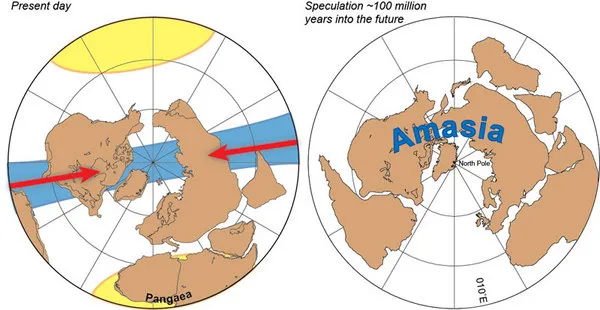
An illustration of how the next supercontinent, Amasia, will form.
Scientists believe that supercontinents form on a cycle every several hundred million years or so, and we should expect another one in around 250 million years. Researchers have proposed a few different scenarios for how the next supercontinent will form. One of these hypothesizes that the Americas and Asia drift northward and merge as the Arctic Ocean closes, meaning many of Earth's future inhabitants could live on "Amasia." Another option is Pangaea reforms, with the Atlantic Ocean closing and the Americas, Europe and Africa coming together as "Pangaea Ultima."
Massive supercontinent will form hundreds of millions of years from now

Patrick Pester is the trending news writer at Live Science. His work has appeared on other science websites, such as BBC Science Focus and Scientific American. Patrick retrained as a journalist after spending his early career working in zoos and wildlife conservation. He was awarded the Master's Excellence Scholarship to study at Cardiff University where he completed a master's degree in international journalism. He also has a second master's degree in biodiversity, evolution and conservation in action from Middlesex University London. When he isn't writing news, Patrick investigates the sale of human remains.