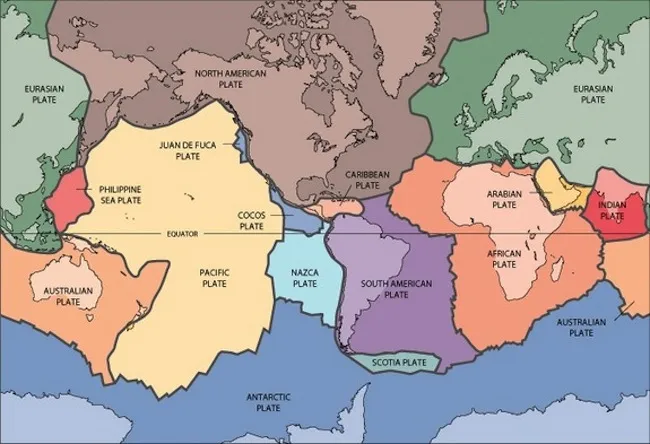
Continental drift was a revolutionary theory explaining that continents shift position on Earth's surface. The theory was proposed by geophysicist and meteorologist Alfred Wegener in 1912, but was rejected by mainstream science at the time. Scientists confirmed some of Wegener's ideas decades later, which are now part of the widely accepted theory of plate tectonics.
Wegener's continental drift theory introduced the idea of moving continents to geoscience. He proposed that Earth must have once been a single supercontinent before breaking up to form several different continents. This explained how similar rock formations and plant and animal fossils could exist on separated continents. Modern science recognizes this ancient supercontinent called Pangaea did exist before breaking up about 200 million years ago, as Wegener theorized.
Why did scientists reject Wegener's continental drift theory?
Geologists roundly denounced Wegener's continental drift theory after he published the details in a 1915 book called "The Origin of Continents and Oceans." Part of the opposition was because Wegener didn't have a good model to explain how the continents moved, something scientists later explained under the umbrella of plate tectonics — the theory that Earth's crust is fractured into plates that move over a rocky inner layer called the mantle.
"There's an irony that the key objection to continent drift was that there is no mechanism, and plate tectonics was accepted without a mechanism," to move the continents, Henry Frankel (1944–2019), an emeritus professor at the University of Missouri-Kansas City and author of the four volume "The Continental Drift Controversy" (Cambridge University Press, 2012) previously told Live Science.
Though most of Wegener's observations about fossils and rocks were correct, he was outlandishly wrong on a couple of key points. For instance, Wegener thought the continents might have plowed through the ocean crust like icebreakers smashing through ice.
Evolving theories
When Wegener proposed continental drift, many geologists were contractionists. They thought Earth's incredible mountains were created because our planet had been cooling and shrinking since its formation, Frankel said. And to account for the identical fossils discovered on continents such as South America and Africa, scientists invoked ancient land bridges, now vanished beneath the sea.
Sign up for the Live Science daily newsletter now
Get the world’s most fascinating discoveries delivered straight to your inbox.
Researchers argued over the land bridges right up until the plate tectonics theory was developed from the 1950s to the 1970s, Frankel said. For instance, as geophysicists began to realize that continental rocks were too light to sink down to the ocean floor, prominent paleontologists instead wrongly suggested that the similarities between fossils had been overestimated, Frankel said.
Plate tectonics is like a modern update to continental drift. In the 1960s, scientists discovered plate edges through magnetic surveys of the ocean floor and through the seismic listening networks built to monitor nuclear testing, according to Encyclopedia Britannica. Alternating patterns of magnetic anomalies on the ocean floor indicated seafloor spreading, where new plate material is born. Magnetic minerals aligned in ancient rocks on continents also showed that the continents have shifted relative to one another.
A map of the continents inspired Wegener's quest to explain Earth's geologic history. He was intrigued by the interlocking fit of Africa's and South America's shorelines. Wegener then assembled an impressive amount of continental drift evidence to show that Earth's continents were once connected in a single supercontinent.
Wegener knew that fossil plants and animals such as mesosaurs, a freshwater reptile found only in South America and Africa during the Permian period, could be found on many continents. He also matched up rock formations on either side of the Atlantic Ocean like puzzle pieces. For example, the Appalachian Mountains (United States) and Caledonian Mountains (Scotland) fit together, as do the Karoo strata in South Africa and Santa Catarina rocks in Brazil.
In fact, plates moving together created the highest mountains in the world, the Himalayans, and the mountains are still growing due to the plates pushing together, even now, according to National Geographic. Despite his incredible continental drift evidence, Wegener never lived to see his theory gain wider acceptance. He died in 1930 at age 50 just two days after his birthday while on a scientific expedition in Greenland, according to the University of Berkeley.
Additional resources
Learn more about the history of continental drift and plate tectonics from the U.S. Geological Survey.
Watch this short video on YouTube about plate tectonics and continental drift, from National Geographic.
This article was updated on Dec. 14, 2021, by Live Science Staff Writer Patrick Pester. Additional reporting by Alina Bradford, Live Science contributor.
Becky Oskin covers Earth science, climate change and space, as well as general science topics. Becky was a science reporter at Live Science and The Pasadena Star-News; she has freelanced for New Scientist and the American Institute of Physics. She earned a master's degree in geology from Caltech, a bachelor's degree from Washington State University, and a graduate certificate in science writing from the University of California, Santa Cruz.