It's quick and easy to access Live Science Plus, simply enter your email below. We'll send you a confirmation and sign you up for our daily newsletter, keeping you up to date with the latest science news.
Get the world’s most fascinating discoveries delivered straight to your inbox.
You are now subscribed
Your newsletter sign-up was successful
Want to add more newsletters?
Join the club
Get full access to premium articles, exclusive features and a growing list of member rewards.
An account already exists for this email address, please log in.
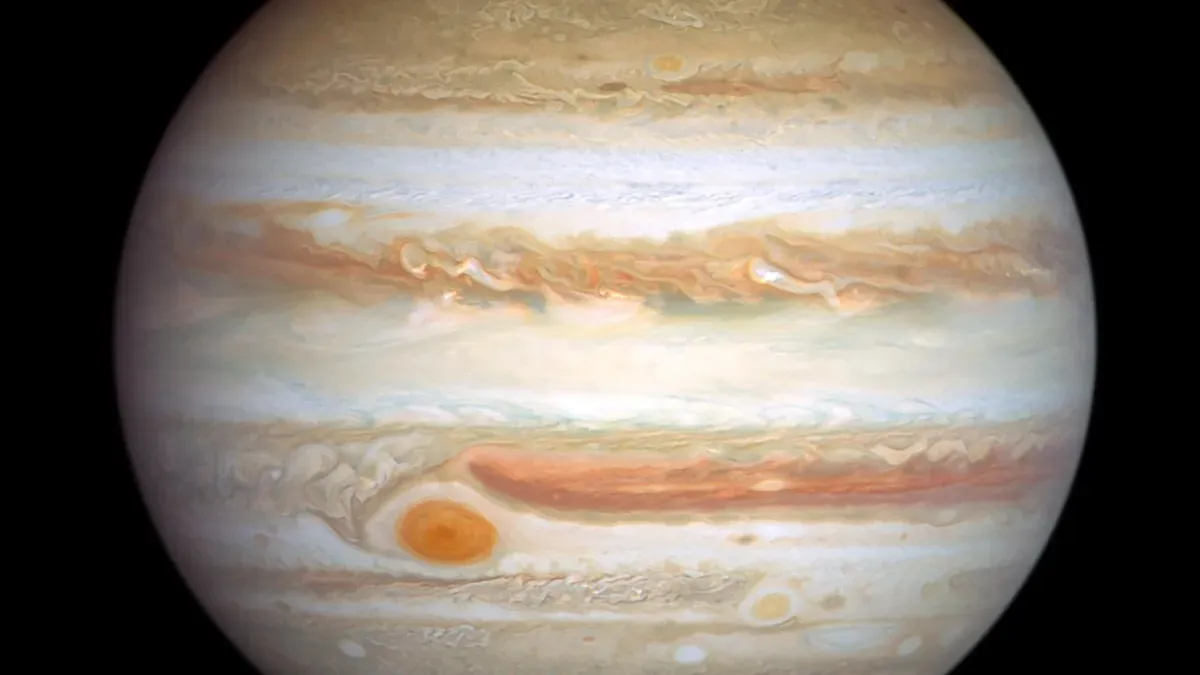
Jupiter's Great Red Spot is being squeezed, Hubble Telescope finds — and nobody knows why
The Hubble Space Telescope has seen Jupiter's Great Red Spot oscillating in width as it drifts around the planet. Could this be related to its overall shrinking?
The venerable Hubble Space Telescope has watched Jupiter's Great Red Spot (GRS) oscillating, as though it were being squeezed in and out roughly every 90 days.
Why this huge anticyclone, which has been shrinking over the decades and currently measures about 9,165 miles (14,750 kilometers) across (although astrophotographer Damian Peach has reportedly measured it to be just 7,770 miles, or 12,500 km, wide), is behaving in such fashion is a mystery.
"With Hubble's high resolution, we can say that the GRS is definitely squeezing in and out at the same time as it moves faster and slower," said Amy Simon, of NASA's Goddard Space Flight Center in Maryland, in a statement. "This was very unexpected, and at present there are no hydrodynamic explanations."
Astronomers led by Simon used Hubble to observe the Great Red Spot for 88.5 days between December 2023 and March 2024. A timelapse of images taken during that period shows that the GRS periodically expands and shrinks along its semi-major axis (the widest part of an ellipse).
"While we know its motion varies slightly in longitude, we didn't expect to see the size oscillate as well," said Simon.
Located 22 degrees south of Jupiter's equator, positioned on the edge of the Jovian atmosphere's South Equatorial Belt, the GRS is buffeted from above and below by mighty jet streams that whip around the giant planet at 266 mph 428 kph. The jet streams stop the huge vortex from wandering into other latitudes, although it is seen to drift westward with respect to the rest of the atmosphere. This drift isn't constant, but it has been measured to accelerate and decelerate over an approximately 90-day oscillation.
Sign up for the Live Science daily newsletter now
Get the world’s most fascinating discoveries delivered straight to your inbox.
"As it accelerates and decelerates, the GRS is pushing against the windy jet streams to the north and south of it," said Mike Wong of the University of California, Berkeley.
Seemingly connected to this approximately 90-day oscillation in its westward drift is the squeezing of the GRS' shape seen by Hubble.
"It's similar to a sandwich where the slices of bread are forced to bulge out when there's too much filling in the middle," said Wong.
The degree of squeezing seems to be anti-correlated with the rate at which the GRS is drifting. During the periods when the GRS' drift has decelerated, the width of the vortex and the size of its core are at their greatest. The core also shines brighter in ultraviolet light when it is at its largest, indicative of there being less haze absorption in the atmosphere above it. When the drift accelerates, the width of the GRS and the size of its core contracts. This may be the result of the GRS interacting with the surrounding atmosphere when its drift rate speeds up.
So far, only one oscillatory period has been observed in full by Hubble. Simon leads the Outer Planet Atmospheres Legacy (OPAL) program, which uses Hubble to image each of the four giant planets in the outer solar system — Jupiter, Saturn, Uranus and Neptune — at least once per year. However, Hubble's studies of the GRS were a separate project in addition to that.
A group of top amateur astronomers, such as Damian Peach, also routinely image Jupiter in high resolution, and their data is so good that Simon and the OPAL team often work with them. It's possible that this squeezing of the spot is evident in amateur images, although Simon thinks it might be slightly too subtle for amateur data to have captured it with any reliability, with the width of the spot varying by just 0.3 degrees in longitude over a two-week period. Nevertheless, now that we know it is occurring, amateurs may be able to finesse their image capture in order to spot it.
Eight snapshots of the Great Red Spot taken by the Hubble Space Telescope between Dec. 10, 2023 and March 8, 2024. Look carefully and you can see its width changing.
Simon also wants to take another look at the GRS with the James Webb Space Telescope, which previously imaged the Jovian storm in near-infrared light earlier this year and found atmospheric waves above the GRS. By being able to probe deeper into the GRS at longer mid-infrared wavelengths, Simon hopes to see whether wind velocities within the storm are also changing in time with the oscillations.
The overall shrinking of the GRS, now coupled with the oscillatory squeezing, mean that the storm is undergoing some interesting changes. Where will it end?
"Right now, it's over-filling its latitude band relative to the wind field," said Simon. "Once it shrinks inside that band, the winds will really be holding it in place." When this happens, it may stabilize in size, but for now that remains speculation until more data can be gathered.

 Live Science Plus