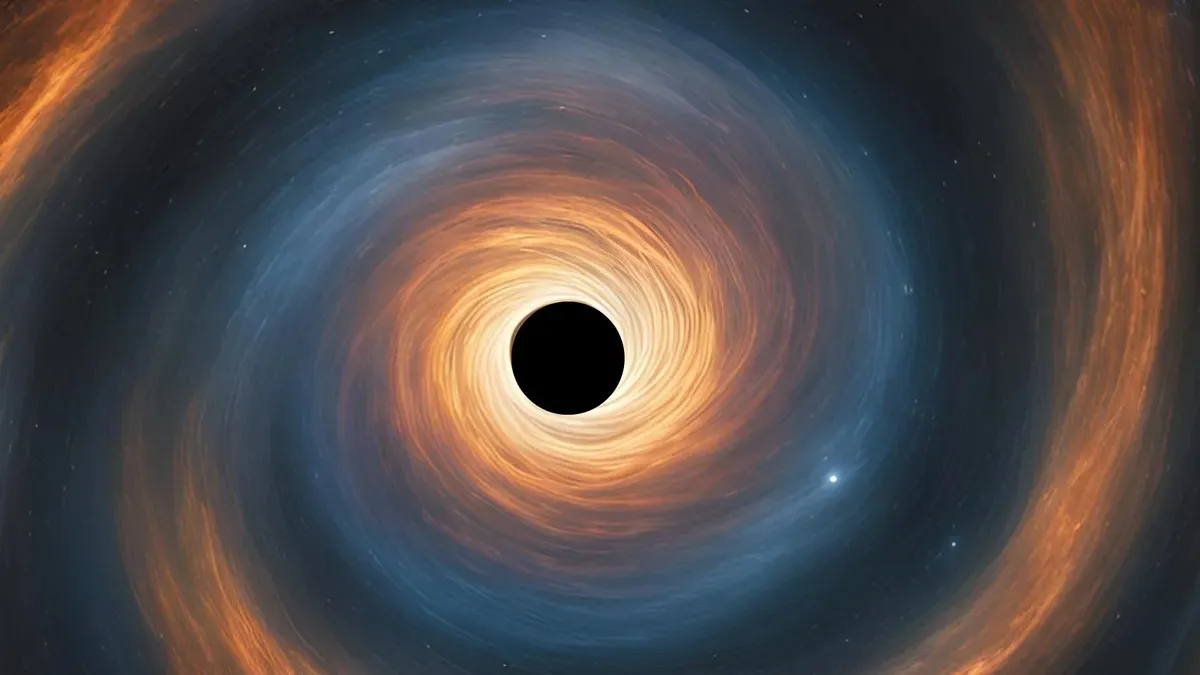
Scientists have discovered that some supermassive black holes rotate much more rapidly than expected. The discovery came as the result of a new form of "black hole archeology" that links black hole spins to the gas and dust they have consumed to grow over 7 billion years of cosmic history.
The findings, courtesy of the Sloan Digital Sky Survey (SDSS) suggest a few things. For one, the early universe may have been more orderly than previously suspected. And secondly, the growth of supermassive black holes through the merger chain of progressively larger and larger black holes (triggered as galaxies collide and merge) may be supplemented by the objects voraciously feasting on surrounding gas and dust.
"We have studied the giant black holes found at the centers of galaxies, from today to as far back as seven billion years ago," team member Logan Fries, from the University of Connecticut, said in a statement. "Unexpectedly, we found that they were spinning too fast to have been formed by galaxy mergers alone.
"They must have formed in large part from material falling in, growing the black hole smoothly and speeding up its rotation."
Measuring balck hole spin isn't easy
Despite being cosmic monsters that shape the entire galaxies around them, supermassive black holes with masses millions or billions of times that of the sun (and their more diminutive stellar-mass counterparts) are overall quite simple.
They can be individually defined by just three characteristics: mass, spin, and, less importantly, electric charge. As physicist John Wheeler wittily explained this lack of distinguishing features: "black holes have no hair."
"Black holes seem so exotic, but you can describe them completely with just two numbers: mass and spin rate," Fries explained. "The problem is that mass is hard to measure, and spin is even harder."
(Left) Artist’s impressions of a black hole and its accretion disk with different spins. (Right) the corresponding multiwavelength spectrum that would be observed in each one.
(Image credit: Left: NASA/JPL-CaltechRight: Logan Fries and the SDSS collaboration)
The speed at which a black hole spins is difficult to distinguish from the speed at which the surrounding flattened cloud of gas and dust — the accretion disk — rotates.
"The challenge lies in separating the spin of the black hole from the spin of the accretion disk surrounding it," Jonathan Trump, team member and a University of Connecticut researcher, said in the statement. "The key is to look at the innermost region, where gas is falling into the black hole’s event horizon.
"A spinning black hole drags that innermost material along for the ride, which leads to an observable difference when we look at the details in our measurements."
Sign up for the Live Science daily newsletter now
Get the world’s most fascinating discoveries delivered straight to your inbox.
A cosmic fossil record
The team tackled the challenging task of determining the spin of black holes using the SDSS’s Reverberation Mapping project. This project has been making extremely precise mass measurements for hundreds of black holes while also conducting detailed observations of the structures of the voids' accretion disks.
This data comes in the form of spectra, or light emitted across the electromagnetic spectrum. With this in hand, scientists can begin to measure the rate at which a central black hole spins.
A subtle shift in the wavelength of light reveals a great deal about the rotation of the black hole. When material falls into the black hole, it also brings with it angular momentum — that rotation reveals details of a black hole's past diet.
“I call this approach 'black hole archaeology' because we're trying to understand how the mass of a black hole has grown over time,” Fries said. "By looking at the spin of the black hole, you're essentially looking at its fossil record."
An illustration of a supermassive black hole in the early cosmos.
(Image credit: Robert Lea (created with Canva))
This "fossil record" can be decoded when scientists compare the observed rate of spin to what is predicted.
Currently, the favored model suggests supermassive black holes grow by mergers triggered when their home galaxies collide and merge. Because these individual galaxies have their own rates of rotation and random orientation, when they merge, these rotations could cancel out. Or, at least, they could combine together. Both outcomes should be equally as likely.
Given this, scientists expect that black holes should spin very slowly. That isn't what this team discovered, however.
A graph of observed black hole spin over the history of the universe, from past to present running left to right. The thick colored dots represent the observed spins of black holes – blue shows rotation in the same direction as the accretion disk, gray shows little or no rotation, and red shows rotation in the opposite direction. The green oval shows what would be expected from black hole growth by smooth accretion; the pink oval shows what would be expected from mergers.
(Image credit: Left: Logan Fries and the SDSS collaborationTop right: NASA, ESA, and The Hubble Heritage Team (STScI)Bottom right: NASA/CXC/M.Weiss)
Not only did this research reveal that many black holes are spinning more rapidly than expected, but it also showed that black holes in more distant galaxies spin even more quickly than those in the local universe.
This suggests the spin of black holes could build gradually over time. One way that could happen is through the black hole's accumulation of angular momentum by its gradual accretion of dust and gas.
Researchers could further test this idea and verify these results using observations from the James Webb Space Telescope (JWST), which, in its three years of operation, has been finding supermassive black holes from earlier and earlier epochs of the universe.
"Black holes really do sit at the frontier of human understanding," Juna Kollmeier, the Director of SDSS-V, the current phase of the SDSS, said in the statement. "We undertake massive surveys like SDSS to build an empirical astrophysical picture of their fundamental properties against which our theoretical models can be put to the test."
Fries presented the team's findings on Jan. 14 at the 245th meeting of the American Astronomical Society (AAS) in National Harbor, Maryland.
Robert Lea is a science journalist in the U.K. who specializes in science, space, physics, astronomy, astrophysics, cosmology, quantum mechanics and technology. Rob's articles have been published in Physics World, New Scientist, Astronomy Magazine, All About Space and ZME Science. He also writes about science communication for Elsevier and the European Journal of Physics. Rob holds a bachelor of science degree in physics and astronomy from the U.K.’s Open University
You must confirm your public display name before commenting
Please logout and then login again, you will then be prompted to enter your display name.