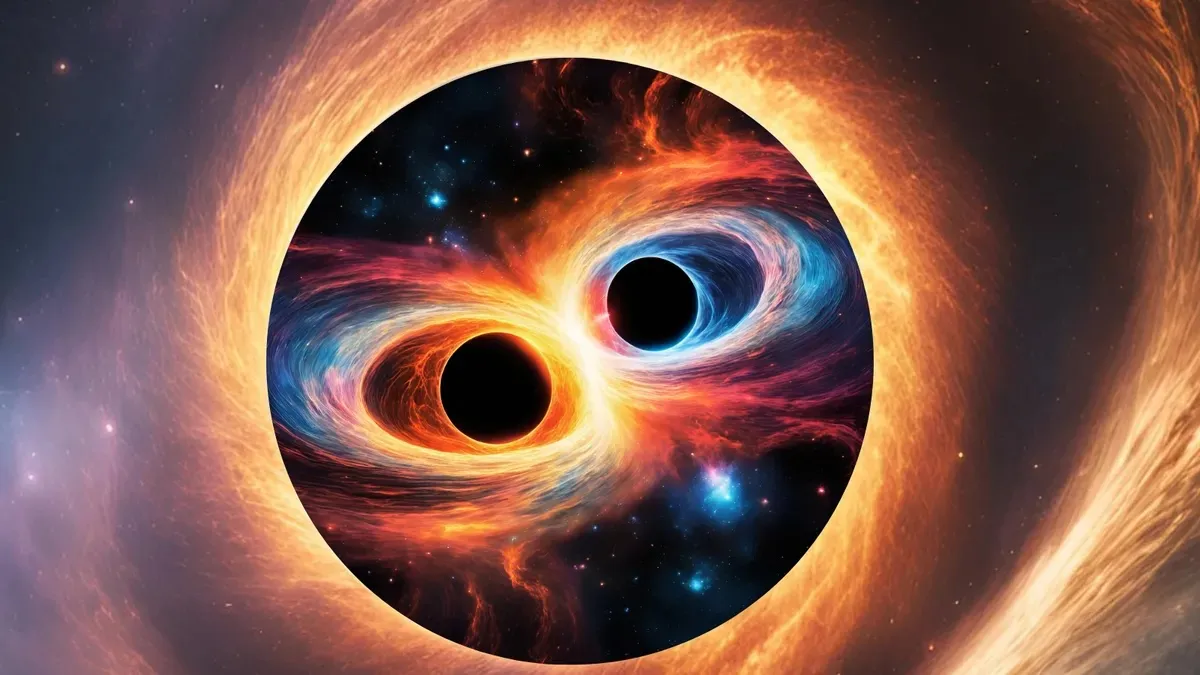
You can tell a lot about a human being's ancestry from their general characteristics. A child can have their father's eyes, their mother's smile, or maybe even their grandfather's male pattern baldness (thanks, grandpa).
However, black holes have few defining characteristics — as theoretical physicist John Wheeler put it, "black holes have no hair" (much like your humble author). Of course, though, testing a child's parentage based on physical features is far too subjective — that's typically where DNA tests come in. Such tests can offer a far more scientific way of checking a person's lineage, and new research suggests an analogous ancestry test for black holes.
Rather than relying on a cheek swab or a little blood, however, these cosmic DNA tests utilize tiny ripples in the fabric of spacetime called gravitational waves, first proposed by Albert Einstein 110 years ago.
A team of scientists, led by researchers from the University of Cardiff, has discovered that the ancestry of supermassive black holes that form from a merger chain of progressively larger progenitor black holes could be hidden in their rotations or "spins."
Additionally, the team's method suggests the spin patterns of these black holes could reveal the region of space in which they were born. Even human DNA tests can't tell you what hospital a baby was delivered in!
Gravitational waves, as detected by facilities like the Laser Interferometer Gravitational-Wave Observatory (LIGO) and Virgo Observatory, could be used to "read" this information like the writing on a birth certificate.
"Our study gives us a powerful, data-driven way to identify the origins of a black hole's formation history, showing that the way it spins is a strong indicator of it belonging to a group of high-mass black holes, which form in densely populated star clusters where small black holes repeatedly collide and merge with one another," team member and University of Cambridge researcher Isobel Romero-Shaw said in a statement.
Black hole family trees
Black hole ancestry became a curious question for scientists when they discovered that some black holes are just too massive to have been spawned the usual way: via a dying star.
Stellar-mass black holes with masses between 10 and 100 times that of the sun are born when stars much more massive than the sun run out of fuel needed for nuclear fusion in their cores. Subsequently, these stars collapse under the influence of their own gravity.
Supermassive black holes, however, have masses equivalent to millions or even billions of sun. No single star can collapse to form such a massive black hole, leading to the theory that they form from mergers of smaller black holes.
The first detection of gravitational waves from merging black holes was made by LIGO and Virgo in 2015, 100 years after Einstein predicted them in his theory of gravity, known as general relativity. This and the wealth of mergers "heard" by these facilities since have helped confirm this "growth by merger" theory.
Sign up for the Live Science daily newsletter now
Get the world’s most fascinating discoveries delivered straight to your inbox.
An artist's concept of two black holes circling each other before merging.
(Image credit: NASA)
General relativity predicts that objects with mass cause the fabric of space and time, or spacetime, to "warp." Gravity arises from this warping.
Einstein also predicted that when objects accelerate in spacetime, this causes ripples that radiate outward at the speed of light. However, these so-called gravitational waves are only detectable when the objects involved are truly massive — and black holes fit the bill. The merger of black holes is intrinsically linked to the emission of gravitational waves.
Once black holes are close enough together to form a binary as they whirl around one another, this constant acceleration (acceleration is a change in speed and direction, so circular motion represents perpetual acceleration) sets the fabric of spacetime ringing with gravitational waves.
As these binary systems emit gravitational waves, those ripples in spacetime carry away angular momentum. This causes the binary to tighten. In other words, the black holes move closer together.
This causes the binary black holes to emit gravitational waves faster and faster or at increasing frequencies, meaning they get closer and closer. This continues until the mutual gravity of these black holes takes over and they are forced together, colliding and merging.
This merger creates a daughter black hole that is more massive than its parents' but not quite the total of their masses due to a mass loss in a high-frequency "scream" of gravitational waves.
An illustration of binary black holes ringing spacetime like a bell with gravitational waves.
(Image credit: ESA–C.Carreau)
"As we observe more black hole mergers with gravitational wave detectors like LIGO and Virgo, it becomes ever clearer that black holes exhibit diverse masses and spins, suggesting they may have formed in different ways," team leader Fabio Antonini from Cardiff University’s School of Physics and Astronomy said in the statement. "However, identifying which of these formation scenarios is most common has been challenging."
To unravel this mystery, the team looked at data concerning 69 gravitational wave events detected by LIGO and Virgo.
What they found was that the spin of a black hole changes when that black hole reaches a certain mass. This represents a clear mass threshold at which the spin of black holes constantly changes. The pattern uncovered by the team corresponds with models that suggest black holes grow through repeat collisions in densely packed star clusters.
Using the findings, scientists can now refine computer modeling techniques used to simulate the formation and growth of black holes.
When future gravitational wave signals are detected by facilities like LIGO, Virgo, the proposed underground gravitational wave observatory known as the Einstein Telescope, and the forthcoming space-based gravitational wave detector LISA (Laser Interferometer Space Antenna), such refined models can be used to better interpret these signals.
"Collaborating with other researchers and using advanced statistical methods will help to confirm and expand our findings, especially as we move toward next-generation detectors," team member and University of Chicago researcher Thomas Callister said in the statement. "The Einstein Telescope, for example, could detect even more massive black holes and provide unprecedented insights into their origins."
Robert Lea is a science journalist in the U.K. who specializes in science, space, physics, astronomy, astrophysics, cosmology, quantum mechanics and technology. Rob's articles have been published in Physics World, New Scientist, Astronomy Magazine, All About Space and ZME Science. He also writes about science communication for Elsevier and the European Journal of Physics. Rob holds a bachelor of science degree in physics and astronomy from the U.K.’s Open University
You must confirm your public display name before commenting
Please logout and then login again, you will then be prompted to enter your display name.