













'Earth's civilizations are shaped by what the ocean engine does,' says oceanographer Helen Czerski
In this interview, British oceanographer Helen Czerski explains the systems driving our ocean, compares it to a fancy cocktail, and explains what the next great ocean frontier is.


We are all used to the lush green landscapes and rugged mountainscapes that define the land we live on, but from space, it's clear that we live on a blue planet. Despite its extreme saltiness, unpredictable nature and unprecedented effect on our weather, this incredible expanse of water is vital to all life on Earth.
Helen Czerski, a British oceanographer and broadcaster, has spent her career studying the ocean. In her new book "The Blue Machine: How the Ocean Works" (W. W. Norton & Company, 2023), she explores how the huge mass of water that surrounds our planet created the world we live in today, why some places are abundant with life while others aren't, how civilizations formed around the ocean currents, and why it acts as Earth's battery, powering its weather systems.
In this interview, she spoke to us about what drives this ocean engine, compares it to a fancy cocktail, and explains what the next great ocean frontier is.
Alexander McNamara: In your book you describe the ocean as an engine, but what do you actually mean by that?
Helen Czerski: The definition of an engine is something that turns any heat energy into movement, which is what the ocean does.
There's a warm layer on the top, which can be up to 100 meters [330 feet] thick, and there's the water below which is much colder, and has itself got layers within it.
But although the top and the bottom of the ocean are sort of separated, there are these plug holes near the poles where they're connected, and that connection drives the circulation where water goes down, slithers along the bottom of the ocean for a few hundred years, and then comes back up somewhere else.
Get the world’s most fascinating discoveries delivered straight to your inbox.
That's what the engine is doing on its biggest scale, moving heat from the equator to the poles. This physical engine, with all of these features and all of this anatomy, is what makes things happen, and then animals and humans are influenced by the results. The whole shape of Earth's civilizations are kind of shaped by what the ocean engine does.
AM: For most people, casual observers will look at the ocean and see it's quite flat, maybe if it's a windy day then it's a bit choppy, but by the sounds of it there's a lot more going on underneath.
HC: So there's two things that drive the engine — the fact that the Earth is spinning and the density of water.
We tend to think that because we can stir it with a spoon, water is very easy to mix, but in general it isn't, you have to put energy in and the spoon is just a way of transferring it. The ocean is the same.
Imagine a layered cocktail where if you're careful you can get one [liquid] to sit on another. This works only if you put them on in the right order, because the top one is less dense than the one underneath it, which is less dense than the one underneath that.
[In the ocean], if you have warmer water, which is less dense, it will sit on top. And then if there's cold water underneath it will stay down at the bottom, and they don't mix. They're just like the layers in the cocktail — there's no energy to mix them up and so they just stay there.
So, there is this warm lid on the ocean — it's called the mixed layer because the water sort of mixes around inside itself — but it doesn't mix with what's underneath it, and the reason that matters is that things fall out of the mixed layer. This is quite often bits of life, and bits of life carry nutrients. These are like the atoms you need to make life, right? You need some nitrate, you need some phosphorus, you need some iron — you need these things, and they tend to fall out of the mixed layer.
And the thing is, if they fall out, they can't get back. So, in theory, there shouldn't be any life on Earth because the sunlight is up at the top and you've got this warm lid that the nutrients just fall out of. And then after a while you run out — you've got the separated ocean with the nutrients down at the bottom where there's no sunlight, and the top, where there's no nutrients and everything's just stagnant.
That's why the middle of the big ocean basins, out in the middle of the Pacific, for example, there's not much life, it's because this separation is very strong. Nothing can live.
The only reason there is life in the ocean is because you can break that paradox. This happens near the edges, where you get periods of upwelling, and close to the poles, then the top layer and the bottom layer can be connected. That's why the layering matters, and it's density that is what sets the layers.
Then of course the ocean moves sideways far more than it moves up and down, generally because wind pushes on the surface and because we're on a spinning planet. Then you're into the world of swirls and circles, where you can create currents that are interesting shapes, constrained, of course, by the continents and the gaps between the continents.
When it comes to heat, obviously at the equator the sun is overhead, and so there's a very direct input of lots of energy, and these circulating currents pull the warm water towards the poles, pushing the cold water back at depth. You have a net transport of heat to the poles and that's how heat is kind of distributed around.
Really the ocean is Earth's battery. That's where the sun's energy is stored, and then it's used to drive the weather. It can feed back into the weather by warming it up, that's what fuels hurricanes, and it can influence where ice is. So, the heat is really an energy store and the ocean dictates where that heat is and where it moves to.
AM: You say these currents take hundreds of years to slowly move around, but how is that? Because I thought if you put water together it sloshes and it mixes depending on how quickly I stir it — does the ocean work in a different, much slower way?
The only reason there is life in the ocean is because you can break that paradox
HC: Well, you do see it. If you have a bath where you run hot water, for example, and then you decide it's too hot, you've got to put some cold water down one end. If you do that when the water is quite still and you go and stir it, it's a long time before the two ends start to mix up — and that's just the size of a bath.
The ocean is basically stirred up by swirls, and it takes energy to form a swirl. If you haven't got any swirls, then there's no reason for the water masses to mix, so they just don't. But the thing about the ocean is that there isn't enough energy in the system to mix the whole thing up. If there was never any stirring, you'd just have perfect layers and nothing would move and nothing would happen, but if it was loads and loads of stirring, then it would just all be the same. There's this kind of in-betweenie Goldilocks bit where there's enough stirring to make it interesting, but not so much stirring that it becomes boring again.
AM: And has it always been like that?
HC: No, so actually it's varied quite a lot. And obviously, this is the sort of thing where you get into very clever dating technology looking at sediments on the bottom of oceans and ice cores and stuff like that.
In almost all of the global ocean, not the Arctic but almost everywhere else, the warm water is at the top and what's down below is much colder. For example at the bottom of the North Atlantic it's probably 4 or 5 degrees Celsius [39 to 41 degrees Fahrenheit], even when it can be 30 degrees [C, or 86 F] at the surface, so it's much much colder. But there have been times in Earth's past where heat has been mixed downwards much more easily and the deep ocean was up at 15 degrees C [59 F].
But the place where that rule is broken is up in the Arctic Ocean because it's cold at the surface — cold enough to freeze, fine — but there is a layer underneath that is warmer, and it's got enough warmth in it to melt all of the ice today. That warmth is sequestered down at depth and the reason it's down there is it's really salty, making it denser than the fresher water on top. Even in today's ocean, it's not just temperature that causes the layers, salt also has an influence.
RELATED STORIES
AM: I'm kind of taken aback by the fact that there's this huge blob of salty water that's sitting underneath the arctic. Is this a problem and how did it get there?
HC: So it gets salty because of ice formation. There's two types, land ice and the sea ice. Land ice forms when water evaporates from the ocean, gets carried sideways and falls as rain or snow and it freezes. But sea ice is when the surface of the ocean itself freezes.
And the thing about that process is that because water molecules lock themselves into this rigid structure that is ice, and because water molecules are quite weird, there's no room in that structure for salt, for sodium or chloride, which are the two components and magnesium and all the other salts, you get in the ocean. And so what happens is that the water makes its little crystal and all the molecules lock into place and the salt just gets squeezed out.
So underneath ice formation, you are generating salty water directly underneath, and it just goes down. So the thing is, if you stop generating ice, then you generate less salt, maybe then you change that system. It's really interesting, these different Configurations that the ocean can have.
And, of course, the whole thing is continuously moving. If you look at a globe at the top of the Arctic it's got these two very narrow inlets, it's kind of constrained, there's only a few ways in and out. Whatever's in there has to have come through those narrow gaps and so what we're starting to see is that the influence of the Pacific creeping into the Arctic Ocean. In the past, the Atlantic and the Pacific were kind of outside and now they're starting to squeeze in through those narrow gaps, and change the structure of the Arctic.
AM: Thinking about the future of the ocean, where, in general, is the next great frontier for us?
HC: Obviously the biggest question is how it's going to change under climate change. There are huge questions about how the things the ocean carries, like oxygen, for example, will change as a result of the ocean engine changing shape because it's got extra energy, it's changing what it's doing. So if you slow down that circulation, you change the amount of oxygen, and in the deep ocean that's going to matter for anything trying to breathe it, for example.
So yeah, I think there are still big dramatic questions, but we have to be pragmatic. We have to understand how the whole Earth machine works, so that we can work with it and not against it, that's what we've failed to do so far.
Editor's Note: This interview has been edited and condensed for clarity.
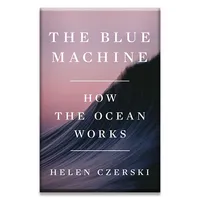
The Blue Machine: How the Ocean Works - $21.93 on Amazon
If you want to know more about how the oceans influence life on Earth, Czerski's book is available now. It's a spectacular story that covers everything from giant waterfalls under the sea, to the magnificent creatures that live within it, to the physical and cultural impact it has had on civilizations.

Alexander McNamara is the Editor-in-Chief at Live Science, and has more than 15 years’ experience in publishing at digital titles. In 2024 he was shortlisted for Editor of the Year at the Association of British Science Writers awards for his work at Live Science. He has previously worked at New Scientist and BBC Science Focus.