-
 CERN halts future collaboration with Russia
The collaboration between American, Russian and European scientists that survived the Cold War has been put on hold.
particle-physics -
 What is the Higgs boson?
Reference A look at the "God particle" — its theoretical origins, its discovery in 2012, and its continuing significance.
Reference -
 'X particle' from the dawn of time detected inside the Large Hadron Collider
The particle was found by smashing billions of lead atoms into each other at extreme speeds.
particle-physics -
 'Ghost particles' detected inside the Large Hadron Collider for the first time
The breakthrough will allow scientists to research long sought-after high energy neutrinos.
particle-physics -
 Scientists capture image of bizarre 'electron ice' for the first time
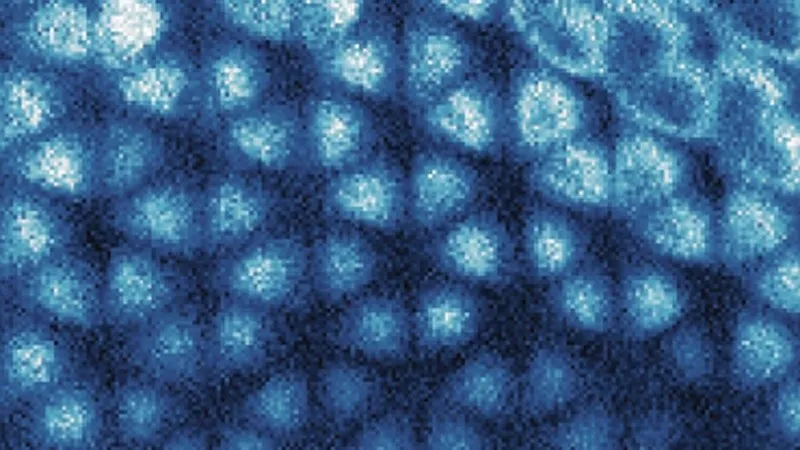
Wigner crystals have been theorized for more than 80 years, but this is the first time the elusive crystals have been captured in an image.
particle-physics -
 1st 'atom tornado' created from swirling vortex of helium atoms
Physicists have created the first-ever atomic vortex beam — a swirling tornado of atoms and molecules with mysterious properties that have yet to be understood.
particle-physics -
 1st sign of elusive 'triangle singularity' shows particles swapping identities in mid-flight
Physicists sifting through old particle accelerator data have found evidence of a highly-elusive, never-before-seen process: a so-called triangle singularity.
particle-physics -
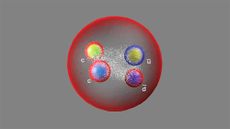 'Doubly charming' tetraquark is the longest-lived exotic-matter particle ever found
Studying the particle could provide physicists with vital insight into the rules that govern how all matter is formed.
particle-physics -
 World's thinnest electronic device is 2 atoms thick
The thinner size allows electrons to move across the device much faster, which could lead to the development of much quicker computers.
particle-physics