













Famous Stephen Hawking theory about black holes confirmed
The areas of black holes are tied to the amount of disorder in the universe

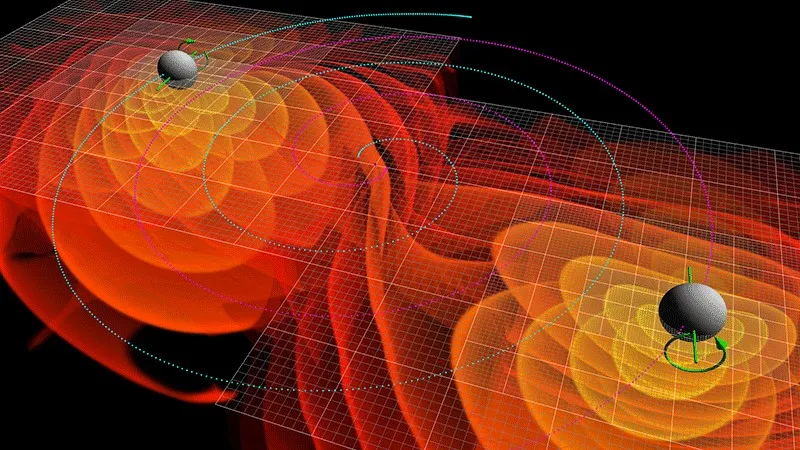
One of Stephen Hawking's most famous theorems has been proven right, using ripples in space-time caused by the merging of two distant black holes.
The black hole area theorem, which Hawking derived in 1971 from Einstein's theory of general relativity, states that it is impossible for the surface area of a black hole to decrease over time. This rule interests physicists because it is closely related to another rule that appears to set time to run in a particular direction: the second law of thermodynamics, which states that the entropy, or disorder, of a closed system must always increase. Because a black hole's entropy is proportional to its surface area, both must always increase.
According to the new study, the researchers' confirmation of the area law seems to imply that the properties of black holes are significant clues to the hidden laws that govern the universe. Oddly, the area law seems to contradict another of the famous physicist's proven theorems: that black holes should evaporate over extremely long time scale, so figuring out the source of the contradiction between the two theories could reveal new physics.
Related: 8 ways you can see Einstein's theory of relativity in real life
"A black hole's surface area can't be decreased, which is like the second law of thermodynamics. It also has a conservation of mass, as you can't reduce its mass, so that's analogous to the conservation of energy," lead author Maximiliano Isi, an astrophysicist at the Massachusetts Institute of Technology, told Live Science. "Initially people were like 'Wow, that's a cool parallel,' but we soon realized that this was fundamental. Black holes have an entropy, and it's proportional to their area. It's not just a funny coincidence, it's a deep fact about the world that they reveal."
A black hole's surface area is set out by a spherical boundary known as the event horizon — beyond this point nothing, not even light, can escape its powerful gravitational pull. According to Hawking's interpretation of general relativity, as a black hole's surface area increases with its mass, and because no object thrown inside can exit, its surface area cannot decrease. But a black hole's surface area also shrinks the more it spins, so researchers wondered whether it would be possible to throw an object inside hard enough to make the black hole spin enough to decrease its area.
"You will make it spin more, but not enough to counterbalance the mass you've just added," Isi said. "Whatever you do, the mass and the spin will make it so that you end up with a bigger area."
Get the world’s most fascinating discoveries delivered straight to your inbox.
To test out this theory, the researchers analyzed gravitational waves, or ripples in the fabric of space-time, created 1.3 billion years ago by two behemoth black holes as they spiraled toward each other at high speed. These were the first waves ever detected in 2015 by the Advanced Laser Interferometer Gravitational-Wave Observatory (LIGO), a laser beam split into two 2,485-mile-long (4 kilometer) paths, and capable of detecting the slightest distortions in space-time by how they alter its path length.
By splitting the signal into two halves — before and after the black holes merged — the researchers calculated mass and the spin of both the two original black holes and the new combined one. These numbers, in turn, allowed them to calculate the surface area of each black hole before and after the collision.
"As they spin around each other faster and faster, the gravitational waves increase in amplitude more and more until they eventually plunge into each other — making this big burst of waves," Isi said. "What you're left with is a new black hole that's in this excited state, which you can then study by analyzing how it's vibrating. It's like if you ping a bell, the specific pitches and durations it rings with will tell you the structure of that bell, and also what it's made out of."
The surface area of the newly created black hole was greater than that of the initial two combined, confirming Hawking's area law with a more than 95% level of confidence. According to the researchers, their results are pretty much in line with what they expected to find. The theory of general relativity — where the area law came from — does a very effective job of describing black holes and other large scale objects.
The real mystery however, begins when we try to integrate general relativity — the rules of big objects — with quantum mechanics — those of the very small. Weird events start to take place, wreaking havoc on all of our hard and fast rules, and breaking the area law completely.
This is because black holes cannot shrink according to general relativity, but they can according to quantum mechanics. The iconic British physicist behind the surface area law also developed a concept known as Hawking radiation — where a a fog of particles are emitted at the edges of black holes through strange quantum effects. This phenomenon leads the black holes to shrink and, eventually, over a time period several times longer than the age of the universe, evaporate. This evaporation may happen over timescales long enough to not violate the area law in the short term, but that's small consolation for physicists.
RELATED CONTENT
"Statistically, over a long period of time, the law is violated," Isi said. "It's like boiling water, you're getting steam evaporating from your pan, but if you only limit yourself to looking at the disappearing water inside of it, you might be tempted to say the entropy of the pan is decreasing. But if you take the steam into account too, your overall entropy has increased. It's the same with black holes and Hawking radiation."
With the area law established for short to medium time frames, the researchers' next steps will be to analyze data obtained from more gravitational waves for deeper insights that could be gleaned from black holes.
"I'm obsessed with these objects because of how paradoxical they are. They're extremely mysterious and confounding, yet at the same time we know them to be the simplest objects that exist," Isi said. "This, as well as the fact that they're where gravity meets quantum mechanics, makes them the perfect playgrounds for our understanding of what reality is."
The researchers published their findings May 26 in the Journal Physical Review Letters.
Originally published on Live Science.

Ben Turner is a U.K. based writer and editor at Live Science. He covers physics and astronomy, tech and climate change. He graduated from University College London with a degree in particle physics before training as a journalist. When he's not writing, Ben enjoys reading literature, playing the guitar and embarrassing himself with chess.