













Mysterious force destroys monster black hole's ring of plasma
Telescopes saw a giant black hole's corona light up and then wink out.

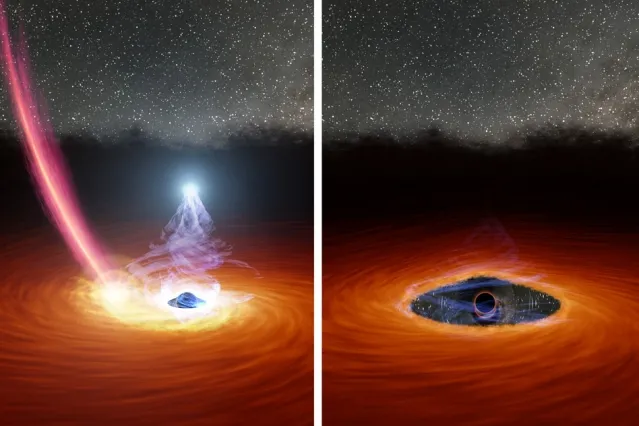
Telescopes all over the world watched a bright flash appear around a distant, supermassive black hole. And then, very quickly, it was gone.
The black hole — the heavy core of a galaxy named 1ES 1927+654 — was visible from Earth due to its corona, the ring of superheated particles whirling around its event horizon, or point of no return for infalling matter. There was nothing special about this state of affairs; all across space, astronomers can spot supermassive black holes thanks to their luminous coronas. And this corona was nestled inside a seemingly ordinary active galactic nucleus (AGN), or a larger region of dust, gas and star clusters.
But in March 2018, this black hole's corona briefly shined extra bright. The All-Sky Automated Survey for Super-Novae (ASSASN), a group of 24 Ohio State University telescopes around the world designed to hunt supernovas , picked up a 40-fold increase in brightness.
"This was an AGN that we sort of knew about, but it wasn't very special," Erin Kara, an MIT physicist and lead author of a paper on the event, said in a statement. "Then they noticed that this run-of-the-mill AGN became suddenly bright, which got our attention, and we started pointing lots of other telescopes in lots of other wavelengths to look at it."
After the AGN lit up, it dimmed suddenly. The black hole at its center — which can be seen best using X-ray telescopes — seemed to get 10,000 times less bright in less than a year.
"We expect that luminosity changes this big should vary on timescales of many thousands to millions of years," Kara said. This region, meanwhile, "But in this object, we saw it change by 10,000 over a year, and it even changed by a factor of 100 in eight hours, which is just totally unheard of and really mind-boggling."
Related: 9 facts about black holes that will blow your mind
Get the world’s most fascinating discoveries delivered straight to your inbox.
The dimming didn't last though. After the initial 8-hour dimming period, the corona continued to dim for much of the next year. Then, over a span of just a few months, the black hole lit up again. Now it looks almost exactly as it did before the corona flashed and disappeared.
So what happened?
Scientists aren't sure, but Kara and her colleagues have a theory.
We spot black holes mainly because of their accretion disks, the rings of matter swirling around them, of which the corona is just the innermost, fastest moving part.
Black holes feed and grow by sipping from their accretion disks. It's difficult for anything to fall directly through the event horizon without first breaking up and spending time whirling circles around it. (This is true of any heavy object in space; It's much harder to fall into the sun, for example, than it is to orbit it.) A lot of the matter in an accretion disk does eventually fall into the black hole, but only after a long period of circling the drain.
RELATED
For something to drop out of an accretion disk and into a black hole, physicists think something has to jostle that object. Usually the culprit is turbulence. But if something heavy, probably a star, smacked into the corona of 1ES 1927+654, the star might have broken up and disturbed the accretion disk enough to knock the orbiting matter into the black whole all at once. Researchers call this sort of event a "tidal disruption."
In that case, the first bright flash would likely have been the star cracking open as it hit the corona. The massive gravity of the black hole would have overwhelmed the gravity holding the star together, ripping it apart.
The precipitous 8-hour drop in luminosity would have been the initial tidal disruption of the accretion disk. A whole bunch of gas, dust, and plasma that had been oribitng in neat circles before the star arrived would have fallen past the event horizon all at once -- smacked in by the collision with the star. And then the further dimming over a period of months would have been the remaining, jostled matter falling out of a now-unstable orbit.
Related: The 18 biggest unsolved mysteries in physics
A rogue star could also have disrupted the magnetic field lines around the black hole. A black hole's magnetic field may help to maintain a high-energy corona -- the magnetic field lines holding the whirling, high-energy material in place.. A collision with a star could disrupt that field enough for the corona to fall apart.
If that's what happened here, it's a big deal.
There's a lot about black hole coronas that scientists don't understand, including the locations of the magnetic field lines that keep them intact. But they do know that a black hole the size of 1ES 1927+654's would have to get as close as about 45 million miles (75 million kilometers) from the singularity itself to be drawn in. That's not much further than the distance from Mercury to the sun.
If a star disrupted the magnetic fields of the black hole after falling apart at that distance, that suggests that corona and magnetic field lines are about that far from the black hole as well. From Earth, black hole coronas are too close to their central singularities to directly measure the distances involved. So that's a big deal.
"With the caveat that this event happened from a stellar tidal disruption, this would be some of the strictest constraints we have on where the corona must exist," Kara said. "We want to keep an eye on it. … It's still in this unusual high-flux state, and maybe it'll do something crazy again, so we don't want to miss that."
Originally published on Live Science.
