It's quick and easy to access Live Science Plus, simply enter your email below. We'll send you a confirmation and sign you up for our daily newsletter, keeping you up to date with the latest science news.
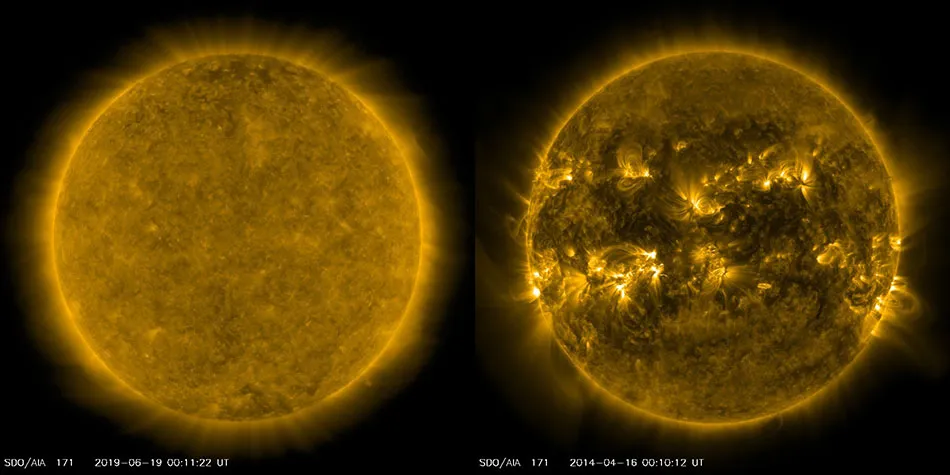
Sunspots appear and disappear from the sun’s surface in 11-year cycles. The left image, taken this month, shows the current solar minimum (a period of low sunspot activity) while the right image, taken in April 2014, shows the last solar maximum (a period of high activity).
In case you've forgotten, Earth's sun is totally epic: It's home to towering fountains of plasma, "lava lamp blobs" of mystery matter 500 times larger than Earth, and a writhing magnetic field that twists, turns, snaps and lashes out into space every 11 years or so, seriously screwing with Earth's power grid.
While trying to better understand that 11-year stellar-tantrum cycle, characterized by a sudden increase in sunspot activity near the sun's equator, scientists discovered a new form of solar epicness you should probably be aware of. When one solar cycle ends and the next begins, the researchers wrote, the sun may experience cataclysmic magnetic field collisions — known as "terminator events" — resulting in gargantuan tsunamis of plasma that can charge across the sun's surface for weeks at a time.
According to the authors of two new studies (published February 4 in the journal Scientific Reports and July 9 in the journal Solar Physics), these solar tsunamis could be a missing link in the solar cycle, kick-starting the production of sunspots — gigantic spots on the sun that tend to form near strong magnetic field lines and are cooler than other parts of the sun’s surface — near the sun's middle latitudes — just a few weeks after they start to disappear near its equator.
"We have observed the sunspot cycle for hundreds of years, but it's been a mystery what mechanism could transport a signal from the equator, where the cycle ends, to the sun's mid-latitudes, where the next cycle begins, in such a relatively short amount of time," Mausumi Dikpati, a senior scientist at the High Altitude Observatory in Boulder, Colorado, and a co-author of both new studies, said in a statement.
Solar tsunamis, Dikpati and colleagues argue, may be the answer.
For the first study, researchers looked at 140 years' worth of solar observations taken from Earth and satellites. The scientists focused on the movement of coronal bright points — small loops of plasma that form over magnetic hotspots in the sun's atmosphere; these points shine with extreme ultraviolet light before disappearing, usually within a single day. Unlike sunspots, which appear only during periods of high solar activity (known as solar maximums), bright points can occur during less-active periods (called solar minimums), providing a more comprehensive view of solar activity across cycles, the researchers wrote.
Tracking these bright points revealed an interesting pattern: They first appeared around 55 degrees latitude (about 20 degrees higher than sunspots tend to appear), then migrated toward the equator by a few degrees latitude every year. Once the points reached about 35 degrees latitude, they began overlapping with sunspots. The points and spots continued moving toward the equator in tandem for several years; when they got there, they all vanished in a "terminator" event. A few weeks after a termination, bright points always started popping up like clockwork in the sun's mid-latitudes again.
Sign up for the Live Science daily newsletter now
Get the world’s most fascinating discoveries delivered straight to your inbox.
This composite of 25 images taken between April 2012 and April 2013 shows the migration of sunspots toward the equator during the last solar maximum. Notice that few spots ever appear above the mid-latitudes of either hemispheres. Solar tsunamis could explain why, the authors of two new papers claim.
(Image credit: NASA Goddard)
Some physical feature of these terminator events seemed to be triggering the start of the next cycle in higher latitudes — but, what? Here's where the tsunamis come in.
In the second paper (co-authored by two of the researchers who worked on the first), researchers explained how terminator events could end in the collision of two huge magnetic field lines near the sun's equator, resulting in dual tsunamis of plasma.
According to the study, magnetic field lines like these — called "toroidal magnetic field lines," because they stretch around the diameter of the sun in a donut (or toroid) shape — may be responsible for the emergence of bright points and sunspots as they move across the sun's surface. It's possible the field lines also serve as magnetic "dams," the researchers wrote, trapping plasma behind them as they advance toward the sun's equator.
When two opposing field lines (one generated by the sun's north pole and the other by the south pole) meet at the equator, their opposing charges cancel each other out, resulting in what the researchers call "mutual annihilation." The field lines snap, releasing the plasma trapped behind them in two massive tidal waves that rush forward, bounce off each other, and surge backward toward the poles in twin tsunamis, traveling 1,000 feet (300 meters) per second.
Within a week or two, these waves reach the mid-latitudes of either hemisphere, where they reach another set of magnetic field lines that are already drumming up bright points for the next solar cycle. When the tidal wave hits this new set of lines, it buoys those magnetic field lines up toward the surface, causing a surge in sunspot creation to accompany the bright points.
This, the researchers wrote, could explain the strangely consistent gap between the termination of one cycle and the start of the next. Computer simulations showed that solar tsunamis like this are theoretically possible — however, for now, they remain just a really cool idea. Luckily, astronomers may soon have a chance to find real evidence of these solar tsunamis; judging from current bright point activity near the equator, the researchers wrote, the sun is due for its next tsunami by 2020.
Brandon is the space / physics editor at Live Science. With more than 20 years of editorial experience, his writing has appeared in The Washington Post, Reader's Digest, CBS.com, the Richard Dawkins Foundation website and other outlets. He holds a bachelor's degree in creative writing from the University of Arizona, with minors in journalism and media arts. His interests include black holes, asteroids and comets, and the search for extraterrestrial life.