















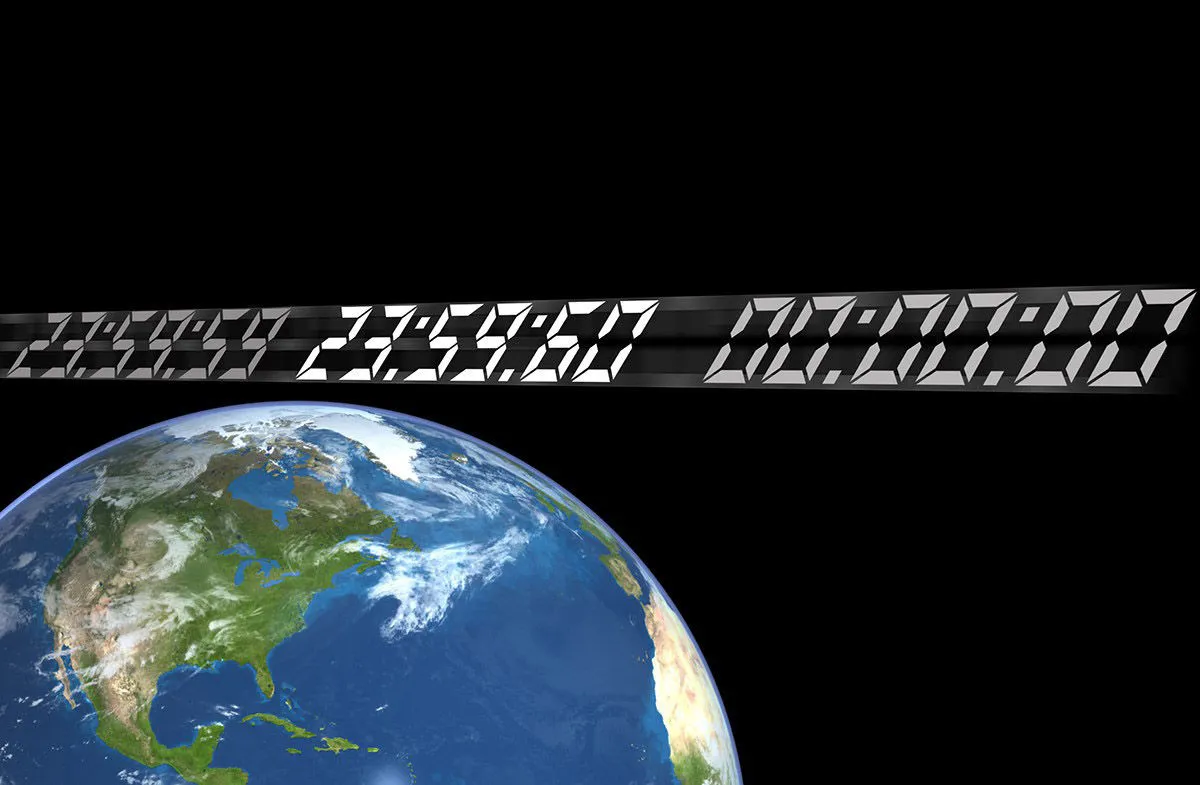
Revelers will get to celebrate New Year's Eve for a tiny bit longer than usual this year.
A "leap second" will be added to the world's official clocks on Dec. 31 at 23 hours, 59 minutes and 59 seconds Coordinated Universal Time (UTC), which corresponds to 6:59:59 p.m. EST; the clocks will read 23:59:60 before ticking over to midnight. The goal is to keep two different timescales in sync with each other.
The units of time had long been defined based on Earth's rotation relative to distant celestial bodies. But that changed with the invention ofatomic clocks in the mid-20th century; scientists then decided to base the second on the natural vibrations of the cesium atom. [How to Build the Most Accurate Atomic Clocks (Video)]
These two timescales don't match up exactly, however. Measurements show that, because the moon's gravitational pull and other factors are gradually slowing Earth's spin, the rotation-based scale loses between 1.5 and 2 milliseconds per day compared to atomic time — meaning the two diverge by a full second every 500 to 750 days.
Leap seconds are a way to make up for this difference. Since 1972, the International Earth Rotation and Reference Systems Service (IERS) — the organization that keeps track of time for the world — has added 26 leap seconds to atomic clocks, with the last such insertion coming on June 30, 2015.
The aim is to keep the two timescales within 0.9 seconds of each other.
"We can easily change the time of an atomic clock, but it is not possible to alter the Earth's rotational speed to match the atomic clocks," officials with the U.S. Naval Observatory (USNO), which maintains the Department of Defense's master clock, noted — wryly, it would seem — in a statement today (July 6).
Get the world’s most fascinating discoveries delivered straight to your inbox.
While Earth's rotation rate is slowing, the effect is quite subtle.
"Confusion sometimes arises over the misconception that the occasional insertion of leap seconds every few years indicates that the Earth should stop rotating within a few millennia," USNO officials wrote. "This is because some [people] mistake leap seconds to be a measure of the rate at which the Earth is slowing. The 1-second increments are, however, indications of the accumulated difference in time between the two systems."
When leap seconds are added, they are always inserted on June 30 or Dec. 31 of a particular year. In 1972, IERS officials called for a leap second to be inserted on both dates.
Follow Mike Wall on Twitter @michaeldwall andGoogle+. Follow us @Spacedotcom, Facebook or Google+. Originally published on Space.com.
