














When Distant Galaxies Light Up: Modeling a Cosmic Slurp
This Behind the Scenes article was provided to Live Science in partnership with the National Science Foundation.
Somewhere out in the cosmos an ordinary galaxy spins, seemingly at slumber. Then all of a sudden, WHAM! A flash of light explodes from the galaxy's center. A star orbiting too close to the event horizon of the galaxy's central supermassive black hole has been torn apart by the force of gravity, heating up its gas and sending out a beacon to the far reaches of the Universe.
In a Universe with tens of billions of galaxies, how would we see it? What would such a beacon look like? And how would we distinguish it from other bright, monumental intergalactic events, such as supernovas?
"Black holes by themselves do not emit light," said Tamara Bogdanovic, assistant professor of physics at the Georgia Institute of Technology. "Our best chance to discover them in distant galaxies is if they interact with the stars and gas that are around them."
In recent decades, with improved telescopes and observational techniques designed to repeatedly survey the vast numbers of galaxies in the sky, scientists noticed that some galaxies that previously looked inactive would suddenly light up at their very center.
"This flare of light was found to have a characteristic behavior as a function of time. It starts very bright and its luminosity then decreases in time in a particular way," she explained. "Astronomers have identified those as galaxies where a central black hole just disrupted and 'ate' a star. It's like a black hole putting up a sign that says 'Here I am.'"
Using a mix of theoretical and computer-based approaches, Bogdanovic tries to predict the dynamics of events such as the black-hole-devouring-star scenario described above, also known as a "tidal disruption." Such events would have a distinct signature to someone analyzing data from a ground-based or space-based observatory.
Get the world’s most fascinating discoveries delivered straight to your inbox.
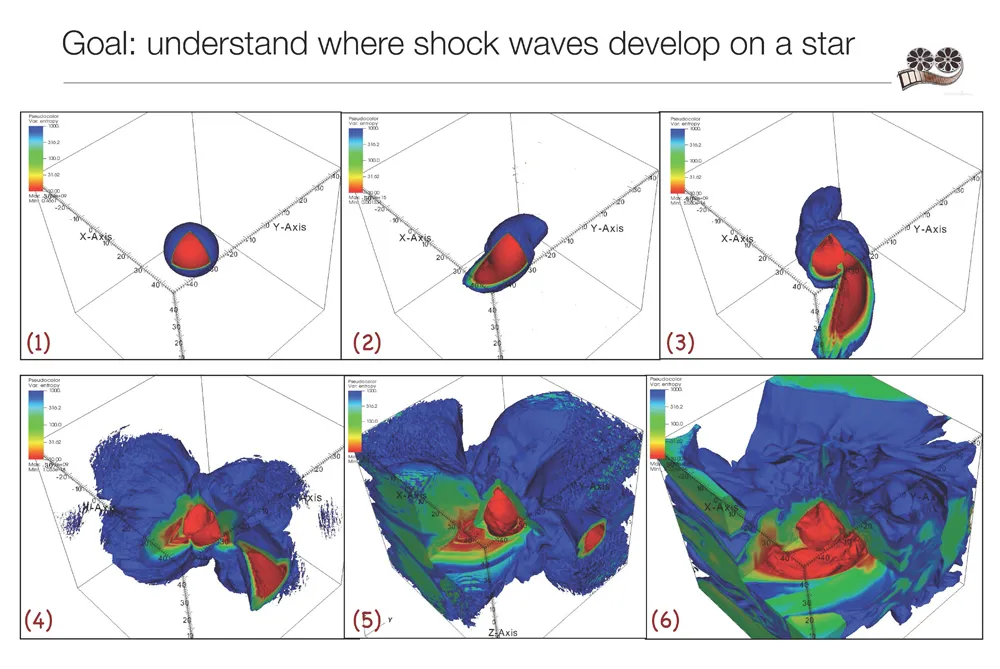
Using National Science Foundation-funded supercomputers at the Texas Advanced Computing Center (Stampede) and the National Institute for Computational Sciences (Kraken), Bogdanovic and her collaborators recently simulated the dynamics of these super powerful forces and charted their behavior using numerical models.
Tidal disruptions are relatively rare cosmic occurrences. Astrophysicists have calculated that a Milky Way-like galaxy stages the disruption of a star only once in about 10,000 years. The luminous flare of light, on the other hand, can fade away in only a few years. Because it is such a challenge to pinpoint tidal disruptions in the sky, astronomical surveys that monitor vast numbers of galaxies simultaneously are crucial.

Huge difference
So far, only a few dozen of these characteristic flare signatures have been observed and deemed "candidates" for tidal disruptions. But with data from PanSTARRS, Galex, the Palomar Transient Factory and other upcoming astronomical surveys becoming available to scientists, Bogdanovic believes this situation will change dramatically.
"As opposed to a few dozen that have been found over the past 10 years, now imagine hundreds per year — that's a huge difference!" she said. "It means that we will be able to build a varied sample of stars of different types being disrupted by supermassive black holes."
With hundreds of such events to explore, astrophysicists' understanding of black holes and the stars around them would advance by leaps and bounds, helping determine some key aspects of galactic physics.
"A diversity in the type of disrupted stars tells us something about the makeup of the star clusters in the centers of galaxies," Bodganovic said. "It may give us an idea about how many main sequence stars, how many red giants, or white dwarf stars are there on average."
Tidal disruptions also tell us something about the population and properties of supermassive black holes that are doing the disrupting.
"We use these observations as a window of opportunity to learn important things about the black holes and their host galaxies," she continued. "Once the tidal disruption flare dims below some threshold luminosity that can be seen in observations, the window closes for that particular galaxy."

Role of supercomputer
In a recent paper submitted to the Astrophysical Journal, Bogdanovic, working with Roseanne Cheng (Center for Relativistic Astrophysics at Georgia Tech) and Pau Amaro-Seoane (Albert Einstein Institute in Potsdam, Germany), considered the tidal disruption of a red giant star by a supermassive black hole using computer modeling.
The paper comes on the heels of the discovery of a tidal disruption event in which a black hole disrupted a helium-rich stellar core, thought to be a remnant of a red giant star, named PS1-10jh, 2.7 billion light years from Earth.
The sequence of events they described aims to explain some unusual aspects of the observational signatures associated with this event, such as the absence of the hydrogen emission lines from the spectrum of PS1-10jh.
As a follow-up to this theoretical study, the team has been running simulations on Georgia Tech's Keeneland supercomputer, as well as Kraken and Stampede. The simulations reconstruct the chain of events by which a stellar core, similar to the remnant of a tidally disrupted red giant star, might evolve under the gravitational tides of a massive black hole.
"Calculating the messy interplay between hydrodynamics and gravity is feasible on a human timescale only with a supercomputer," Roseanne Cheng said. "Because we have control over this virtual experiment and can repeat it, fast forward, or rewind as needed, we can examine the tidal disruption process from many perspectives. This in turn allows us to determine and quantify the most important physical processes at play."
The research shows how supercomputer simulations complement and constrain theory and observation.
"There are many situations in astrophysics where we cannot get insight into a sequence of events that played out without simulations. We cannot stand next to the black hole and look at how it accretes gas. So we use simulations to learn about these distant and extreme environments," Bogdanovic said.
One of Bogdanovic's goals is to use the knowledge gained from simulations to decode the signatures of observed tidal disruption events.
"The most recent data on tidal disruption events is already outpacing theoretical understanding and calling for the development of a new generation of models," she explained. "The new, better quality data indicates that there is a great diversity among the tidal disruption candidates. This is contrary to our perception, based on earlier epochs of observation, that they are a relatively uniform class of events. We are yet to understand what causes these differences in observational appearance, and computer simulations are guaranteed to be an important part of this journey."
Other stories that might be of interest:
Modeling Protostellar Disks to Understand How Planets Are Born
Dense Cloud Breaks Rules of Star Formation
Editor's Note: Any opinions, findings, and conclusions or recommendations expressed in this material are those of the author and do not necessarily reflect the views of the National Science Foundation. See the Behind the Scenes archive.
