














US Students Win Gold in International Rocketry Challenge

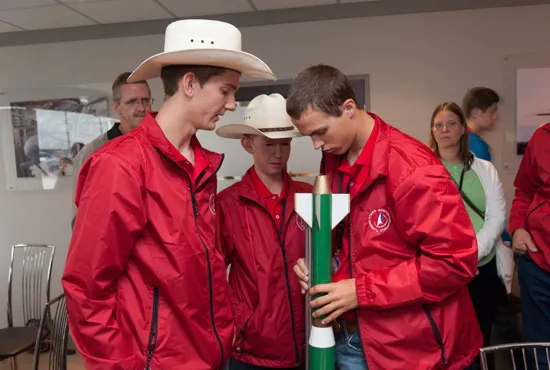
Three cowboy hat-clad Texas teens won gold medals for the United States in the International Rocketry Challenge at the Paris Air Show, besting the French and British teams.
With a delicate payload of an uncooked egg, the students' rocket launched for its winning flight at Le Bourget Airport in Paris on June 21, docking the fewest penalties of the three teams.
The gold medalists were Mark Janecka, 13, his brother Matthew, 17, and their teammate Daniel Kelton, 16, of the Georgetown, Texas, 4-H rocketry club. They advanced to the international competition after winning the Team America Rocketry Challenge (TARC) and were pit against the winners of similar contests: Britain's UKAYRoC and the French Rocketry Challenge.
The international challenge at the Paris Air Show required teams to launch a rocket exactly 750 feet (228 meters) in the air within a narrow 48- to 50-second flight window, returning the horizontally-placed raw egg to the ground intact by parachute. The teams racked up penalties for each foot off the target altitude and each second off the target time.
With a 49.18-second flight reaching an altitude of 703 feet, the Georgetown 4-H team earned the lowest (and best) flight score of 47. France's team from the Leonard de Vinci school came in second with a score of 76.81, followed by the United Kingdom's team from the Royal Liberty school in third with a score of 105.67.
"It was short — but it worked, apparently," Kelton said in a statement from Raytheon, a Massachusetts-based defense and aerospace company that sponsored the winning team. Kelton added that the longer launch rail used in international competition slowed the rocket's ascent.
"And the rain, especially, didn't help anything," the Texas student said. "It makes the air a lot denser, and the rocket gets wet."
Get the world’s most fascinating discoveries delivered straight to your inbox.
The competition is intended to encourage middle school and high school students to get involved in science, technology, engineering and math (STEM). The contest is organized and sponsored by the Aerospace Industries Association of America and their British and French counterparts: ADS and and Groupement des Industries Francaises Aeronautiques et Spatiales.
This story was provided by SPACE.com, a sister site to LiveScience. Follow SPACE.com on Twitter @Spacedotcom. We're also on Facebook and Google+.
