














Mysterious Geologic Structure Seen from Space

This story was updated at 12:54 p.m. EDT.
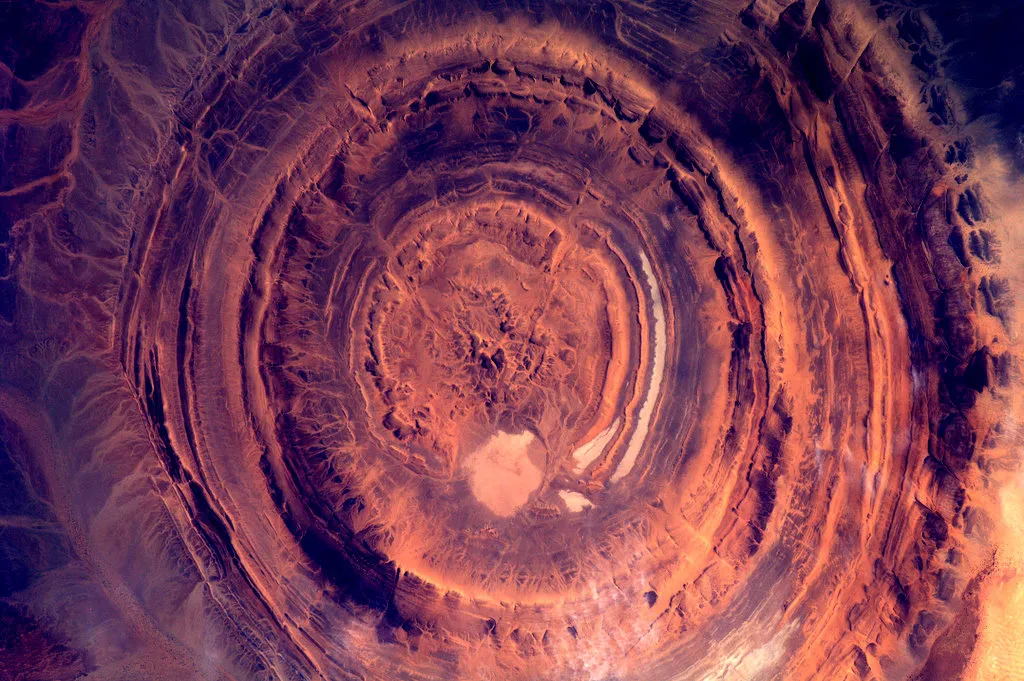
A huge, copper-toned formation in West Africa dominates a mesmerizing photo taken by an astronaut aboard the International Space Station.
Dutch astronaut Andre Kuipers snapped this hypnotic image of the so-called Richat structure in Mauritania, as the space station flew over the Sahara Desert on the Atlantic Coast of West Africa. Erosion of the various rock layers created the ring-like features that make up the sprawling structure, but the origin of the Richat structure remains somewhat mysterious, geologists have said.
The photo shows Kuipers' unique vantage point from the orbiting complex, which flies approximately 240 miles (386 kilometers) above the surface of the Earth. The image was taken on March 7 using a Nikon D2Xs camera, officials at the European Space Agency said in a statement.
During their months-long stints aboard the International Space Station, astronauts often perform Earth observations for science and public outreach.
Throughout their mission, many spaceflyers maintain active social media presences, such as on Twitter or Google+, to share stunning views from spacewith members of the public.
Space agencies also use photos taken by astronauts to engage students and space enthusiasts in geography, planetary science and human spaceflight.
Get the world’s most fascinating discoveries delivered straight to your inbox.
There are currently six people living and working on the space station: Kuipers, Americans Dan Burbank and Don Pettit, and Russian cosmonauts Anton Shkaplerov, Anatoly Ivanishin and Oleg Kononenko. Burbank is commander of the station's Expedition 30 mission.
Kuipers launched to the space station in December 2011. He is almost midway through his six-month stay at the orbiting outpost. Kuipers, Kononenko and Pettit are slated to return to Earth on July 1.
Editor's Note: This story was updated to reflect that the Richat structure in Mauritania is not a lava crater.
Follow OurAmazingPlanet for the latest in Earth science and exploration news on Twitter @OAPlanetand on Facebook.
