














Nearby Star Has Strange Cool Layer Like the Sun

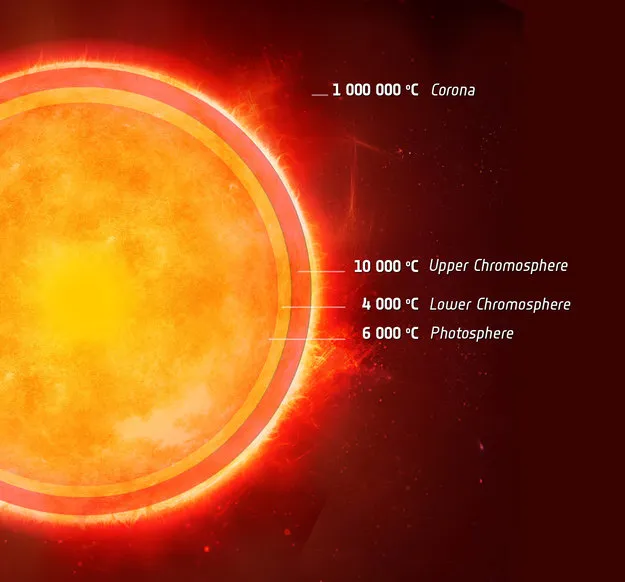
Scientists have discovered that the sun and its nearest twin star, Alpha Centauri A, share an odd solar quirk: a puzzling cool layer in their wispy, hot atmospheres.
The different temperatures of the sun's layers have long intrigued solar scientists. The outer atmosphere, or corona, is millions of degrees hotter than the sun's surface, or photosphere, where temperatures are about 10,000 degrees Fahrenheit (5,537 degrees Celsius).
But the temperatures don't simply rise the further away you get from the surface. There is actually a cooler layer sandwiched between the photosphere and the corona called the chromosphere, where temperatures dip as low as 7,300 degrees F (4,000 degrees C).
Now scientists have found a similarly cool layer around Alpha Centauri A using the European Space Agency's Herschel space observatory to look at the nearby star in far-infrared light.
"The study of these structures has been limited to the sun until now, but we clearly see the signature of a similar temperature inversion layer at Alpha Centauri A," study leader René Liseau of the Onsala Space Observatory in Sweden said in a statement. [Alpha Centauri Stars Explained (Infographic)]
Scientists believe the extreme heating of the sun's corona is likely related to the twisting of magnetic field lines that give rise to explosions known as solar flares. Studying Alpha Centauri A could help scientists better understand the atmospheric phenomenon, especially since the star is almost a twin to the Sun in mass, temperature, chemical composition and age.
"Detailed observations of this kind for a variety of stars might help us decipher the origin of such layers and the overall atmospheric heating puzzle," Liseau said.
Get the world’s most fascinating discoveries delivered straight to your inbox.
The discovery may also help astronomers better estimate the amount of dust in the cold debris disks surrounding sun-like stars, the scientists said. The research is detailed in a recent edition of the journal Astronomy & Astrophysics.
The three stars of the Alpha Centauri system are the nearest to Earth beyond the sun. The two main stars are the binary pair Alpha Centauri A and Alpha Centauri B. They are about 4.37 light-years from Earth.
The third star, a faint red dwarf named Proxima Centauri, is the closest at just 4.22 light-years from Earth.
In 2012, astronomers announced the discovery of an Earth-size alien planet orbiting Alpha Centauri B.
The European Space Agency's Herschel observatory used to make the new Alpha Centauri A discovery is the largest infrared space telescope ever launched into space. The observatory launched in May 2009 to map the universe in the far-infrared and submillimeter light wavelengths.
This story was provided by SPACE.com, a sister site to Live Science. Follow SPACE.com on Twitter @Spacedotcom. We're also on Facebook and Google+.
