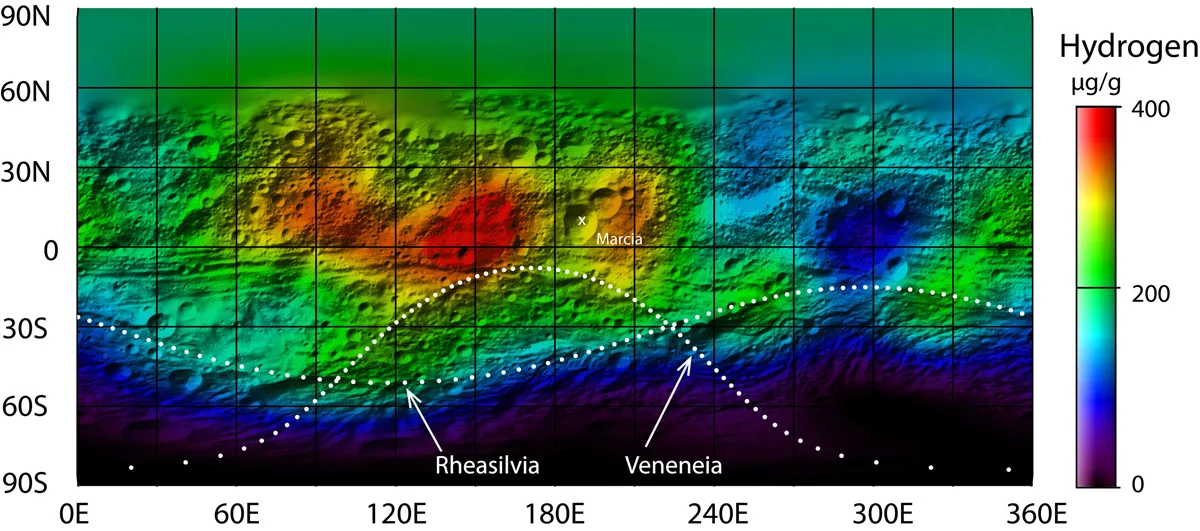
Data acquired by the gamma ray and neutron detector (GRaND) on board the NASA Dawn spacecraft have been analyzed to determine the distribution of hydrogen on the giant asteroid Vesta. Image released September 20, 2012.
The protoplanet Vesta, a large space rock in the solar system's asteroid belt, is covered with a surprising amount of hydrogen, and bits of Vesta may have rained down on Earth in the form of meteorites, NASA's Dawn probe has revealed.
Dawn spent more than a year orbiting Vesta, a behemoth 330-mile-wide (530 kilometers) asteroid that circles the sun between the orbits of Mars and Jupiter. Earlier this month, on Sept. 5, Dawn took its leave of Vesta to begin trekking to the even-larger space rock Ceres, which is categorized as a dwarf planet.
Meanwhile, though, scientists are still poring over the treasure trove of data on Vesta gathered by the probe, and two new studies are reported today (Sept. 20) in the journal Science. In one, researchers report the findings of Dawn's Gamma Ray and Neutron Detector (GRAND), which mapped the elemental composition of Vesta's surface.
"We were surprised to see that Vesta has a significant amount of hydrogen," said Thomas Prettyman of the Planetary Science Institute in Tucson, Ariz., leader of one of the new studies. [Photos: Asteroid Vesta and NASA's Dawn Spacecraft]
Bits of Vesta on Earth
GRAND showed a widespread abundance of the element hydrogen, which was not thought to be prevalent on Vesta. Furthermore, Vesta's composition appears strikingly similar to a class of meteorites on Earth called howardite, eucrite and diogenite (HED), leading scientists to think these chunks of rock originally came from Vesta.
"This firmly links the HED meteorites to Vesta," Prettyman told SPACE.com. "The significance and importance of that is if you know these meteorites come from Vesta, you can study them in great detail in a lab and learn about how Vesta formed. Vesta is a frozen planetary embryo, frozen at a very early stage of development."
Sign up for the Live Science daily newsletter now
Get the world’s most fascinating discoveries delivered straight to your inbox.
Scientists think Vesta was created within the first few million years of the solar system's existence, and could have turned into a full-fledged planet, had things worked out differently. By studying this failed planet, researchers could learn more about how Earth came to be.
"Vesta is the second most massive asteroid in our solar system and provides the opportunity to study the early Earth as a developing planet while it was still barely one-sixth the size of the moon," MIT scientist Richard Binzel, who was not involved in the research, wrote in an accompanying essay in Science.
A perspective view of Marcia crater, Vesta. Marcia (70 km in diameter) is one of the youngest large craters on Vesta and host to the largest concentration of pits on the asteroid. Image released September 20, 2012.
A second paper in Science reports "unusual pitted terrain" on Vesta characterized by strange rimless depressions on the asteroid's surface in and near impact craters.
Similar landscapes have been seen on Mars, where the indentations are thought to form when chemicals vaporize off the surface after being heated by impacting space rocks, wrote the scientists, led by Brett Denevi of the Johns Hopkins Applied Physics Laboratory.
This finding ties in with the revelation of hydrogen on Vesta, because the likeliest explanation for the indentations on the surface is that hydrogen, which is likely bound up in minerals there, is released in the form of water vapor when the material is heated up by impacts.
Ultimately, the new studies offer some surprises, and some confirmations of the coalescing picture scientists have about this early stage of the solar system's history. These findings would not have been possible without the up-close study of this world provided by Dawn, the researchers said.
The probe entered a special low-altitude orbit for about five months to allow the GRAND instrument to analyze emissions from Vesta's surface that result from collisions between cosmic ray particles and elements in the asteroid's dirt.
"Dawn's crowning success at Vesta was the delivery of instruments that require proximity, exemplified by the gamma-ray and neutron measurements of Prettyman et al. yielding elemental abundances that unequivocally confirm the meteorite links," Binzel wrote.
The $466 million Dawn spacecraft launched in September 2007 and arrived at Vesta in July 2011. It is due to arrive at Ceres in February 2015.
Clara has a bachelor's degree in astronomy and physics from Wesleyan University, and a graduate certificate in science writing from the University of California, Santa Cruz. She has written for both Space.com and Live Science.