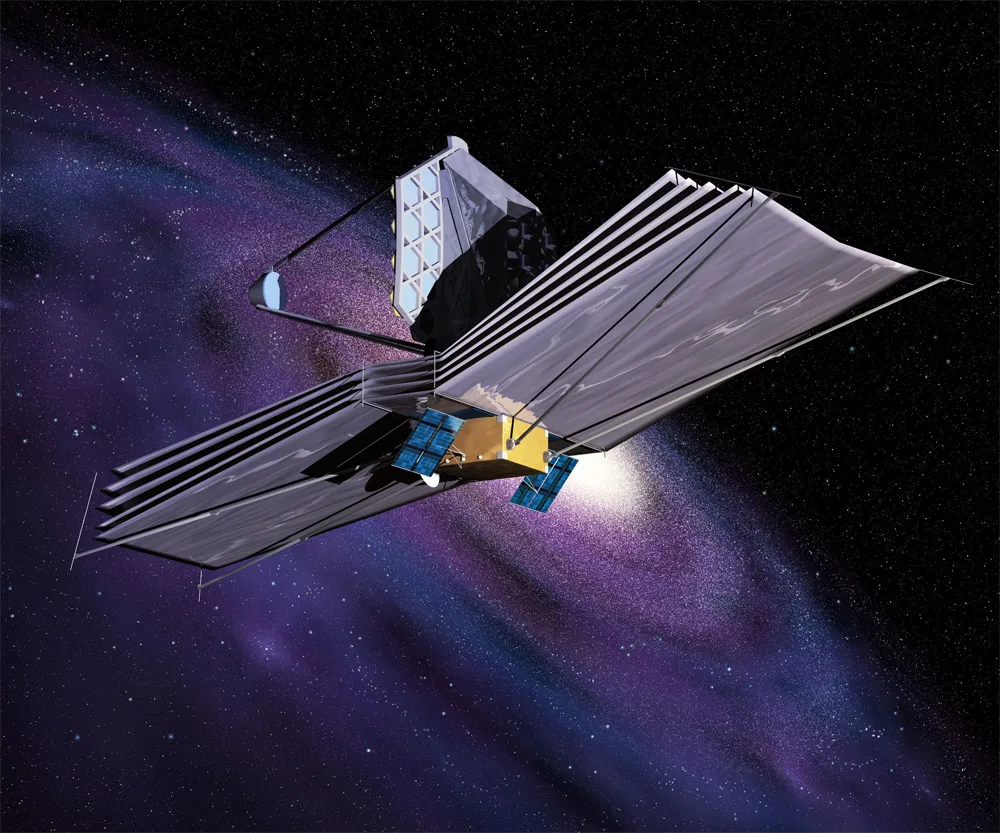
The James Webb Space Telescope (JWST) is the successor to the Hubble Space Telescope, and it will be almost three times the size of Hubble. JWST has been designed to work best at infrared wavelengths. This will allow it to study the very distant Universe, looking for the first stars and galaxies that ever emerged.
NASA's James Webb Space Telescope is a sophisticated new observatory that is being designed to unlock some of the greatest mysteries of the universe, but it could also play a key role in the hunt for alien planets, scientists said.
The $8.8 billion James Webb Space Telescope (JWST), which is slated to launch in 2018, will orbit 930,000 miles (1,500,000 kilometers) from Earth, in a region called the Lagrange Point 2. Here, the gravitational forces from the Earth and the sun essentially cancel each other out, so JWST will be able to maintain a stable orbit without using up too much energy.
From this distant orbital perch, JWST will be able to stare uninterrupted at stars with sensitive infrared instruments. The telescope's powerful tools could let astronomers "sniff" the atmospheres of alien planets and break down their molecular composition.
SPACE.com recently sat down with David Charbonneau, an astronomer at the Harvard-Smithsonian Center for Astrophysics in Cambridge, Mass., to talk about how JWST could be a critical addition to the field of exoplanet research.
SPACE.com: NASA's Kepler spacecraft was launched in 2009 and has already detected 61 confirmed alien planets and 2,326 planetary candidates. What will JWST be able to contribute to the hunt for exoplanets?
David Charbonneau:Kepler is finding planets of all sizes, including true Earth-size planets. But the trick with kepler is that all the planets orbit stars that are in one patch of the sky. These are typically quite far away, and faint, so they are not necessarily the best possible targets.
Kepler tells us the statistics but it doesn't do any of the atmospheric studies whatsoever, so it's really just a discovery machine. Provided we can find planets transiting the very closest and brightest stars, they emit so much light that the Webb telescope can go and study their atmospheres. [Photos: Building the James Webb Space Telescope]
Sign up for the Live Science daily newsletter now
Get the world’s most fascinating discoveries delivered straight to your inbox.
There are big gas giant planets, and those are going to be easy to study with Webb — we're already doing that with Hubble. But with Webb, we'll be able to do much better because we'll be able to study planets that are much more like Earth.
JWST will study every phase in the history of our Universe, from the first luminous glows after the Big Bang, to the formation of solar systems capable of supporting life on planets like Earth.
SPACE.com: If you can let your imagination run wild, what would you consider to be the best possible targets for Webb to study?
Charbonneau: The best possible scenario is to find nearby stars that are small, and then planets of any kind. There are definitely targets now that would be spectacular to study with Webb, and these ones are interesting because they're planets transiting some of the nearer stars. These are gas giants and Neptune-size planets, but we can learn a lot from them.
We have yet to discover the small planets transiting the closest stars. Kepler tells us that most stars have planets, and we know that most stars have small planets, but it's only recently that we've had the ability to find them.
SPACE.com: How will Webb be able to expand on the work done by space telescopes that preceded it, such as the Hubble Space Telescope and the Spitzer Space Telescope?
Charbonneau: For one thing, Webb will be able to go beyond the reach of Hubble and Spitzer because they're too small. Spitzer is infrared, but it has a tiny mirror. Hubble has a good size mirror but not the infrared sensitivity. The other major problem with Hubble is its orbit — we have gaps in data because of Hubble's orbit.
Webb is an infrared telescope with a large aperture, so it's ideally suited for spectroscopy. It'll also have an uninterrupted view, so for example, if we're monitoring a transit that lasts 10 hours, we won't have gaps every 90 minutes. [Giant Space Telescopes of the Future (Infographic)]
This artist’s impression shows the super-Earth exoplanet GJ 1214b passing in front of its faint red parent star. The exoplanet, orbiting a small star only 40 light-years away from us, has a mass about six times that of the Earth. GJ 1214b appears to be surrounded by an atmosphere that is either dominated by steam or blanketed by thick clouds or hazes.
(Image credit: ESO/L. Calçada)
SPACE.com: What kind of alien planets are you most interested in studying?
Charbonneau: What I want to do is try to find super-Earths — planets a little bigger than Earth — that are orbiting tiny stars. If I could study their atmospheres with Webb, I could look for the presence of water or carbon dioxide, and basically figure out whether the atmospheres are similar to Earth.
One particular way the atmospheres may be different is the abundance of hydrogen and helium. For example, Uranus and Neptune have thick atmospheres of hydrogen and helium. When we study super-Earths, we want to know, do they have those atmospheres of hydrogen, which are interesting but not good for life? Or do they have atmospheres mostly of nitrogen? These are all fascinating things I'd want to figure out.
SPACE.com: Funding for JWST has been a controversial topic. Clearly you see scientific benefits for launching the telescope, but how would you respond to others who are more skeptical?
Charbonneau: The thing about JWST is that it's not serving just one community and starving everybody else. It's a telescope that serves a very large fraction of the astronomical community. I think that we do need these kind of general purpose observatories where everybody around the world puts forward their best ideas and we compete and pick the best ones to go forward.
SPACE.com: Finally, how close do you think we are to finding an Earth-size planet in the habitable zone?
Charbonneau: It's really hard to predict timescales because the field is moving so rapidly. With exoplanets, it's sort of like the weather. You can see a 10-day weather prediction, and we can all look ahead, but the truth is, the predictions are probably only good for the first two days. Having said that, if we look ahead three years or five years, it's a very reasonable thing to do with Webb.
This story was provided by SPACE.com, a sister site to LiveScience. You can follow SPACE.com staff writer Denise Chow on Twitter @denisechow. Follow SPACE.com for the latest in space science and exploration news on Twitter @Spacedotcom and on Facebook.
Denise Chow was the assistant managing editor at Live Science before moving to NBC News as a science reporter, where she focuses on general science and climate change. Before joining the Live Science team in 2013, she spent two years as a staff writer for Space.com, writing about rocket launches and covering NASA's final three space shuttle missions. A Canadian transplant, Denise has a bachelor's degree from the University of Toronto, and a master's degree in journalism from New York University.