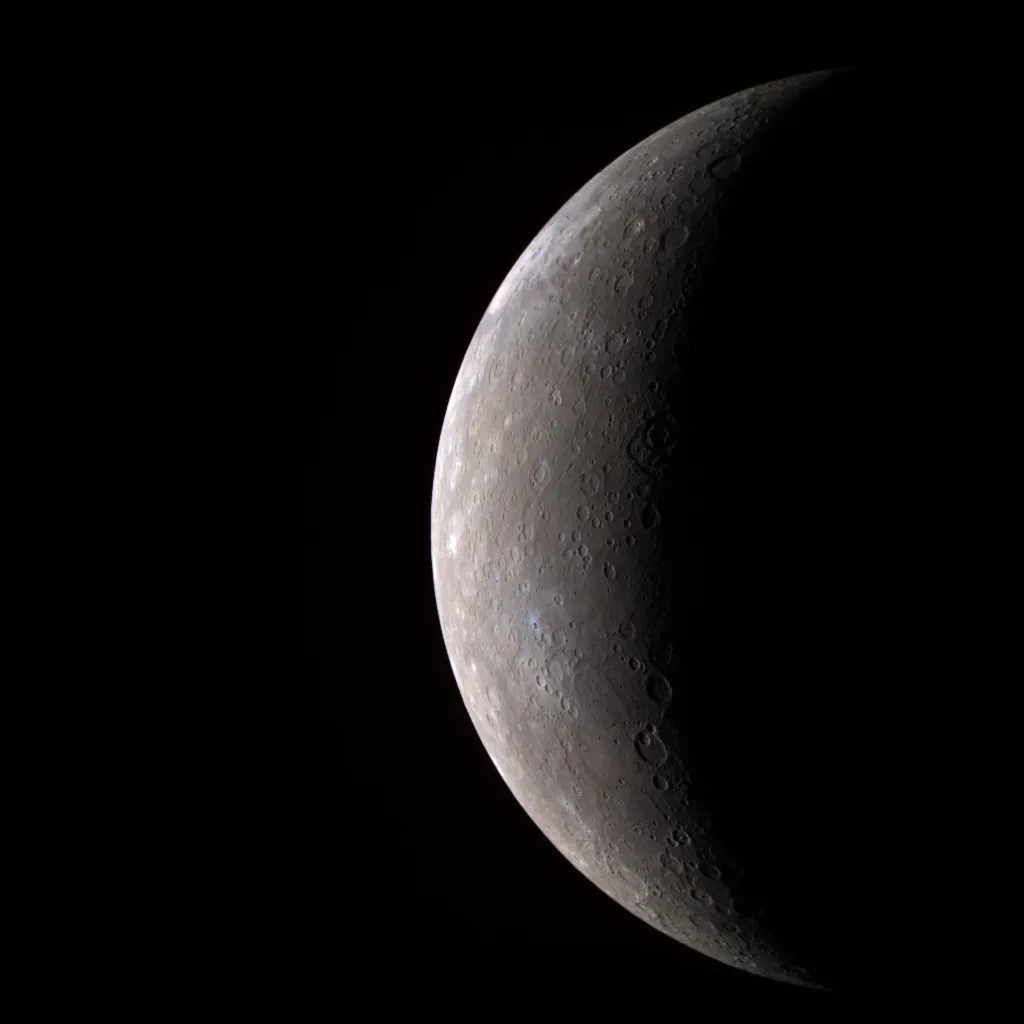
The mystery of why Mercury's magnetic field is so weak may just have been solved: It is being stifled by the solar wind, researchers think.
Mercury and Earth are the only rocky planets in the solar system to possess global magnetic fields, and for years scientists have puzzled over why Mercury's is so flimsy. Roiling molten iron cores generate magnetic fields, and given how extraordinarily iron-rich Mercury is for its size — its metallic heart may comprise two-thirds of Mercury's mass, twice the ratio for Earth, Venus or Mars — the innermost planet should have a magnetic field 30 times stronger than what spacecraft such as NASA's MESSENGER probe have detected so far.
To study Mercury's magnetic field, researchers created 3-D computer simulations of the planet's interior and of the solar wind, the deluge of energetic particles from the sun that constantly bombards its nearest planet.
The computer models suggested that the churning of Mercury's molten iron core ordinarily would amplify the magnetic field up to Earth-like levels, in a so-called dynamo process like the one within our planet. [The Greatest Mysteries of Mercury]
However, the onrushing solar wind likely prevents that from happening, researchers said.
The study found that the solar wind deflects charged particles in the shell around the planet known as a magnetosphere. The magnetic field of this magnetosphere reaches all the way to Mercury's core, limiting the strength of the field created by the planet's interior, researchers said.
This schematic of the Mercury's magnetic field shows the magnetosphere and heavy plasma ion flux as seen by NASA's Messenger spacecraft orbiting the small planet. Messenger has been in a near-polar, highly eccentric orbit (dashed red line) since 18 March 2011. Maxima in heavy ion fluxes observed from orbit are indicated in light blue.
(Image credit: Courtesy of Science/AAAS)
"The magnetic coupling between the magnetosphere and the dynamo in the planetary interior yields a weakened dynamo that can explain the enigmatic weakness of the magnetic field of Mercury," said study lead author Daniel Heyner, a physicist at Technical University in Braunschweig, Germany.
Sign up for the Live Science daily newsletter now
Get the world’s most fascinating discoveries delivered straight to your inbox.
Scientists plan to test the accuracy of their models using data on Mercury's magnetic field and magnetosphere collected by MESSENGER and by the European BepiColombo mission due to launch in 2014, researchers said.
"This is quite a challenge, as the magnetosphere is small and very dynamic," Heyner told SPACE.com.
The growing number of alien planets that astronomers are discovering around distant stars may also offer insights into how planetary dynamos "are controlled by the stellar wind of stars that are in a different evolutionary phase compared to our sun," Heyner added.
Heyner and his colleagues detail their findings in the Dec. 23 issue of the journal Science.
This story was provided by SPACE.com, a sister site to LiveScience. Follow SPACE.com for the latest in space science and exploration news on Twitter @Spacedotcom and on Facebook.
Charles Q. Choi is a contributing writer for Live Science and Space.com. He covers all things human origins and astronomy as well as physics, animals and general science topics. Charles has a Master of Arts degree from the University of Missouri-Columbia, School of Journalism and a Bachelor of Arts degree from the University of South Florida. Charles has visited every continent on Earth, drinking rancid yak butter tea in Lhasa, snorkeling with sea lions in the Galapagos and even climbing an iceberg in Antarctica.