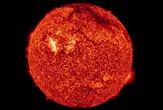
NASA's Solar Dynamics Observatory snapped this X-ray photo of the Sun early in the morning of Sunday, August 1st. The dark arc near the top right edge of the image is a filament of plasma blasting off the surface - part of the coronal mass ejection. The bright region is an unassociated solar flare. When particles from the eruption reach Earth on the evening of August 3rd/4th, they may trigger a brilliant auroral display known as the Northern Lights.
Skywatchers at high latitudes could be in for a spectacular treat of northern lights, the aurora borealis, Tuesday and Wednesday: After a relatively quiet stretch, it appears the sun is ramping up its activity.
The sun's surface erupted early Sunday, blasting tons of plasma (ionized atoms) into space. These atoms are headed toward Earth and could create a stunning light show in the process.
"This eruption is directed right at us and is expected to get here early in the day on Aug. 4th," said Leon Golub of the Harvard-Smithsonian Center for Astrophysics. "It's the first major Earth-directed eruption in quite some time."
The solar eruption, called a coronal mass ejection, was spotted by NASA's Solar Dynamics Observatory, which captures high-definition views of the sun at a variety of wavelengths. SDO was launched in February and peers deep into the layers of the sun, investigating the mysteries of its inner workings.
"We got a beautiful view of this eruption," Golub said. "And there might be more beautiful views to come if it triggers aurorae."
Views of aurorae are usually associated with Canada and Alaska, but even skywatchers in the northern U.S. mainland are being told they can look toward the north Tuesday and Wednesday evenings for rippling "curtains" of green and red light.
When a coronal mass ejection reaches Earth, solar particles stream down our planet's magnetic field lines toward the poles. In the process, the particles collide with atoms of nitrogen and oxygen in the Earth's atmosphere, which then glow, creating an effect similar to miniature neon signs.
Sign up for the Live Science daily newsletter now
Get the world’s most fascinating discoveries delivered straight to your inbox.
The interaction of the solar particles with our planet's magnetic field has the potential to create geomagnetic storms, or disturbances in Earth's magnetosphere. And while aurorae are normally visible only at high latitudes, they can light up the sky even at lower latitudes during a geomagnetic storm.
The sun's activity usually ebbs and flows on a fairly predictable cycle. Typically, a cycle lasts about 11 years, taking roughly 5.5 years to move from a solar minimum, a period of time when there are few sunspots, to peak at the solar maximum, during which sunspot activity is amplified.
The last solar maximum occurred in 2001. The latest minimum was particularly weak and long- lasting. The most recent solar eruption is one of the first signs that the sun is waking up and heading toward another maximum.
Space.com is the premier source of space exploration, innovation and astronomy news, chronicling (and celebrating) humanity's ongoing expansion across the final frontier. We transport our visitors across the solar system and beyond through accessible, comprehensive coverage of the latest news and discoveries. For us, exploring space is as much about the journey as it is the destination.