The 'easyJet ecoJet'¯ would emit 50 percent less CO2 than today's newest ...
A lot more Martian rocks were altered by water than scientists originally thought, suggesting that early Mars was a very wet place.
New observations made by NASA's Mars Reconnaissance Orbiter (MRO), currently circling the planet, have revealed evidence that vast regions of the southern highlands of Mars were altered by water in a variety of environments billions of years ago.
Water is a key condition for life as we know it. Though there is no firm evidence that Mars has ever harbored life, knowing that the planet was once wet suggests that it was at least habitable in the past.
The key to the finding is the discovery that rocks called phyllosilicates are widespread on at least the planet's southern hemisphere. The water present on Mars from about 4.6 billion to 3.8 billion years ago transformed some rocks into these phyllosilicates, which include clays rich in iron, magnesium or aluminum, mica, and kaolinite (an ingredient in Kaopectate).
"In a phyllosilicate, the atoms are stacked up into layers, and all of the phyllosilicates have some sort of water or hydroxyl [oxygen and hydrogen group] incorporated into the crystal structure," said study team member Scott Murchie of Johns Hopkins University.
Previous data from an instrument called OMEGA - Observatoire pour la Mineralogie, l'Eau, les Glaces et l'Activite on the Mars Express spacecraft had revealed only a few large outcrops of phyllosilicates, suggesting they were a relative rarity on Mars.
"It sort of gave the false impression that rocks that were altered like this were more restricted than they really are," Murchie said.
But the new observations, made with MRO's Compact Reconnaissance Imaging Spectrometer for Mars (CRISM) and detailed in the July 17 issue of the journal Nature, reveal "thousands and thousands of outcrops that we can now resolve with the higher resolution of the instrument, and they're scattered all over the planet wherever the older rocks occur," Murchie told SPACE.com.
"What that's suggesting to us is that we're seeing a pervasive subsurface layer that goes back in time — it's been altered by water to clays and related minerals, and it's outcropping all over the place," Murchie added.
The layer of water-altered rocks sits below younger, volcanic rocks and the ubiquitous windblown Martian dust and sand in many places. But in craters and scarps, including Valles Marineris, across the terrain of the southern hemisphere, the ancient clays and other minerals have been exposed.
"It's like going to the bottom rock layer in the Grand Canyon," Murchie said, where ancient layers underlie the whole area, but are only exposed in a few places.
This layering gives scientists a dividing line of about 3.7 to 3.5 billion years ago for a transition in Martian geology: "Before that the rocks were altered into clays, since then they're not," Murchie said.
The variety of clays and other minerals formed also tells scientists that rock was altered by water under a variety of conditions.
"There's a variety of environments that are formed where the rock was lightly altered where you see things like chlorite, to where it was altered with water at really high temperature, where you see mica, to where a lot of water must have flowed through the rock in order to dissolve out the iron and magnesium and you're left with kaolinite," Murchie said.
The alteration of later rocks, such as the sulfates found by the Mars Exploration Rovers (MER), Spirit and Opportunity in the northern hemisphere, on the other hand, formed under much more restricted conditions.
One implication of these findings is that some of the environments that formed the phyllosilicates would not have been antagonistic to any potential life, unlike the conditions that formed the sulfates, which formed in a highly acidic environment similar to battery acid, as Murchie put it.
Whether the MER rovers can get a close-up peek at these phyllosilicates while the robots still roam the Martian surface is uncertain, Murchie said, because so far the rocks haven't been detected near the crafts. But they could be there and simply be obscured in the north from the MRO instruments by dust.
"It doesn't take much to hide something from our optical instrument in orbit," he said, just a few micrometers of dust. "So just brushing away the rock surface could be enough," he added.
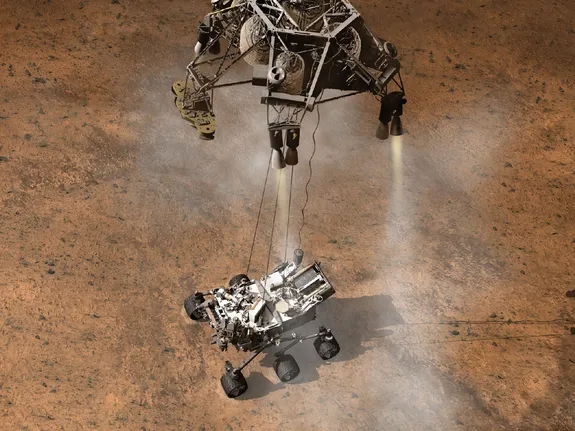
Whether or not Spirit and Opportunity get a chance to investigate these intriguing rocks up close, future rover missions, such as the Mars Science Laboratory set to launch 2009, could certainly be aimed at known phyllosilicate-rich sites, Murchie said, shedding more light on the mysteries of early Mars.
Most Popular
- Recommended
- Commented
- God and Evolution Can Co-exist, Scientist Says
- The Physics of Teardrops
- Gremlins Thought Extinct, Found After 85 Years
- Smoking's Many Myths Examined
- Clean People Are Less Judgmental
- First 3-D Images Inside Human Arteries
- Origin of Sex Pinned Down
- Fore! Here Comes the Ultimate Golf Ball
- Grave Reveals Violent Death of Ancient Family
- Taboo Lifts on Sex in Nursing Homes
- God and Evolution Can Co-exist, Scientist Says
- Intelligent Design: An Ambiguous Assault on Evolution
- The Human Soul: An Ancient Idea
- People Said to Believe in Aliens and Ghosts More Than God
- Gremlins Thought Extinct, Found After 85 Years
- Top 5 Most Unusual Big-Screen Vampires
- First Known Turtle Had Shell Shortcomings
- British Science Minister Claims Sixth Sense
- Extinct Woolly Mammoth's DNA Mapped
- Painful Labor: A Modern Thing
Animals
Marketplace Links
- Meet the HP ProLiant DL385 G5
- The HP ProLiant DL385 G5 server helps reduce resources and lets you manage systems-or collaborate-remotely
- Science. Technology. Sustainability.
- Visit the new Innovation Channel on LiveScience.com.
- One-stop destination for the lowest domestic airfares
- Search all airlines, including Southwest now!
- Get a free brochure
- Go exploring with the best ice team on earth. Polar bears or penguins? Choose now! expeditions.com/ice
- HP
- The HP portfolio of server solutions helps you push the envelope-without pushing your budget to the brink. ProLiant technology, affordably priced.
- LiveScience Store
- Find everything from weird science to cool gadgets!
- Don't toss it, Recycle it!
- Find local recycling centers now
- Feel Strongly About Energy Options?
- Speak your mind about technologies and innovations in our forums.
- BP
- There’s energy security in energy diversity.
- Facing a Dilemma? Let Geek Logik help.
- Use Algebra to inform your decisions
- HP
- Protect and store your business's critical data with HP All-in-One and Disk-Based backup systems