













How One Chinese Emperor Changed the World

Each Monday, this column turns a page in history to explore the discoveries, events and people that continue to affect the history being made today.
Ever heard of Qin Shi Huang?
Maybe not. But it's likely you have heard of the country he unified – China – and the Great Wall he built. Plus, there's that enormous army of terra-cotta warriors that watches over his mysterious mausoleum.
The world's most populous nation and emerging superpower was a jumble of warring states when Qin Shi Huang appeared on the scene in 246 B.C. as a powerful regional leader. Two decades later he was Emperor, bringing together the vast territory that would become China, standardizing its culture and implementing a form of government that his followers would use for another 2,000 years.
Qin Shi Huang (pronouncerd "chin shuh huang") remains a mythical figure in China, still laying in rest in the largest unopened tomb in history, said to contain rivers of mercury and a ceiling covered in precious stones.
Get along
When Qin Shi Huang ascended as ruler of the Qin tribe in 246 B.C., China had been at war for 200 years. Seven major states were battling each other for dominance in the land, which was then a patchwork of feudal villages with no central bureaucracy. After a series of victories, Qin absorbed its last rival in 221 B.C., unifying China under one leader.
Get the world’s most fascinating discoveries delivered straight to your inbox.
As head of the new empire of China, Qin Shi Huang didn't hesitate to establish a new law of the land. The Emperor quickly abolished the old feudal system, standardized the Chinese writing and currency systems, built a vast network of roads and canals to link the country and divided China into states with one centralized government.
A noted egomaniac, Qin Shi Huang was also known for building large, extravagant structures. He was also paranoid of attack from insiders. Almost immediately after taking power, he began construction on a large wall that would link up bits and pieces of existing defensive walls throughout the country. This would become the forerunner to the Great Wall that's still in existence, most of which was completed under a later dynasty.
Tomb to rival the pyramids
Whether he had predicted his eventual greatness or just had a big ego from the start, the eccentric Qin Shi Huang set to work on his own massive mausoleum just shortly after taking power of the Qin tribe at the age of 13. It was ready just after his death 36 years later in 210 B.C.
The mausoleum complex covers approximately four square miles near the modern city of Xi'an. Its main burial chamber is as big as the Great Pyramids of Egypt, but has yet to be excavated because archaeologists do not yet have the means to properly protect what they expect to find inside.
According to a historian writing 100 years after the Emperor's death, Qin Shi Huang's burial chamber contains a vast map of the land he conquered, complete with rivers of mercury. The "sky" ceiling is encrusted with stars made of jewels. And, like something straight out of an Indiana Jones movie, the entrance to the tomb is booby-trapped with crossbows.
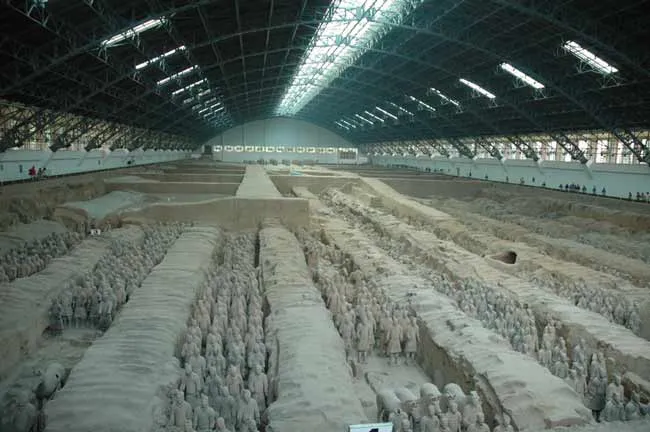
The historian's accounts of the tomb's grandeur may have been passed off as a tall tale had a family of peasants not stumbled upon one of the greatest archaeological discoveries of the century in 1974. A battalion of 8,000 clay soldiers and horses collectively known as the terra-cotta army was found standing guard near the burial mound, each one life-size and uniquely carved. Thousands more like them may remain underground within the funerary complex, archaeologists think.
What's in a name?
Just three years after Qin Shi Huang's death in 210 B.C., the Qin dynasty was overthrown. The imperial system that he'd set in motion, however, would remain at work in China until 1912, when the last Emperor abdicated and China became a Republic.
At the very least, Qin's dynasty, pronounced "chin," lives on in the country's name.
