













Tunic Worn by Saint Francis Identified
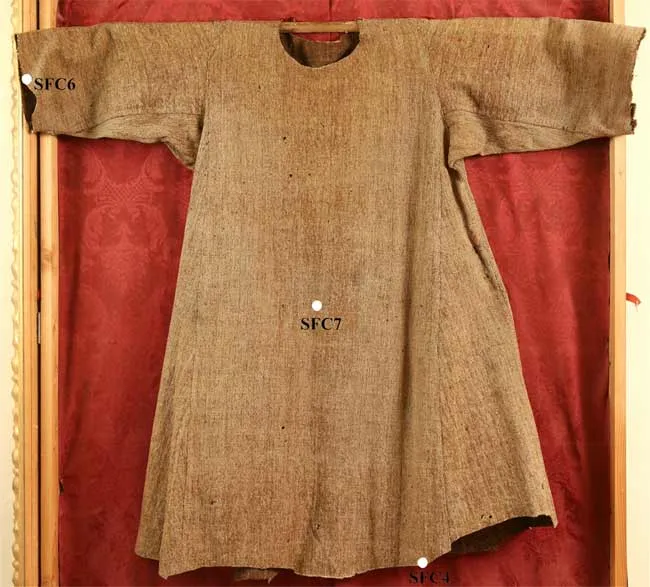
Only one of two recently examined ancient tunics thought to be worn by the Roman Catholic friar Saint Francis of Assisi is an authentic relic of the saint, according to a new analysis.
Using a radiocarbon dating method, physicists at the Italian Institute for Nuclear Physics (INFN) in Florence, Italy, analyzed material fragments from two tunics assumed to be relics of Saint Francis, one preserved in the Church of Saint Francis in Cortona in Italy and the other in the Basilica of Santa Croce in Florence, Italy.
They have not examined the two other tunics in Italy that have been ascribed to Saint Francis, one of which is preserved in the city of Assisi, where he was born, and the other in the Sanctuary of La Verna in Tuscany.
The measurements dated the ancient apparel in Santa Croce to a time between the late 13th century and the late 14th century, indicating it was made at least 80 years after the death of Saint Francis in 1226—and thus, could not have been worn by the saint.
The tunic in Cortona, however, was made between 1155 and 1225, coinciding with the lifetime of the "Poor Man of Assisi," as the saint was called, due to his voluntary casting away of all worldly possessions and his preaching of a simple life.
This tunic is one of three Franciscan relics thought to have been brought to Cortona by Friar Elia, Saint Francis' first successor as leader of the Order of Friars Minor (founded by Francis). The others, an embroidered cushion and a book of gospels, also dated back to the period in which Saint Francis lived.
Saint Francis is the patron saint of animals and the environment. Catholic churches today customarily hold ceremonies to honor animals on his feast day, Oct. 4.
Get the world’s most fascinating discoveries delivered straight to your inbox.
The study results were presented recently in Florence at the European Conference on Accelerators in Applied Research and Technology.
- Top 10: History's Most Overlooked Mysteries
- Fresh Claim that Shroud of Turin is Fake
- Trivia: The Artifact Wars
Jeanna Bryner is managing editor of Scientific American. Previously she was editor in chief of Live Science and, prior to that, an editor at Scholastic's Science World magazine. Bryner has an English degree from Salisbury University, a master's degree in biogeochemistry and environmental sciences from the University of Maryland and a graduate science journalism degree from New York University. She has worked as a biologist in Florida, where she monitored wetlands and did field surveys for endangered species, including the gorgeous Florida Scrub Jay. She also received an ocean sciences journalism fellowship from the Woods Hole Oceanographic Institution. She is a firm believer that science is for everyone and that just about everything can be viewed through the lens of science.