













Cities Force Plants to Evolve

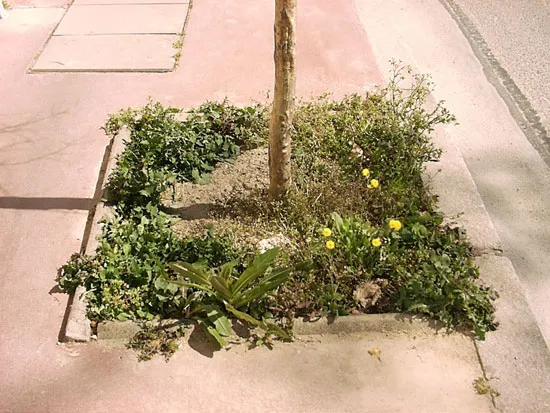
As concrete slabs chop up more and more of our urban landscapes, plants are forced to evolve in ways that may not benefit them in the long run, a new study suggests. As a plant or any organism's habitat becomes fragmented — whether by intervening sidewalks and roads in cities or by logging in rain forests — it can be cut off from other members of its species, making reproduction more difficult. Ecologists at the National Center for Scientific Research (CNRS) in France studied how a weed, Crepis sancta, changed its reproductive strategy when faced with ever-increasing amounts of concrete sidewalks. C. sancta produces two types of fruit, one that is heavy and falls on the ground near its parent plant, and another that is lighter and blown to other patches of ground by the wind. The researchers compared plants that grew in small "tree boxes" along the sidewalks of Montpellier, France, to plants that grew in open areas outside of town. The C. sancta plants that grew in the sidewalk patches produced fewer lighter fruits than those that grew outside the city. The finding suggests the plants had evolved to favor the heavier fruit because they were more likely to survive; they tended to fall in the parent plant's dirt patch, whereas lighter fruits blown away from the plant were more likely to land on the concrete. Using a model, the researchers estimated that it took the city-dwelling C. sancta plants only about 12 years (or 12 generations) to evolve to produce mainly heavy fruit. Ironically, though the weeds evolved this way because ithe adaptation favored the survival of the isolated population of the species, ultimately it likely only intensifies that isolation by reducing the population's gene pool, said study author Pierre-Olivier Cheptou of CNRS. Though the study only examined C. sancta, its findings, detailed in the March 3 issue of the journal Proceedings of the National Academy of Sciences, likely would apply to any plants or other organisms that can make a similar reproductive trade-off, Cheptou told LiveScience.
- Top 10 Poisonous Plants
- Mystery Solved: How Plants Know When to Flower
- Do Plants Have Sex?
Get the world’s most fascinating discoveries delivered straight to your inbox.

Andrea Thompson is an associate editor at Scientific American, where she covers sustainability, energy and the environment. Prior to that, she was a senior writer covering climate science at Climate Central and a reporter and editor at Live Science, where she primarily covered Earth science and the environment. She holds a graduate degree in science health and environmental reporting from New York University, as well as a bachelor of science and and masters of science in atmospheric chemistry from the Georgia Institute of Technology.