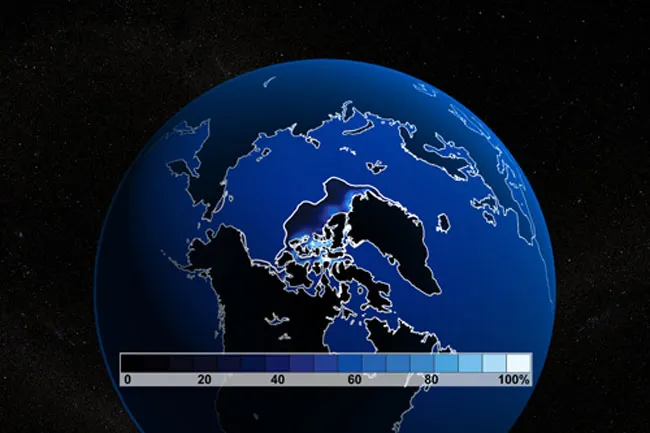
If you're looking to photograph a polar bear hopping sea ice floes on your next summer cruise, you better hurry because in 30 years, the Arctic Sea could be free of ice.
Simulating the climate with computer models, researchers analyzed how global warming could affect sea-ice in the future. The results, published in the Dec. 12 issue of Geophysical Research Letters, indicate that if greenhouse gases continue being released at their current rate, most of the Arctic basin will be ice free in September by 2040 [animation].
Additionally, winter ice, now about 12 feet thick, will become less than 3 feet thick.
One previous study predicted that the region will have no summer ice by 2060, another study forecasts that the Arctic will be icy up until 2105.
The rapid meltdown, result of a warming globe, will itself accelerate the heating of the oceans, according to the latest study.
"As the ice retreats, the ocean transports more heat to the Arctic and the open water absorbs more sunlight, further accelerating the rate of warming and leading to the loss of more ice," said study lead author, Marika Holland, a scientists from NCAR. "This is a positive feedback loop with dramatic implications for the entire Arctic region."
Additionally, ocean circulations—affected by global warming—are driving warm ocean currents into the Arctic.
Sign up for the Live Science daily newsletter now
Get the world’s most fascinating discoveries delivered straight to your inbox.
"We have already witnessed major losses in sea ice, but our research suggests that the decrease over the next few decades could be far more dramatic than anything that has happened so far," Holland said. "These changes are surprisingly rapid."
However, the future of the Arctic doesn't have to be so grim: running simulations with less greenhouse gases, the researchers found that the summer sea ice melted at a much slower rate.
"Our research indicates that society can still minimize the impacts on Arctic ice," Holland said.
Animation: Year-to-Year Variability of Arctic Sea Ice
What makes Earth habitable? This LiveScience original video explores the science of global warming and explains how, for now, conditions here are just right.
Sara Goudarzi is a Brooklyn writer and poet and covers all that piques her curiosity, from cosmology to climate change to the intersection of art and science. Sara holds an M.A. from New York University, Arthur L. Carter Journalism Institute, and an M.S. from Rutgers University. She teaches writing at NYU and is at work on a first novel in which literature is garnished with science.