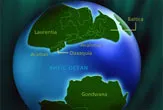
A graphic showing what scientists previously thought Earth looked like 420 million years ago (left) and a revised map (right) based on new evidence uncovered in southern Mexico.
A section of the Appalachian Mountains discovered in Mexico is forcing scientists to redraw their maps of ancient Earth.
The Appalachians are a series of mountain ranges in eastern North America that extend from Southern Quebec in Canada to northern Alabama. A piece of the chain was recently uncovered in a large Mexican outcropping of rock, known as the Acatlan Complex.
Analyses of the rocks revealed they were formed on the ocean floor, and dating showed they were much younger than previously thought.
"This will change the way geologists look at Mexico," said study leader Damian Nance of Ohio University.
It also challenges current theories about the creation of the Appalachians, mountain ranges that have revealed valuable clues about the planet's early geography.
Previously, scientists thought that 420 million years ago Earth contained two main land masses that were separated by a large expanse of sea, called the Rheic Ocean. In the south was Gondwana, a supercontinent consisting of South America, Africa, India, Australia and Antarctica. And to the north was Laurussia, made up of North America, Greenland, Europe and parts of Asia.
According to the standard scenario [image], the Acatlan Complex was once part of Gondwana, but it broke off the supercontinent about 500 million years ago. The complex, along with a few other chunks of land, drifted northward, and in the process blocked a stretch of sea known as the Iapetus Ocean. The Acatlan Complex eventually collided with North America, and with the force of a colossal bulldozer sent the once flat land into mountain-size ripples—forming the Appalachian Mountains.
Sign up for the Live Science daily newsletter now
Get the world’s most fascinating discoveries delivered straight to your inbox.
But the recent analysis of the Acatlan Complex rocks revealed they once existed on the Rheic ocean floor, not the Iapetus, suggesting the Appalachian-forming collision occurred about 120 million years later.
According to this scenario, the Acatlan Complex remained a part of Gondwana and the entire supercontinent slammed into North America. The collision closed the Rheic Ocean, created the Appalachian Mountains and formed the goliath land mass known as Pangea.
The study is detailed in the October issue of the journal Geology.
Pangea
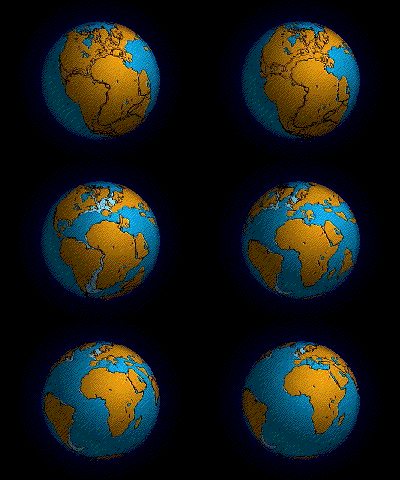
Pangea began to break up about 225-200 million years ago. This animation shows how it unfolded.