There is a joke about how hard it is to find a venue for meetings of astronomers. Hotels don’t want to host them, because they’re such a serious lot that not enough drinks are sold to make it a profitable affair.
What astronomers lack in party skills they make up for in the field of argumentation. They fight about how the asteroid search should be conducted, they argue over what telescopes deserve NASA’s precious funding, and they have the occasional spat about whether an unseen thing around a faraway star is a planet or a brown dwarf.
But mostly they argue about Pluto. Heatedly for seven years now. It’s approaching comical. And I think even they can see the humor in it all. That Pluto was ever termed a planet was a grand error, many astronomers agree. But school children love Pluto, so an equal number of astronomers are loathe to cross them. An even larger number of astronomers, meanwhile, have kept their mouths shut the whole time.
This week’s proposal to finally create a definition for the word “planet” (isn’t that amazing that there has never been one?) has pulled the bystanders out of the bleachers and into the brawl. It’s as if a pitcher in game 7 of the World Series beaned Barry Bonds and there was no crowd control. Read for yourself.
Even supporters of the definition—which makes planets out of a whole lot of small round things—concede it’s not that great. But it’s better than no definition, they say. Funny thing, so many astronomers are sick of the whole thing, it just might pass in next week’s vote.
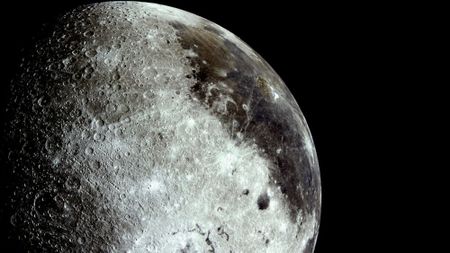
Okay, that’s not the really funny thing. The really funny thing is that Earth’s Moon might one day be considered a planet under the new definition.
With all due respect to what I know has been an arduous and serious process, let me propose some possible names for our wayward satellite, in keeping with “pluton,” the goofy term (people we interviewed laughed about it) that the astronomers came up with to describe little planets way out there. I’m thinking, for our venerable Moon-turned-planet: Planemoon, or Moonet, or my favorite: Moolanet. Accent on the “Moo.”
UPDATE: A 2nd definition has been proposed at the IAU meeting, one that would demote Pluto. Astronomers seem to be split about 50-50 on the two ideas now. One astronomer sent me this email: “A wild time in Prague.” And I don’t think he meant the hotels were making money.


August 18th, 2006 at 11:02 am
Why don’t they call Pluto a Traditional Planet? They can then get around the issue of Pluto’s size and Planet description to make a proper definition for categorizing future planets.
August 18th, 2006 at 11:36 am
Anything the same size as Pluto or larger would be considered a planet. Anything smaller would not. That would keep Pluto as the 9th planet. If current observations are confirmed 2003 UB313 would become the 10th planet, presumably to be called Xena. Charon, Ceres would not have to be reclassified.
Keep it simple. The IAU is curretly in danger of looking confused to the public. Nothing changes except there is now a 10th planet. The definition of “planet” becomes much clearer. It is all arbitrary anyway, why make it complicated.
August 18th, 2006 at 1:09 pm
Dear za Space Peoples
Had da Mr. Valter Disney not named his happy cartoon pooch za “Pluto” da popularity uff da ,er, eccentric pair in za questioning vould not haff been so greatly exaggeratink.
Instead uff demoting da cute Pluto set or devisink entirely newsome name classifications und further muddyink za etherial “waters” while likewise upsetting the little kiddies, perhaps da Pluto object could just be called za Planet (Emeritus), like me.
Sinkcerely,
Substitute Associate Professor (Emeritus) Erstwhile Dangdinglehoffer
August 18th, 2006 at 1:38 pm
Dear Robert,
As the debate rages over what’s a planet and what’s not, there’s clearly a struggle between passions and science. Theories aside, there is more here than meets the eye. A portion of the scientists will not be happy with a definition that includes Pluto as a planet; there’s no changing their mind. There’s a portion of the community that will only be happy if Pluto remains a planet; there’s no changing their minds either. The remainder are somewhere in the middle. Many of those people in the middle are uneasy with the thought of hundreds of planets based on ‘loose’ and unscientific definitions.
The resolution and compromise, however, is much easier to articulate:
1) First, the term ‘plutoid’ needs to be eliminated from all discussions. This immediately groups Pluto into a category with all smaller bodies. Instead of the term ‘plutoid’ or ‘dwarf planet’, the term planetoid is appropriate.
2) The newest definition of a planet needs to be refined to include additional criteria to eliminate asteroids and other small bodies circling the sun. The easiest measures to use are probably mass and circumference. Objects less than some arbitrary size won’t pass muster. So, some giant ice ball, yet to be discovered, that’s very large but without sufficient mass would be defined as a planetoid. As would very dense asteroids that don’t meet the circumference criteria.
3) If further delineation is required to avoid hundreds of planetoids, then a similar criteria of circumference and mass could be applied to planetoids. Objects smaller than some arbitrary size could then be classified as sub-planetoids. Not a catchy name, but it works for me.
4) The scientific community needs to define their arbitrary measures. Apparently, size does matter. Would the debate be raging if Pluto were the size of Neptune? Maybe not. You cannot please 100% of the scientific community. They need to choose measures that can then be added to their new definition… something larger than Pluto to exclude it, something smaller than Pluto to include some new planets… or exactly Pluto’s size to set the measure at fixed / known size; scientists love to compare things to a known quantity for classification.
5) What’s going on here combines historical precedence of Pluto being a planet vs. the formulation of a ‘perfect theory’. Some people are just not going to be happy. My personal feeling is Pluto should be a planet; but hey, they didn’t really ask my opinion now did they?
Should there be 3 more new planets? Yes, no, maybe.
The one thing I do know is a measure of common sense won’t hurt.
John DiBiasi
Sedona, AZ
August 18th, 2006 at 1:42 pm
They should bite the bullet and demote Pluto. It never should have been called a planet in the first place. If students raise an outcry than let them argue their case with facts and logic. It would be great to see school kids excited about something for a change.
And “Pluton” sounds like what an inhabitant of Pluto would be called. That name is ludicrous to say the least.
August 18th, 2006 at 3:33 pm
People should get used to the fact that science is not religion, and that things are bound to evolve. The Earth is not that flat anymore, and we went on with the idea that it is even a planet (it was not the case before, planets were the moving stars in the zodiacal constellation).
If you create a plot of solar system objects, showing their mass versus the inclination of their orbit in the solar system, you find two nice clouds of objects, at left, the asteroids, in the lower right, planets. Guess what, Pluto is part of the asteroids. I have these plots on a web page I wrote last January : http://www.spaceobs.com/perso/textes/planetsandasteroids.htm
The whole story shows how hard it is to study far away objects in the solar system. For a long time, we believed Pluto was a planet. It looks like a dot in any telescope. It has a long unseen satellite, and is also covered with ice, therefore very white. The astronomers in the 30s when trying to measure its diameter thought it was about 5000km (i.e. like Mercury which is the smallest planet), when in reality, more recent measurements showed it to be about 2200km, something like 2/3 of our moon, 455 times less massive than the Earth. We could have left things at a status quo, but the problem is that now we have many Pluto like objects, including one, 2003UB313 which was dubbed the tenth planet by its discoverer, without the rest of the astronomers being consulted. Either the astronomers put the line above Pluto (and 2003 UB313), which is a logical thing to do, and it should have been done a long time ago, or in order to save Pluto has a planet (which it is not), we have to include 2003UB313, then other transneptunian asteroids of almost similar size, like 2005FY9, then 2003EL61, then…. Sedna, Quaoar, Ixion, Varuna, and a very long list of objects which are in the same ballpark as Pluton. Then in order to get a limit, we could think of using the roundness of the object, which is what the IAU resolution tried to do (I think it will not go through). The fact is that we can not measure precisely the diameter and the shape of far away objects in most cases. So either Pluto is at last not considered a planet anymore, or it is, but together with 50 other objects, plus 20 challengers to the title. It would be a terrible thing to have so many planets, and then so many objects for which we can not really know if they are planets or not. So now, poor children who are sad about Pluto not being a planet (personally I find that an asteroid is way cooler than a planet, but that’s a personal point of view), how are you going to be when you will have to learn a list of 50 boring names instead of just 8 ?
Alain
To Ed Shafer : Pluton _is_ the name of Pluto in most latine languages, french, italy, spain, etc… But yes, using it to define a new subclass stinks…
August 18th, 2006 at 5:15 pm
I like what has been proposed. It would bring into the public eye many objects that not to far from now will have cities on them. As far a having too many planets, whats the problem?
Geography in the mind of a space faring people: There is the inner solar system with some planets and some moons, the main belt with some dwarf planets and lots of asteriods, the giant planets with lots of moons and some rings, then the far off outer solar system with wild and exotic things like double planets.
Ceres, why not call it a planet so it’s in the public mind when jobs there get advertised in news papers here on earth?
August 18th, 2006 at 5:27 pm
I think the popular definition of a planet will just diverge from the astronomical one, if they choose one that’s too different.
There’s an example from physics. In physics, “acceleration” means speeding up, slowing down, or changing direction. In the popular mind, acceleration just means speeding up. But the physicists aren’t just being perverse or arbitrary, they *need* that definition because physical reality behaves in such a way that those three things are in fact one.
For planets, astronomers will choose the definitions that are most productive and least confusing for *their* purposes, and the public might make a different choice.
August 18th, 2006 at 6:18 pm
I just got an email from Steve Kortenkamp at the Planetary Science Institute. Among other things, he models the oddities of orbits of small space objects in the outer solar system. He has a sidelong glance at this whole thing that I found illuminating. His words (my boldface):
“Planet” has become a cultural term, not in need of a scientific definition. In fact, you could argue that “planet” has _always_ been a cultural term. As a scientific body wading into a cultural issue, the IAU is shooting itself (and all astronomers) in the proverbial foot by twisting around it’s own new definition to fit Charon. Supporters say the new definition is simple because it all comes down to gravity. But all this talk of barycenters ignores the fact that at the most basic level Charon feels a stronger gravitational acceleration from Pluto than from the Sun (as do all other satellites). Therefore, Charon must be a satellite, not a planet. Same thing goes for those other hulking satellites Titan and Ganymede. They’re bigger than Mercury but feel a stronger force of gravity from their host planets than from the sun. Thus, they too are satellites.
August 18th, 2006 at 7:02 pm
As far as I know there are no other moons in our solar system with moons of their own. Therefore in Pluto’s case Charon is a moon because it orbits Pluto and Pluto should be “grandfathered” as a planet regardless of future decisions on the matter of planet designation since it has had that “label” for so many years.End of discussion no further action needed.
August 19th, 2006 at 12:07 am
I’d accept the proposal, at least the are trying to employ objective criteria, mainly that gravity is strong enough to give it the classical world like shape. Intuitively you may ask am I on a world or a flying mountain (as I would describe many asteroids)? Ceres and Pluto are in fact very interesting worlds, they certainly shouldn’t be ignored, Pluto might well have a whole armada of moons an atmosphere the whole shebang so at some level if I was standing on it I would think I’m on a planet. If I was writing the proposal I’d have a semi-major planet catagory for Pluto and Ceres yes they are technically planets but worlds not much bigger than the disney ride, mostly because we are going to be finding huge populations of these things and it could get cumbersome, no need for that if you have the semi-major catagory they have their status but don’t need to be on the short list. I’d ditch the rule making Charon a planet, in binary planets the larger of the two should be considered the primary. Intuitively we think of Charon as a satellite based on the very rule I’m proposing.
August 19th, 2006 at 12:32 am
I don’t understand why defining the term “planet” is so difficult. It seems very straightforward to me. What is the largest celestial body that can hold a thin atmosphere of mix gas? Every planet in our solar system has the same thing in common. They can all hold an atmosphere. Pluto can not, its too small. So therefore, Pluto is really a K object and not a Planet. I’m sure there is a critical diametrical mass that an object can possibly retain an atmosphere. Like Mercury is probably big enough to retain an atmosphere but due to its proximity to the Sun it has long since burned away.
Astronomers 100 years from now are going to look back and say that Scientists let “nostalgia” and not science dictate the definition of a planet.
August 19th, 2006 at 4:48 am
I am on the side of the first proposal.
I am fully aware that there might be hundreds of potential planets in the solar system. I have no problem with it.
The roundness of an object is a scientic definition.
It’s true that many satellites are much bigger than Ceres. However, Titan and Ganymede are bigger than Mercury. Should Mercury be demoted?
The most coherent proposition would be to call all planetary satellites “planets” and not only satellites. However this is too much revolutionary. I still think the first proposal is a good compromise.
If Pluto gets demoted… let us just wait until a new discovered KBO is bigger than Mercury.
August 19th, 2006 at 6:49 am
In our solar system…
1. There are rocky planets and gas planets… The difference between a gas planet and a rocky planet is huge, yet they are all called “planets”.
2. The difference between a gas planet and a rocky planet is “scientific” (not arbitrary) just like the difference between a solid and a gas is scientific.
2. “Historic planets” have been found to orbit the Sun following a plan called the ecliptic.
3. Kuiper Belt Objects have been defined as such for having a non-regular orbit around the sun… for being relatively small (compared to the historic planets) and for being composed of ice and rocks (like comets?).
3. There are satellites that are bigger than Mercury.
4. There is at least one “Kuiper Belt Object” that is bigger than Pluto.
5. There are some big “asteroids” large enough to be round-shaped like a planet.
6. There are quite a few “Kuiper Belt Objects” that are much more massive than Ceres but they are still less massive than Pluto.
7. There are no reasons to believe that new larger KBOs will not be discovered. The possibility that an unknown KBO is even larger than Mercury does exist.
Among all the extrasolar planets that we know…
1. There are no evidence that they orbit their star in a regular way.
2. There is at least one planet discovered without orbiting a star.
3. There are no evidence that a satellite of an extrasolar (gas) planet is not as big as the Earth.
Among the stars…
1. There many classes of stars based on their size and their longevity but they are all called stars.
2. Brown dwarfs are actually not big enough for thermonuclear fusion. There are no such clear-cut distinction to be made between planets bigger than Mercury and the smaller… objects.
Conclusion: If we want to set up a long-term standard, there are no other solutions than giving up the previous arbitrary definitions set up in terms of orbit and the size of “historic” planets. We need a gravity-based definition. I understand the frustrations about the issue of planets not being satellites, and satellites being smaller than planets. If we are serious about sorting out the controversy, then we should call all round satellites “planets”.
Roundness can be defined in terms of a necessary mass and density for gravity to shape a round object. Excluding all new round objects from joining the club is not a solution.
August 19th, 2006 at 9:54 am
I obtained a copy overnight of the alternative planet defintion that was presented yesterday at the IAU meeting. See it here.
August 19th, 2006 at 3:27 pm
I think the best plan is to base planetariness on gravity. It’s a physical basis instead of an arbitrary one. Pluto should never have been called a planet, eh? Why? Because it’s orbit is weird? Look outside of our solar system…lots of planetary orbits are weird. Is it because it’s icy? That’s just silly. Is it because it’s too small? Too small? Is it? How small is too small? Oh yeah, that’s what we’re arguing about.
Right now, based on what I’ve read, it seems to mostly come down to whether or not you like Pluto being called a planet and then you form your recommendation based on that. Me, I don’t care much one way or the other. It just seems that saying something like “It must have a diameter of 3000km” is remarkably arbitrary unless you have some physical conditions to back you up.
I’ve expanded on these views at:
August 19th, 2006 at 9:15 pm
So…here’s the deal, demoting Pluto would be silly. It would totally screw up that Animaniacs song about the planets.
It’s time to tour the planets that make up our solar system - come on!
The closest to the sun is the planet Murcury
Next the shouded planet venus
Is as covered as can be
The Earth is next, we call it home
Let’s hope it stays that way
And then there’s Mars, it’s really red
What more can I say?
The Gassy planet Jupiter’s
As big as planets come
Then there’s Saturn with its mighty rings,
Made up of tiny crumbs
We travel on to Neptune
That’s a gassy-freezy ball
And cold and tiny Pluto
It’s the furthest one of all
Well, there you go, that’s our solar system
-You forgot Uranus
Goodnight everybody!
Go ahead…try to sing it without Pluto…you can’t.
August 19th, 2006 at 10:16 pm
I think I can solve all of our problems. We’ve all seen the asteroid disaster movies, and there has been plenty of speculation about how we’re going to solve our problem in the eventuality that it ever comes up. So, lets use Pluto as target practice. Define a planet any way you want, and no special case for Pluto. It’ll be gone (or, you know, somewhat reduced).
August 19th, 2006 at 11:15 pm
I like the alternative planet definition in that it seems intuitive that a planet would have accreted all the mass around it during the creation of a solar system.
The only thing I don’t like is the lumping of the larger non-planetary solar bodies like Pluto, Ceres, Xena, et al into the “small solar system bodies” category along with asteroids and comets. I’d prefer to see them separated into their own category defined as:
planetoid is a non-planetary object massive enough for its gravity to form a nearly round shape. There can be both solar and extra-solar planetoids.
August 19th, 2006 at 11:46 pm
(1) pluto could truly be a double panet/binary planet seeing as it’s two outer moons orbit around Pluto and Charon…
(2)I can’t see calling the eart’s moon a planet seeing as it orbits the earth…
(3)I can even see Ceres being called a planet seeing as there is enough debris in the asteroid belt to be a small planet at one time prior to a possible collosion that busted up the planet… Ceres is the place holder for the once possible planet…
(4) Xena/Sedna… Why not call them planets… In 50 /60 years our space probes will explore the Kiper belt area and we can reclassify them then if need be…
(5) Leave the openings for more planets in our solar system. This will stimulate children to become astronomers and seach to find a new planet, possimly forfil there dreams…
(6) Moons orbit a planet regardles of the exsistance of life found on a moon, whether the life is being intellegent or not. It is possible some were where the planet will be dead but it’s moon hold all the life… Moons orbit planets… If the Earth orbited the Moon then the Moon would be the planet and the Earth would be a Moon… IF we find life on a moon around Jupiter, it’s still should be classified as a Moon around Jupiter
(7) Planets are place holders that orbit/travel around a star whether its in an ecliptic plane or not…
(8) If a planet can be that of gas why can’t a planet be that of water/ice
(9) Possibly there is a solar system out there where life is miniture compared to us and all the planets are small in coparison to Mercury or Pluto… A Planet is a Planet regardless of size… AGAIN I SAY, A Planet is a place holder in a solar system,
(10) Man makes up the definitions in our solar system wether they be correct or not… Planets are not man made, but man is attempting to define a planet… Keep it simple because space is full of surprises… Just when we believe we know all the rules a solar system out there will contridict all our made up rules…
August 20th, 2006 at 12:41 pm
I feel the need to throw in my two cents on this whole topic. I would say I have more than just a passing interest in science and technology. I am by no means a pseudo-scientist or even a hard-core astronomer. I read my Discover magazine and Popular Science, keep up to date with all things science related on-line as well as catching any good science documentaries that may pop up on PBS from time to time. I am confident in classifying myself as an ordinary person with a love for science.
With that said I think the new planet classification system is great. The rules seem simple enough to me (as a layman) and it astounds me when people say it may be confusing for the general public. I think some people are making this new system more confusing than it is. The rules are straightforward and anyone with a passing love for space/science will be able to understand them easily. The public who doesn’t ‘get it’ really has no interest to begin with and shouldn’t be factored into the equation.
Even though there is no formal definition of a planet I feel that if you were to take a random sampling of people off the street, sit them down in a room and show them illustrations of the following (non-labeled) celestial objects on flashcards, then ask them to state yes or no if what was on the flashcard was a planet or not, it would probably (9 out of 10 times) go like this:
Vesta – “No”
Sedna – “Yes”
Jupiter – “Yes”
The Sun – “No”
Eros – “No”
Halley’s Comet – “No”
Europa (with Jupiter in background) – “No”
Earth – “Yes”
Ida – “No”
The Voyager Spacecraft – “No”
Pluto – “Yes”
The Moon (so long as it was a familiar photograph) – “No”
Europa (with NO Jupiter in background) – “Yes”
A perfectly round cantaloupe floating in space – “Yes”
The point to all this is the definition of a planet is imbedded into our psyche. A giant sphere floating in space (unless it is in flames or understood as a moon) is a planet. Add to this the fact that nature determines if it becomes a sphere or not just makes this whole debate a no-brainer to me.
In addition I feel some people think that upon christening these new (minor) planets the major-planets will somehow be demystified. I mean come on people, how can you look at Jupiter or Saturn and say if you throw in Ceres it will make the former two loose their magic? Quite the contrary I think it will further illustrate the magnificence of them. When it comes down to it all what does it matter to the scientist? Ceres is Ceres, Jupiter is Jupiter and everything is what it is, what point is there in labeling it all?
Well I will tell you what the point is… excitement for us normal people. I see my two Nephews (ages 9 and 12) now excited over the prospect of 3 new planets. It has sparked INTREST in them and they want to know more about the solar system and have been going online looking at ALL the planets as a result of this. Even myself have been online the past couple days reading all about Ceres, Charon and ‘Xena.’ I have to admit before all of this I knew very little about Ceres… Now I am fascinated by it.
This system, though helpful for the professional scientific community (which in reality, will view things the same no matter however the vote goes), should really also be considered for us ‘normal’ people of the world. I truly feel that if passed this new definition (as well as announcements of future ‘new’ planets) will spark a new founded public interest in our own solar system. Instead of a static system where 8 (or 9) planets are the ‘end-all-be all’, we will have dynamic fluid solar system where new things are still possible. That is exciting… and anything that makes kids and adults excited and interested in science cannot be a bad thing.
August 20th, 2006 at 1:15 pm
Earth’s size shouldn’t be a factor; The definition should be universal to any star system. Mass, as a percentage relative to the central body, could be the alternative consideration. I’m sure for some that would would be too rigid, but it would permit a line to cross before becoming a planet. Pluto being downgraded from status as a planet wouldn’t bother me one iota. The rule about a planet not supporting fusion/fission/whatever is a good division as well.
Plutoid is a term for the circular file; it, too, is Sol-centric.
I’m not too keen on the idea that Pluto’s moon can become a planet. A Planet’s primary orbit should be around the central star. In a case of near-identical sized objects orbiting each other, that could be termed a planetary pair; a key concept here is orbiting each other so each has a sine-wave orbital path– i.e. Athena major and Athena minor. If it orbits a planet without significant impact on the planet’s eliptical orbital, IT’S A MOON. Of course, then you have to define “significant impact”, which could be twice the planet’s diameter.
Here’s a simple view:
Planets should be a product of the star’s system formation (with other caveats).
1) Primary planets should be within a narrow angle of the sun’s plane of rotation, i.e. 15 degrees.
2) Secondary planets orbit in a plane tilted larger than the primary/principle ( these objects would appear to have been captured subsequent to the system formation or as a result of a massive collision between a primary object and an extra-system mass).
3) Those objects with sufficeint mass to form a ball, but fall outside the definition of a planet should be called planetoids– NOT PLANETS, NOT DWARF PLANETS. The term dwarf planet to me sounds like “almost pregnant”– to wishy-washy
I’m sure there are situations in the Galaxy that would play havoc with this simplistic approach. One system’s planet would be another’s plantiod, but that’s to-well into our future to debate now. Just make a definition that’s (largely) applicable, regardless of star system referenced.
Just a simpleton’s opinion…
August 20th, 2006 at 3:01 pm
I like the original IAU proposed definition of planet: “A planet is a celestial body that (a) has sufficient mass for its self-gravity to overcome rigid body forces so that it assumes a hydrostatic equilibrium (nearly round) shape, and (b) is in orbit around a star, and is neither a star nor a satellite of a planet.”
The definition is simple and has no arbitrary numbers. In fact, it has no numbers at all. This is good because it means the definition is based on basic principles.
I like original proposal more than the counter-proposal: “A planet is a celestial body that (a) is by far the largest object in its local population, (b) has sufficient mass for its self-gravity to overcome rigid body forces so that it assumes a hydrostatic equilibrium (nearly round) shape, (c) does not produce energy by any nuclear fusion mechanism.”
The population-based counter-proposal is not as simple as the size-based original proposal. It will require various somewhat arbitrary numbers to define “by far the largest” and “local population”. The counter-proposal is not easy to apply to other planetary systems. We are are likely to know the mass (and therefore the roundness) of extra-solar planets, but we are unlikely to know much about the “local populations” of extra-solar planets. Another problem is that the counter-proposal would not, without revision, categorize an extra-solar double-Jupiter as a planet.
The fact that the original proposal opens the doors to a lot of dwarf planets is not a problem. Just because there are a lot more planets, that does not mean we will require kids to memorize all their names. They will simply need to learn the eight main planets (the four rocky mid-size planets and the four gas giant planets) and know that there are also a lot of dwarf planets that do not need to be memorized.
The counter-proposal is a reasonable proposal. I have no problem with demoting Pluto and saying there are only eight planets, if that is what the majority of astronomers want to do. But I think the original proposal is better: it is simpler, has fewer arbitrary numbers, and is easier to apply to other solar systems.
August 21st, 2006 at 12:28 pm
I like the original proposal much better, but add in the upper limit of no nuclear fusion.
August 21st, 2006 at 12:31 pm
I am perplexed by both IAU’s initial and the so called 2nd proposed defintion of a planet mentione on this blog. They both have very arbitary and complex elements in them. Both these definitions propose to mix what an object is with its role (ther relationship with other celestial objects). We don’t do this with stars, so why do it with planets? A dwarf planet is, by definition still a planet, just a dwarf one. It sounds to me that a dwarf is just a sub-classification of an object, which is first and formost, a planet.
Let me throw in my two bits at coming up with a definition of a planet. This definition is partly a compilation of ideas already expressed by others on the internet. I have taken these ideas and applied Occam’s-Razor, together with some of my own ideas, to come up with what I believe a more simple and concise definition.
• Definition of a planet
Rule 1: A planet must not be so massive that it can support any fusion reactions, even briefly.
Rule 2: A planet must not contain degenerate matter, such as a core of solid neutronium that might be left over from the death of a star.
Rule 3: A planet must have sufficient mass to have a shape determined by gravity and not by the strength of its materials. This means it is spheroid, i.e., nearly spherical.
Note: These rules allow certain objects in our Solar System such as moons, Ceres and some Kuiper Belt objects to also be classified as planets. How the object formed, or whether or not it is in orbit around a star is not part of this definition of a planet. However, it is generally accepted that most planets do form by accretion in the disc of gas, dust and rocks left behind by a proto star and therefore do orbit stars or Brown Dwarfs. Is seems quite reasonable that some planets might be ejected from their birth stellar systems and become wandering planets in interstellar space. Such objects would not by such action somehow magically metamorphose and cease to be planets.
• Roles of planets (with special meanings applied to certain terms) It would seem useful to distinguish between what an object IS and what ROLE it plays in a system.
o Major Planet — a planet that is in orbit around a star.
o Minor Planet — i.e., a natural satellite, or moon — a planet which is in orbit around another planet. This definition allows moons in turn to, themselves, have moons.
o Wandering Planet — A wandering planet would be one which is not in orbit around any other object, except perhaps, though not necessarily, around a Galaxy.
o These roles could also be applied to planetesimals. (see below)
• Definition of a sub-planet, i.e., a planetesimal (again exapting a word for this definition)
o Planetesimals would be any objects in space too small to fit the definition of a planet, e.g., asteroids, comets and other space debris larger than gas and dust. These may exist in orbits around a galaxy, a star, a brown dwarf, a planet, or other planetoid.
• Sub-classes of planets
Just as we have sub-classes of stars based on certain criteria such as size and luminosity, so also can we have sub-classes of planets. Planets might be sub-classed as: Giant, Dwarf, Gas, Rocky, Icy and so on. Sub-classifying planets should not make them non-planets.
Wade Starks
August 21st, 2006 at 4:12 pm
The IAU’s draft definition of “planet” is, at once, both scientific and clever. For the time being, Pluto remains a full fledged planet.
But once the number of planets gets too high, perhaps a little beyond the teens, the media will no doubt count them as follows:
* 9 “regular” planets (including Ceres) and
* a dozen or more “plutons,” including Pluto.
August 21st, 2006 at 8:21 pm
I must say, I have never understood the Pluto-haters frame of mind. It always seems the most obnoxious form of elitism. It seems clear to me that there is more in common between Pluto and ‘Xena’ and Earth and the other rocky planets than the four gas giants. I suspect that if we were from Jupiter, we would think that there are only four planets in our Solar System.
One argument that I am tired of is that if we open up the definition to include objects like Pluto, there will be ‘too many’ planets. What kind of logic is that? With that kind of thinking, the US should have stuck with the original 13 states because all those others would be too hard for school kid to memorize. Does anyone have a problem that we have over a hundred countries on our planet?
I think we will find that the general public will not accept a definition that does not include Pluto. Clearly there is no total agreement among astronomers - only if 95% or so agreed that Pluto did not fit the definition of a planet would they be able to convince the public. As divided as they are, they may as well accept that Pluto will be considered a planet and accept a definition that includes it.
August 22nd, 2006 at 1:34 pm
I have a problem with the “is by far the largest object in its local population” part of the second proposed definition.
Depending on what you consider “local population” you could end up with only one planet in the solar system.
Jupiter has a mass over three times that of Saturn the next largest object in the solar system, and over 317 times that of Earth, the largest of the “terrestial planets.”
August 22nd, 2006 at 9:52 pm
All this talk got me to wondering how scientists could quantify “by far the largest body in its local population” and I discovered Steven Soter’s article, “What is a Planet” at . He defines a planet as “the end product of secondary accretion from a disk around a primary body”. He has a couple of parameters that can measure this. Lambda quantifies the extent to which a body scatters smaller masses out of its orbital zone. Lambda = kM^2/P, where k is a constant, M is the object’s mass, and P is the orbital period. Mass and orbital period are pretty easy to measure even for extra-solar planets. A second parameter is mu = M/m where M is the object’s mass and m is the mass of everything else in its orbital zone. If mu is greater than 100, then the object is a planet. The remarkable thing is that both these measures (Lambda and mu) show an immense gap of five orders of magnitude (!) between the eight main planets in our solar system and all the other debris, like Pluto and Ceres. The log-log plots at the end of Soter’s paper show this gap very starkly. There is no gray area between planet and non-planet. Soter convinced me that an accretion-based definition of planet is really more scientifically useful than a roundness-based definition. But I am still very fond of the definition based on roundness, because it is so simple. I’d be happy with either kind of definition.